Showing posts with label DAN DURYEA. Show all posts

Tuesday, March 31, 2026

THE EARLY SHOW, PT. 66

 Pre-codes dominate today's quadruple feature, with one semi-noir rounding out the show.


CHINATOWN NIGHTS (1929): This must be the only movie where its source material -- in this case, Samuel Ornitz's Tong War -- is given almost equal billing on the one-sheets and opening credits, making me think either the guy had a lot of pull at Paramount or the phrase was on everybody's tong -- er, tongue.

Two tong leaders -- nightclub owner Chuck Riley (Wallace Beery) and Chinese businessman Boston Charley (Warner Oland) -- are on the Zhan tu (that's warpath to you white devils).  Chuck falls hard for uptown dame Joan Fry; before you can say "dim sum", the two are shacking up, Chinatown-style. But the couple are from two different worlds -- you might call them a dim sum -- and it seems inventible they're going to break like a bamboo chopstick. 

The William Wellman-directed Chinatown Nights has potential but is an utter mess. Filmed as a silent, the Paramount bosses ordered it reshot as a talkie. Dialogue was simply dubbed in over some silent footage, with real talking scenes added only when necessary. By my estimate, it's 50/50 split, and a bad one at that. Much of the dubbed dialogue is out of synch with the actors' lips; the back and forth between the two styles is jarring, often happening in the middle of a scene. Chinatown Nights would have worked better one way or the other rather than an awkward hybrid that likely fooled nobody.

As with the truculent Louise Brooks in The Canary Murder Case, Chinatown Night's leading lady Florence Vidor left the dubbing to someone else. Wallace Beery had no problem yakking his lines as the gangster whose hard heart softens with love. And you can never go wrong with Warner Oland in one of his stereotypical Asian roles. Unless you're Asian. Then you can join the non-movie nerds of today who will find nothing of interest in Chinatown Nights except wondering why people in 1929 paid 10 cents a ticket to watch it.

BONUS POINTS: In an effort to get Chuck out of the crime business, Joan tells the authorities that the tong members are illegal immigrants and suggests mass deportations. Say, that sounds familiar....


SAFE IN HELL (1931): New Orleans chippie Gilda Carlson, accused of murdering a john, is dropped off in Tortuga by her seaman sweetie Carl Bergen, who promises to return to her when the coast is clear. It's hard enough for Gilda to keep away from the horny criminal hotel guests without the local hangman Bruno figuring out how to get his paws on her as well. The unexpected arrival of a certain man from Gilda's past offers the chance of her escape from this island. But just try telling Bruno the hangman that.

Let's get this out of the way: Safe in Hell is one of the grimiest, sweatiest, squirm-inducing studio releases of its time; you've never seen so much spitting or sexually-depraved behavior on celluloid. Every glimmer of hope is killed with all the joy of a New Yorker stomping on a spotted lantern fly. And talk about racy! When Gilda checks into the hotel, one of the male guests warns his pals to avoid using "words ending in 'it', 'itch', and 'er'." While modern day viewers may think Gilda is being punished for her sins, Safe in Hell's original trailer describes her "The Little Girl Who Tried So Hard To Be Good -- And The World Wouldn't Let Her"; pre-code movies usually cut slack to Depression-hit janes who did what they had to in order to survive.

The long-forgotten Dorothy Mackaill gives the doomed Gilda the right balance of cynicism and faith; it's the kind of pre-code character that anticipates Jane Fonda's turn in Klute decades later. The ever-boyish Donald Cook, as Carl, really looks like the kind of guy who'd forgive his girlfriend's trespasses. Yet for all the greasy goons who populate Safe in Hell, it's the two black actors -- Nina Mae McKinney as the barmaid and Clarence Muse as the porter -- who stand out. Not only are they terrific actors whose careers were unfairly confined to roles like these due to their race, their characters seem to be the only decent people on the island. Maybe they need their own ICE troops to throw out the white illegals.

BONUS POINTS: Safe in Hell is the earliest studio movie I know of that begins only with the title card, saving the other credits for the end. Director William Wellman seemed to want to get the movie going pronto.


NARCOTIC (1933): Dwain Esper, the Emperor of Exploitation, never met a social problem he couldn't cash in on. But unlike his delirious 1934 screed Maniac, Narcotic takes a fairly serious if seriously cut-rate look at drug addiction, while providing enough just enough tawdriness to entice audiences who patronized the more declassee grindhouses. 

This "true biography" follows the downward spiral of Dr. William G. Davis from brilliant surgeon to hopeless addict, starting at the local opium den before moving on to the harder stuff, and eventually hawking his own heroin-laced snake-oil remedy. Soon, he's surrounded by junkies ("If I don't get a pop right away, I'm gonna go nuts!"), hopheads, coke fiends, and -- gasp! -- prostitutes. And thanks to the graphic close-ups that would never be featured in studio releases, Narcotic makes it easy to learn how to puff, snort, and shoot up. Thanks for the instructions, Dwain!

Narcotic
 contains everything expected from Esper's
 grimy productions -- flimsy sets, women's gams, rickety silent movie footage of car chases and freak shows, and the requisite stilted line-readings from actors ranging from amateur to washed-up. Special commendation to J. Blackton Stuart, Jr., whose absurd portrayal of a "Chinaman" couldn't be less convincing if he played him as Australian. 

Oddly for the already-odd Esper movies, I recognized character actor Harry Cording (in a rare lead role as Dr. Davis) from his later appearances in the Rathbone/Bruce Sherlock Holmes movies. Having appeared in well over 200 movies, he's the probably the only actor in Narcotic capable of a decent performance, but only when not instructed by the director to chew scenery, mainline heroin, or smoke opium.

BONUS POINTS: In a brief sequence you'll never see on The Pitt, Narcotic also includes documentary footage of a real cesarian birth. When I later described the scene to my wife (a retired nurse), she said, "Oh, that was the old-fashioned way!" 


CRISS CROSS (1949): Burt Lancaster, Yvonne DeCarlo, and Dan Duryea make for
the most dangerous triangle outside Bermuda in this grade-A noir. 
Steve Thompson (Lancaster) returns to L.A. after odd-jobbing around the country, getting back his old job as armored truck driver, while doing likewise with his ex-wife Anna (DeCarlo), despite her being involved with gangster Slim Dundee (Duryea). Thompson gets the bright idea of arranging for Slim's gang to hijack his truck, split the dough with them, and run off with Anna. Sure, no way that plan won't go off the rails.

All noir elements -- doomed lovers, flashbacks, lust confused with love, greed mistaken for genius -- feature in the fast-moving Criss Cross. Director Robert Siodmak handles every aspect, from actors to lighting to framing, with the same skill that made his previous picture Cry of the City such a great watch. And just when you think you've reached the climax, the story continues into another, unexpected direction followed by another and another -- all within the final two reels. 

As for the cast, the incredibly young, curly-haired Lancaster likely never looked better. He and the borderline trashy DeCarlo have a real connection; they look like a couple who know they're doomed yet unable to resist their unhappy fate. And it's always a treat when Dan Duryea turns up in slimy roles like this, giving off sinister vibes with just his eyes. I don't know how Criss Cross never made it on my radar until now, but it was worth the wait.

BONUS POINTS:  Unbilled bit player Tony Curtis (still answering to the name of Bernie Schwartz) makes his very brief movie debut as DeCarlo's dance partner. And Alan Napier (all together now: Alfred the butler on the Batman TV series), has a small but key role as the classy dipso who organizes the truck hijacking. 

                                                                        *********

Sunday, March 3, 2024

THE EARLY SHOW, PT. 30

If I were single, I'd cancel the cable and streaming services but keep YouTube. Not that it carries everything I watch, but it's mostly what I watch. Alas, being married keeps me connected to the rest of the world. But who needs the world when there's entertainment like the following four examples to luxuriate in?

SHOOT TO KILL (1947): Somewhere in Shoot to Kill's low budget heart, there's a really good movie foundering. A car driven by
criminal Dixie Logan, with Assistant D.A Lawrence Dale and his wife/secretary Marian Langdon as passengers, goes off a cliff while being chased by police. While Logan and Dale are killed, Marian survives and tells reporter George Mitchell what happened. Dale had been in cahoots with a trio of gangsters who essentially hold the city under their thumb; all four men framed Logan for a crime they  committed. Marian started working for Dale shortly afterwards. What Dale didn't know is that she was Logan's sweetie, and out to get the dirt on her new boss, going so far as to stage a fake wedding with him. When Logan found out what Marian was really up to, he tried to put his three gangster friends in the slammer by double-crossing all of them in order to make himself look innocent of any criminal activity. If only Dixie Logan hadn't escaped from prison to gum up the works.

There are plenty of other twists and turns in Shoot to Kill's 64-feels-like-120 minutes. A janitor getting tossed down an elevator shaft. The priest "marrying" Logan and Marian being Dixie Logan in disguise. Dale ordering a hit on two shmucks who provided the phony evidence that sent Logan up the river. Had this been a more prestigious studio picture rather than a B from the declassee Screen Guild Productions, Shoot to Kill likely would have had a less generic title, a superior script, and definitely a better reputation. 

There's no point in namechecking the leads; you've never seen them in anything else. In fact, Shoot to Kill is one of those movies where the supporting actors onscreen for two minutes are more recognizable. Guys like Vince Barnett as the doomed janitor and Nestor Pavia as the one of the gangsters -- and you probably don't even know them.  While not a bad movie, it's just a shame Shoot to Kill cops out at the very end when reporter George Mitchell, who's gotten the scoop of the year from Marian's confession, kills the story while Logan's boss destroys the evidence. This is what happens when a reporter has a crush on his source and the top District Attorney doesn't want the public to know he's got lousy judgement when it comes to hiring people. 

BONUS POINTS: Joe Devlin, who appears near the end, also played Benito Mussolini in Hal Roach's The Devil with Hitler and Nazty Nuisance.


JOHNNY STOOL PIGEON (1949): Our first of two movies directed by William Castle in his pre-horror days. Federal agent George Morton springs Johnny Evans from Alcatraz in order to get help infiltrating a heroin ring and bring down its main players, starting with dealer William McCandless. With McCandless's slut girlfriend Terry Stewart tagging along, Morton and Evans make their way to Tucson to visit the supplier, Nick Avery, whose cover is being the bespectacled, glad-handing manager of a dude ranch in Arizona. When Avery learns the truth about his guests' identities, Morton finds himself on what looks to be a one-way trip to Mexico, with Evans in charge of punching his ticket. 

As with pornography, I can't define "film noir" but I know it when I see it. And Johnny Stool Pigeon isn't it. However, this doesn't negate the movie's quality, seeing that it's a 75-minute programmer with a fine group of actors spouting crunchy dialogue, throwing punches, and firing guns. While Howard Duff has the lead role of Morton, his lowkey style allows the co-stars to take charge whenever they're onscreen. As Evans, Dan Duryea, who never disappoints, positively seethes with contempt at Morton; he's helping to bring down the drug ring only because his junkie wife fatally overdosed. Shelly Winters trots out her usual screechy, trashy floozie routine as Terry. The absolute surprise of Johnny Stool Pigeon is John McIntire's Nick Avery, whose initially howdy-folks demeanor eventually gives way to his real cold-blooded self. If you ever wondered what "underrated" meant, both McIntire and Duryea's performances in Johnny Stool Pigeon are good examples. 

Then there's 24 year-old Anthony Curtis in his third movie role as a mute gunsel named Joey. Under contract to Universal-International, Curtis was still a year away from changing his first name to Tony and becoming one of the most popular leading men of the '50s. Did the studio cast him as a mute so that his heavy New York accent wouldn't seem out of place in Arizona? It doesn't matter, because he looks like a guy who'd talk like that, making him just one of a dozen or so reasons to watch the briskly-paced Johnny Stool Pigeon -- even if its bizarre happy ending not only makes no sense considering what happened to two of its characters minutes earlier, but looks imposed by the studio after a sneak preview with a disgruntled audience.

BONUS POINTS:  If Johnny Stool Pigeon really is a film noir as some people claim, it's the only one that takes place in San Francisco, Vancouver, and a Tucson dude ranch. 


HOLLYWOOD STORY (1951): It's a rare thing when a movie you've never heard of
turns out to be great. So it's nice when you're able to settle for "Hey, that was pretty good!" Hollywood Story fits the bill, with its ace cast of character actors and interesting story. Movie producer Larry O'Brien (Richard Conte) decides to make a biopic of Franklin Ferrara, a director whose murder has gone unsolved since 1929. Shortly after hiring Vincent St. Clair (Henry Hull), Ferrara's favorite scriptwriter from the silent days, to pen the movie, O'Brien is warned by several people, including Ferrara's daughter Sally, to drop the project. Even his business partner, Sam Collyer (Fred Clark) and agent Mitch Davis (Jim Backus) are antsy about going forward with it. An errant gunshot directed at O'Brien and the killing of an informant make him only more determined to solve the Ferrara murder.

Obviously based on the still-unsolved 1922 murder of director William Desmond Taylor, Hollywood Story also feels like Universal-Interational's attempt to cash in on Sunset Boulevard, released a year earlier. But Hollywood Story is more respectful in its portrayal of the movie industry's early days; unlike Sunset Boulevard's Gloria Swanson, none of the characters here from the old days are whack jobs. Oh, washed-up scripter Vincent St. Clair is an alky who speaks more floridly than any character in Shakespeare, but that's how all movie writers were portrayed then. The closest anyone comes to appearing really off-kilter is Richard Egan as Police Lt. Bud Lennox, whose weird, constant grin can only be described as shit-eating. 

As with Johnny Stool Pigeon, William Castle directs Hollywood Story with efficiency. He was also good enough to round up four former stars of the silent days -- Francis X. Bushman, William Farnum, Betty Blythe and Helen Gibson -- to play themselves. (Oddly, the still-popular Joel McCrae briefly shows up as himself, too.) Paul Cavanaugh -- a former leading man who was now a supporting player -- plays Roland Paul, a former leading man who's now a supporting player. (I guess that's what they call drawing from real life). However, it's the quartet of great character actors -- Conte, Clark, Backus, and Hull -- who make Hollywood Story such an entertaining watch. As with actors who were established before The Method, these guys don't dig into themselves to bring their characters to life. They're being paid to do their usual shtick, and leave the customer satisfied.

BONUS POINTS: Hollywood Story is one of the few movies where Jim Backus underplays his role; at no moment does he sound like Mr. Magoo or Thurston Howell III. And the aforementioned Paul Cavanaugh was in The Sin of Nora Moran. I'm going to keep plugging that movie until you run out and buy the Blu-ray.


TURN ON (ABC-TV, February 5, 1969): Judging by audience reactions, the most
shocking moments in television history are 9/11, the shooting of Lee Harvey Oswald, and Turn On, the only series cancelled by a network affiliate in the middle of its first episode. Other affiliates refused to air it all; those who did were bombarded with angry phone calls. ABC, having gotten the message, pulled Turn On within days of its debut/finale. 

Created by George Schlatter, Turn On was very much like his other series, Rowan & Martin's Laugh-In, only for overcaffeinated viewers with ADHD. The concept is that a computer has been programmed to spew out brief comedy sketches, some lasting less than 10 seconds, while the occasional "funny" messages pass by on the screen. (One of the messages, ISRAEL UBER ALLES, is more prescient of today's antisemitism than whatever joke they were going for.) Topics center around sex, police, sex, drugs, psychiatry, sex, police, sex, drugs, sex, psychiatry, sex, as well as now-dated, stereotypical humor involving Asians, Mexicans, and blacks. Outside of the recurring appearance of a sleazy pitchman, there was one bit I found funny: "Where's the capitol of South Vietnam?"  "In Swiss banks." You gotta grab your chuckles where you find them.

I can boast (if that's the correct word) of seeing Turn On's original airing 45 years ago. Not yet 13, I thought that most of the material was silly, lazy, and, too often, on the same intellectual level of my hornier 6th-grade classmates. (Sample: a sexy woman in a lowcut negligee says, "Now that he's president, Richard Nixon is the titular leader of the Republican party.") The one sketch I remember best -- because it was, at roughly 60 seconds, the longest -- featured Tim Conway and one of the female cast members engaging in a mimed conversation while the word sex reacted to their unheard dialogue. Even as an adolescent, I thought it was sophomoric. People claim that Turn On -- now available on YouTube -- was ahead of its time. Nope, it's definitely of its time, in all the bad ways late '60s "far-out" humor was. Fortunately, one of its writers, Albert Brooks, went on to much better things.

BONUS POINTS: The one interesting facet of Turn On is that the credits appear on and off throughout the entire episode, rather than all together at the end. (I can hear you ask, That's interesting? On a show like this, yes.)

                                                                         ***********

Wednesday, September 27, 2023

THE EARLY SHOW, PT. 23

Two silent movies, two gangster pictures -- it's a good day to be alive.

FOR HIS SON (1912): A year after tackling the  question What Shall We Do with Our Old?, D.W. Griffith was back dealing with social issues that still resonate -- in this case, drug addiction. A physician decides the best way to keep his layabout son in money is to develop a soda with a special ingredient -- cocaine -- and marketed as Dopokoke. Before you can say "strung out", the whole town is going Dopokoke-crazy -- including the physician's son, who starts adding pure cocaine to his own soda stash. When his fiancée breaks things off with him, the son elopes with his father's secretary, another cokehead. Now shooting up the stuff, it doesn't take long before he overdoses, leaving his father bereft of both his son and, presumably, a thriving cocaine business.

There's nothing funny about drug addiction. But there are few things unintentionally amusing, or at least baffling, about the 15-minute long For His Son. A soda called Dopokoke sounds like a mock commercial from the first season of Saturday Night Live. People of all ages knock back glass after glass of the stuff at the local ice cream parlor, yet despite its effect -- and a promotional sign boasting FOR THAT TIRED FEELING -- nobody is aware that it's essentially liquid cocaine, despite being called, duh, Dopokoke. At least the son figures it out, giving him the chance to get the real deal without having it watered down. Too bad that once he and his bride start holing up in their drug den, they appear to age about 40 years in four seconds.

As with D.W. Griffith's other shorts at the time, For His Son was filmed at Biograph Studios in the Bronx; from the looks of it, it probably could have been in the can by the end of the first day of shooting. Simple sets, one exterior locale, a hand-cranked camera standing rigidly in one place. The actors ratchet up the melodrama to make sure we can feel their emotions coming through the screen. At times, they really do seem coked out -- not that I would know, of course. Sure, For His Son goes over the top -- what do you expect from a movie more than a century old? -- but can be seen as an interesting piece of American culture that can take modern audiences by surprise. Almost as much as Dopokoke does to its consumers.

BONUS POINTS: Blanche Sweet (the fiancée) is, as far as I know, the only person from D.W. Griffith's troupe of players who appeared on an episode of The Many Loves of Dobie Gillis.


MENILMONTANT (1926): Dimitri Kirsanoff's Menilmontant, a 37-minute French silent movie, is likely considered "experimental" or "avant-garde". And by 1926 standards, perhaps it is. But unlike other movies with those two sometimes-dreaded adjectives, 
Menilmontant actually has an understandable throughline. Two nameless sisters, having discovered their murdered parents' bodies, move to the city (Paris), where they work at an artificial flower factory. The younger of the two eventually spends the night with a disreputable young man. Nine months later, having given birth, the young woman, now homeless, walks the streets looking for food and shelter. Before the day is over, she discovers her sister, having been "ruined" by the same disreputable young man, is now a hooker. Both women find their salvation in each other: the younger one gives her sister the baby, which presumably will set both of them on the right track. Meanwhile, the young man is murdered by another woman he presumably ruined. C'est la vie, mon ami!

From Menilmontant's first shocking frames -- the violent ax murder of the parents -- to the fade out, you know you're watching something unusual. Quick cuts, dissolves, double exposures, and tight close-ups set it apart from your average 1926 release. Much of Menilmontant has the feel of a dream; the performances of Nadia Sibirskaia, Yolande Beaulieu, and Guy Belmont (as the sisters and the young man) add to this quality. They are neither completely realistic nor artificial, occupying a strange in-between stage one finds only in the most unusual of silent cinema.

Not that I don't have some questions. The sisters were sharing a humble but perfectly nice apartment, so why is the younger one suddenly homeless? How did doing the dirty turn the older sister into a hooker? Will the baby really survive better with a hooker than her real mother? And why do the sisters go their separate ways at the end? I figured the now-impure sisters, along with the baby, would continue sharing an apartment and nobody would bat an eye, considering the French are tres sophistique. Funny how Menilmontant resembles an American movie in that respect.

BONUS POINTS: Plenty of location shots of the Paris neighborhood of Menilmontant (now you know what the title means).


THE SECRET SIX
 (1931): M-G-M must have noticed the kind of dough that gangster pictures were raking in for Warner Brothers, seeing that The Secret Six follows roughly the same formula as The Public Enemy: a newcomer brought into the bootlegging game quickly goes up the ladder of the criminal underworld, challenging and eventually bringing down his immediate superior, before meeting his own inevitable end.

But while The Public Enemy relied on newcomer James Cagney, The Secret Six stars Metro's longtime dependable character actor Wallace Beery in the lead as Louie "Slaughterhouse" Scorpio. Beery is quite good here as the bootlegger who never touches alcohol -- he always orders "a glass of cow" at speakeasies. Go ahead and laugh (if you haven't already) but he reminds me at times of Marlon Brando, using subtle physical and verbal "tricks" to seem believable as the guy who can never quite shake his days as a slaughterhouse worker no matter how fancy his clothes or plentiful his money. (Watch how he spits out his chewing tobacco. Disgusting.) Showing strong support is Lewis Stone as alcoholic lawyer Richard Newton, who also leads Scorpio's gang. Stone, better known for his paterfamilias roles, is startling as the soulless mouthpiece who has no problem turning one of his gunsels over to the cops for a murder Scorpio committed. It's just business, you see.

What makes 
The Secret Six  fascinating today is that it also acted as a launchpad for three new Metro contract players: Ralph Bellamy as Newton's second lieutenant, who makes the mistake of turning his back on Scorpio before the end of the second reel; Jean Harlow as a worker at a high-class speakeasy; and Clark Gable as the wiseass reporter who's doubling as an undercover spy for "The Secret Six", a group of businessmen out to destroy the underworld's grip on the unnamed city. It's always interesting to see Gable in his early, pre-stardom days; only Beery rivals him sheer charisma. Although billed seventh in the credits here, Gable runs every scene he's in, especially those with good ol' boy John Mack Brown (as a rival reporter), and even Jean Harlow -- only 20, and still in her awkward stage. Sporting an obviously higher budget than the Warners' crime movies, The Secret Six is great to look at in all respects and is worthy of any 1930s gangster film festivals.

BONUS POINTS: The titular Secret Six wear domino masks to disguise themselves from outsiders, giving them an unintendedly creepy look. 


LARCENY (1948): Any movie where Dan Duryea plays the heavy is 90 minutes well spent, especially in Larceny, where he helps to push things to the film noir goal line, even if it doesn't quite make the score. Duryea plays Silky Randall, the well-dressed leader of a pack of conmen. Silky sends his ace bunco Rick Maxon to a small town in order to swindle Deborah Clark by helping to set up a youth center in honor of her late husband killed in the War. Things are going well, although the scam gets mucked up by the arrival of Silky's trashy girlfriend Tory, who's been seeing Rick on the sly. And even as Rick finds it hard to shake Tory, he starts getting the guilts over lifting Deborah's hundred-grand contribution for the youth center. Will he pull out of the scheme? Not if Silky has any say in it -- even if it means framing Deborah for Tory's murder.

Yes, there's plenty of noir ingredients in Larceny, but we're supposed to root for the antihero, which is difficult to do when he's fleecing a war veteran's widow. Perhaps that's why John Payne is the perfect for the role of Rick. Unlike Duryea's characterization of Silky, you can tell almost from the get-go that Payne's Rick has something resembling a soul residing deep inside his otherwise steel-cold shell. And it's appropriate that Deborah is played by someone named Joan Caulfield, since she's one step removed from Joan of Arc. I don't want to feel bad for the sucker in movies like this! Every time Dan Duryea popped back onscreen, I breathed a little easier. Not only does he knock his slimy delivery out of the park, his fantastic late-'40s wardrobe is something I would con Deborah for.

The real surprise in Larceny is Shelly Winters as the tawdry Tory. Never one of my favorite actresses, she's fabulous as the hot hoochie playing Silky for a sap while riding Rick on the side, chewing on hardboiled dialogue like she hadn't eaten in weeks. "Stop twisting my arm!" she shrieks at Rick during a violent moment, "people will think we're married!" Payne can give as good as he gets: "You might have a brain, but you must've rented it out to a medical student!" As I think about it, Larceny is better than I initially thought it. I just wish that damn war widow didn't get in the way.

BONUS POINTS: Two years after appearing in The Chase, Don Wilson returns to the land of noir, auctioning off the Rose Bowl football for a good cause before returning to more familiar climes of The Jack Benny Program. 

                                                             ****************

Friday, March 10, 2023

THE EARLY SHOW. PT. 13

 Unlike the previous entries in The Early Show pieces, this one is strictly 1940s, the decade when movies were taking a darker turn, and TV was starting to seem like it just might be here to stay. Whether the latter was a good thing is still debatable. Let's pull back the curtains...

THE SOUL OF A MONSTER (1944): Ann Winson, finding no luck with God, prays to hell to save her dying husband George. Moments later, a mysterious woman named Lilyann Gregg appears at the Winson home to heal him. By morning, George is alive and well... and, over time, starts turning from the kind, generous doctor he used to be and into a cynical, angry man who's not above killing his barking dog. Lilyann seems to possess George's soul, ordering him to murder one friend, the religious Fred Stevens, only to be disappointed when the doctor stops himself at the last second. She has better luck, though, when convincing him to leave his wife and allow his assistant, Dr. Roger Vance, to die after she runs him down with a car.  As George finally puts 6, 6, and 6 together, he decides it's time to put Lilyann back where she belongs -- but how does one kill evil?

By the 15-minute mark, The Soul of a Monster had its hooks in me -- so much so I thought This better not turn out to be a dream or I'm going to be really pissed off. Lilyann makes her screen entrance surviving getting hit by a car. An electrical wire snaps off a pole and burns as she passes by. Her hair resembles the stereotypical devil's horns. George kills his dog. The wife prays to hell! Everything about The Soul of a Monster sets it apart from other B-pictures of its time. Whether it's the violent thunderstorm during a performance of "The Mephisto Waltz" or Lilyann's calm sense of evil, a genuine creepiness runs through its entire running time. (The piano recital and George's stalking of Fred seem to be as long as they are just to get the movie to 66 minutes.)

Rose Hobart is aces as Lilyann, a real devil woman with a heart of coal and a black pit for a soul. If Satan wants a man to do his bidding, this is the way. Character actor George Macready, sporting a real scar across his right face, inhabits Dr. Vinson as much as his evil companion. His suave speaking style makes him scarier than he already is -- it's difficult to picture Vinson as the altruistic medico he supposedly was before Lilyann stepped into his life. The moral of The Soul of a Monster seems to be "Better to die than trust a healer without a good referral."

BONUS POINTS: The finale makes it just plausible enough that this whole thing wasn't a dream. At least that's what I say. 

BLACK ANGEL (1946): When nightclub thrush Mavis Marlowe is strangled to death,
her married boyfriend Kirk Phillips is wrongly arrested and convicted. His two-timed wife June convinces Mavis's barfly ex-husband Martin Blair to help her find the real killer. Posing as a singer and pianist, June and Martin start working at the nightclub owned by a suspicious character named Marko, whom Martin saw going up to Mavis's apartment the night of the murder. Just as they seem to get the goods on him, Police Detective Flood, who arrested Kirk, steps in to disrupt what seemed to be an airtight case. So who really is the killer? And, more importantly, where did Martin get his super-cool fedora?


The powerhouse trio of Dan Duryea (Martin Blair), Peter Lorre (Marko), and Broderick Crawford (Capt. Flood) elevate Black Angel to the level of "very good", with occasional flashes of "great", mainly at the climax. Martin, having fallen in love with June, goes back on the sauce when she rebuffs his advances. A long night of barhopping leads him to a heretofore missing clue, igniting a woozy flashback montage that unlocks his memory as to what really happened the night of the murder. 

If only the rest of Black Angel were as good as the climax. There's nothing wrong with the actors -- although June Vincent and Constance Dowling as June and Mavis look so much alike, I took them for the same actress. But Dan Duryea is always better as an outright slimeball rather than the guy trying to solve a mystery he is here.  

As for the costars, Peter Lorre was born to play creeps, while Broderick Crawford, only 35, gives a preview of his Highway Patrol cop role, a decade before the booze, smokes, and food turned him into a human gargoyle. Eighty minutes in length, Black Angel is definitely worth a look, but works best if you keep your expectations just this side of low.

BONUS POINTS: Nobody but nobody can keep a cigarette dangling from his lips as long as Peter Lorre. What a great creep.


NIGHT EDITOR (1947): Over a late-night poker game with some reporters, Daily Star night editor Crane Stewart recounts the story of Police Detective Tony Cochran. A good cop, Cochran threw his marriage and career out the window after not reporting a murder he witnessed, thanks to being in a compromising with the equally-married high-class floozie Jill Merrill. As he "investigates" the crime, Cochran gets himself deeper by not arresting the killer, respectable bank president Douglas Loring, due to a lack of physical proof (outside of seeing him do it, of course). When his conscience finally gets the better of him, Cochran drops by a party Jill and Loring (now a couple) are attending to make an arrest. Sap that he is, Cochran succumbs to one last kiss from Jill, not knowing she's making ready to literally stab him in the back.

Like I Love a Mystery and the Whistler movies, Night Editor was a Columbia B-picture based on a radio series. While the program is forgotten, the movie should be much better known than it is. All the noir elements are in the recipe -- combine a fool, slut, ugly murder, and plenty of shadows. Baste with a heavy dose of guilt for just over an hour. Serve with a side of tragedy.

William Gargan, as Det. Cochran, makes up for lack of range with a hangdog face and a voice that reflects what sounds like a 100-a-day cigarette habit. Shame eats away at him like a fast-moving bacterium; he can't even smile without looking like he's hiding a terrible secret. He's all wrong for Jill Loring (played by Janis Carter), who takes delight in stringing him along, while never losing a chance to remind him that he's just one of many dopes she messes with. And talk about crazy -- after witnessing the murder, she goes into a sexual frenzy, begging Cochran to show her the body of the young woman who got her head bashed in with a tire iron. That's my kind of dame! And Night Editor is my kind of movie, even with its upbeat ending.

BONUS POINTS: Familiar character actor Frank Wilcox plays against type as the killer, while perennial Three Stooges adversary Vernon Dent has a two-line, 10-second appearance -- just one of his 449 movie roles. Gotta keep those Columbia contract players earning their pay!


FIREBALL FUN FOR ALL (July 5, 1949): Television was still running second to radio in the middle of 1949, but it wasn't for lack of trying. And few programs were more trying than Fireball Fun for All, sponsored by Buick and hosted by the proudly lowbrow comedy team of Ole Olsen & Chic Johnson, the creators and stars of the anarchic Broadway revue Hellzapoppin. 

Olsen & Johnson believed in "anything for a laugh". Today's viewers won't laugh at anything here. This show might have aired in 1949, but the jokes had already fossilized by 1849. And if you need to know where the punchline is, the team will obligingly laugh when you don't. They and their cast replicate Hellzapoppin's interactive experience with the live audience, which doesn't translate well to television, as it makes the "spontaneity" look very much planned. For entertainment archeologists like me, Fireball Fun for All is the Lascaux Cave of primitive TV, only in black & white and even more mold.

Broadcast live from the International Theater in Columbus Circle, the episode
 exploits the heatwave then enveloping New York City by opening with 15 minutes of hot weather jokes, sight gags, and a chorus singing, what else, Irving Berlin's "Heat Wave". Of the non-weather-related material, one sketch that plays fairly well for its shock value involves Olsen & Johnson as babysitters who intend to care for their little charges with a whip, revolver, a box of razor blades, and matches. When one of the brats acts up, the portly Johnson throws him on the couch and sits on him before later hanging him on the wall. (Don't worry, the kid is actually a midget little person.) While the sketch is entertaining in its own crude way, everything else on Fireball Fun for All will leave you in gales of agony.

BONUS POINTS: The sole Buick commercial appears at the midway point with a real, live Roadmaster Convertible on the stage. In addition to its Fireball 8 engine, the Roadmaster has automatic windows and a front seat that can move back and forth! What will they think of next?

                                                         *****************

Wednesday, March 2, 2022

THE EARLY SHOW, PT. 2

My 4:30 a.m. wake-ups seem to be a thing of the past. Now I'm rising in the usual 5:30-6:00 range. This still gives me time to occasionally catch a quality (by my standards) movie or TV show that have been lost to time but deserve a quick mention -- the same way I'll be treated after I'm gone. Alphabetically:


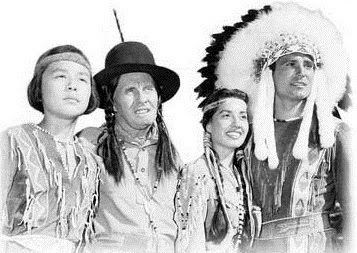
BRAVE EAGLE (1956): A short-lived TV series told from the perspective of the Native Americans. In the episode titled "Moonfire", white settler Penny Pattifore is rescued by Chief Brave Eagle from the clutches of an opposing tribe. Initially frightened, Penny, given the honorary tribal name Moonfire,  decides she'd like to go native with Brave Eagle and company. She's rebuffed by Smokey, the tribe's token halfbreed, which sounds a little hypocritical if you ask me. Penny decides her fate by sitting atop a "vision rock" (no mention of psilocybin being involved). Her uncle, Col. Matthews, is ready to kill her new friends in order to bring her back to "civilization". Luckily for them, Penny decides cultural appropriation isn't cool after all. She wouldn't have looked good in a headdress anyway.

One of the dozens of 1950s TV Westerns, Brave Eagle deserves to be commended for making the usual bad guys into the heroes. And by "heroes", I mean knowing their place. Brave Eagle goes so far as to provide safe passage for white people who, of course, are stealing his people's land. That's the kind of redskin we like!

Where it doesn't differ is that almost all of the lead characters are played by whites.
 Keith Larsen, as Brave Eagle, looks as Native American as Errol Flynn. I mean, he doesn't even wear that stupid red make-up you see in these things. 

But what puts Brave Eagle into whacko territory is that his sidekick Smokey is played by Bert Wheeler of Wheeler & Woosley fame. And despite being the only actor wearing "Injun" make-up, Wheeler delivers his lines in his usual wisecracking style, as if Smokey's white father had been a pre-vaudeville comedian. Again, the halfbreed hypocrisy is stunning.

Brave Eagle's contradictions put today's woke viewers in a bind. Respecting Native American culture, heritage, and knowledge: good! Not respecting it enough to cast a real Native American in the lead: ugh!

BONUS POINTS: When informed that his niece Patti has gone to the vision rock, Col. Matthews simply accepts the explanation rather than saying, as any 19th-century American soldier would, "What the fuck is a vision rock?!"


CHLOE, LOVE IS CALLING YOU (1934): Mandy, a/k/a Mammy, returns to her home in the Florida Everglades seeking revenge on Col. Gordon, the white man she believes lynched her husband 17 years earlier. Accompanying Mandy is her daughter Chloe, and her assistant Jim, both of whom had white fathers. Chole resists Jim's amorous moves while finding herself attracted to the white Reed Howe, who manages Col. Reed's turpentine factory (what a man!). Chloe soon discovers that she's actually Col. Gordon's daughter and was kidnapped by Mandy as a baby. She's now free to marry the white guy -- yay for the honky girl! -- if she isn't sacrificed in a voodoo ceremony first.

Wowwee! Chloe, Love is Calling You has it all -- racial politics, interracial love, black stereotypes, voodoo, and authentic animal abuse. A mainstream studio release this is not.

Yet for all its, shall we say, debatable social viewpoints, the movie, at least in the beginning, makes Mandy sympathetic. Can you blame her for wanting revenge on the guy who allegedly lynched her husband on "the death tree"? That alone sets it apart from other movies of its time.

But once we learn that Col. Gordon is innocent of the charge, and that Chloe is actually 100% pure-as-Ivory Snow white, it regains its footing as a weird, racist, low budget indie exploitation melodrama that will never be run in any film studies class today.

Chloe, Love is Calling You was the last stop for lead actress Olive Borden, whose bad attitude, drinking habits, and difficulty transitioning to sound saw her fall from $1,500-per-week, 1920s stardom to alcoholic scrubwoman at a skid row homeless shelter in downtown L.A. That's Hollywood!

BONUS POINTS: The climactic voodoo ceremony, featuring Chloe being lowered over a flaming pit, is pretty creepy. As are the real scenes of a snake being smashed in half, and a man wrestling an alligator underwater before stabbing it to death. You don't see that kind of thing in movies anymore. 


MEET THE MAYOR (1932): Imagine Forrest Gump, only with a slightly higher IQ and never getting laid. That's elevator operator Spencer Brown. But he's smart enough to help best pal Harry Bayliss invent a home recording device which eventually gets the goods on the honest mayor's crooked rival. Just not smart enough to realize the girl he crushes on loves Harry. What a dolt.

Likely realizing his suave stage persona didn't play outside of the New York stage, Frank Fay's characterization of the smalltown Spencer Brown -- a cross between Harold Lloyd and Harry Langdon -- was a desperate attempt to achieve the movie stardom that had eluded him. His low-key performance is occasionally affecting, particularly when he forces the mayor's rival to drop out of the race. Yet none of the major studios would release the Fay-financed Meet the Mayor, despite it being no worse than many movies of its time. 


Perhaps it was because Frank Fay -- the first stand-up comic -- wasn't boffo box office. On the other hand, being a raging anti-Semitic racist who counted Franco supporters, the Ku Klux Klan, and the American Nazi Party as his best only friends couldn't have helped. 

The two-bit outfit that finally released Meet the Mayor in 1938 -- six years after its production! -- must have had second thoughts as well, seeing that Fay's name on the opening credits is about the size of the copyright notice. That's what happens when your star would have been comfortable in a movie called Meet the Fuehrer. 

BONUS POINTS: Meet the Mayor is the earliest movie I know of that uses the phrase "Looking out for number one" and the slang "coffin nails" for cigarettes. Do I win a prize?


PAROLE, INC. (1948): Special agent Richard Hendricks goes undercover to find out why the locale parole board keeps freeing dangerous prisoners. He infiltrates a posse of low-rent gangsters, who seem to do nothing but play cards at a diner all day. (Maybe if they committed a few more crimes, they'd get somewhere.) Hendricks soon discovers their puppet master -- a lawyer -- is paying off the board members. That's one way of having a constant stream of clients returning to you, even if it does cost a few bucks off the top.

Low budget B's like Parole, Inc. did a better job of showing the seedy criminal underworld than the A's. Actors like Bogart, Robinson, and Cagney always seem like they're living the good life. You can tell just by looking at the crew in Parole, Inc. that they reek of cheap cologne, Lucky Strikes, and stale Ballantine Ale. There's nothing romantic or exciting about these yeggs and their lifestyle. 

Everybody is reminiscent of actors that the producers couldn't afford. Michael O'Shea, as Hendricks, is a cut-rate Dan Duryea. Turhan Bey, the lawyer, sounds like George Sanders despite being of Austrian/Turkish/Czech heritage. His sweetie, Evelyn Ankers, is vaguely reminiscent of Joan Crawford, though less glitter and more gutter.

Between the cast, cheap sets, and not-so-great dialogue (crooked parole board member facing cops with tear gas: "They've got gas and I've got sinus trouble!"), Parole, Inc. is a more accurate look at low-rent criminals than anything Warner Brothers made. Just not as good.

BONUS POINTS: Michael O'Shea speaking the phrase "punchboard racket" with a straight face. Also, one of only four movies credited as "An Orbit Production." 


THE STUDIO MURDER MYSTERY
(1929): Who killed leading man Richard Hardell? Was it his wife Blanche, who was sick of his 
tomcatting? Hardell's sidepiece Helen MacDonald, who learns he will never leave Blanche? Helen's brother Ted or her father, both of whom hated Hardell? Hardell's director Rupert Borka, who suspected Hardell of fooling around with his wife? 

Brother, if you can't figure it out by the end of the first reel, you have no right to watch any mystery. No matter. Movies like The Studio Murder Mystery are strictly for pleasure. Not only do we see the Paramount Pictures soundstages when they're not in use, we also glimpse a recreation of how silent movies were still being shot. Too, many scenes take place outside the Paramount gate, where the actors' breaths are visible in the nighttime scene. L.A. must have been mighty chilly in early '29. 

Unlike other early talkies, The Studio Murder Mystery showcases actors delivering their lines in normal tones rather... than... very... slowly. Fredric March (Hardell), Warner Oland (Borka), Eugene Pallette (Detective Dirk), and Neil Hamilton (wiseacre gagman Tony White) enunciate while still sounding like real people -- if real people had a script at the ready. Although it's still impossible not to hear Oland without thinking of his soon-to-be career-changing move as Charlie Chan. (Why does a Swedish-born actor playing an Eastern European sound Asian?)

At 62 minutes, the fast-paced The Studio Murder Mystery never has a chance to be dull. What it lacks in genuine mystery it more than makes up for with entertainment. But it kind of makes you wonder what Fredric March thought being killed off ten minutes after the opening credits.

BONUS POINTS: Studying the reactions of Florence Eldridge as Hardell's two-timed wife, since in real life, she had to put up with the same sexual shenanigans from her husband -- none other than Fredric March! Talk about method acting.

                                                         ****************