Showing posts with label ERROL FLYNN. Show all posts

Tuesday, December 27, 2022

THE EARLY SHOW, PT. 8

This Early Show line-up could pass for an evening's entertainment at the movie theater -- a short, an A, a B, plus a an episode of a TV series nobody ever saw. They're all interesting for different reasons, and at least two are actually worth watching. But if my batting average is anything to go by, you'll probably prefer the ones I don't recommend as strongly. It's lonely having unique tastes.

MESHES OF THE AFTERNOON 
(1943): If you haven't heard of the 14-minute silent avant-garde short Meshes of the Afternoon, the editors of Sight and Sound magazine would like a word with you, seeing that they just placed it at #16 in their decennial list of the 200 greatest movies of all time. 

As with most avant-garde movies, Meshes of the Afternoon is difficult to describe because it must be seen to be understood (good luck with that). A young woman arrives home and, after momentarily losing her key, enters the front door. She looks around, goes upstairs, turns off the portable phonograph, and takes a nap. She dreams of what appears to be Death in a black shroud, only with a mirror for a face. She gives chase a few times, before returning to find two of her doppelgangers sitting at the living room table.  One of them tries to kill her, a guy turns up to help, the mirror breaks into the ocean...

I dunno, I forget. Heavy with shadows and images like the woman repeatedly taking the key from her mouth, Meshes of the Afternoon likely made it as high as it did on the Sight and Sound list -- above such piddling pictures as Apocalypse Now, Taxi Driver, Night of the Hunter, Rear Window, and Casablanca -- because... well, who knows. Is it because it was co-written and directed by a woman (Maya Deren) who also has the lead role? Does it say something about illusion vs real life? Is it as simple as "well, why not?" And what are the meshes anyway?

For me, it's just fascinating that in 1943 something like Meshes of the Afternoon impressed certain audiences. Fans of other movies that year, like Son of Dracula and Lassie Come Home, would have asked, "This is what our boys overseas are fighting for?"

BONUS POINTS: For someone who was alive 80 years ago, Maya Deren looks incredibly contemporary. In fact, come to New York sometime and you're likely to see a woman wearing those same goggles.


SILVER RIVER (1948): Imagine if Robin Hood became the evil King John, and you have Silver River. Unfairly court-martialed during the Civil War, Mike McComb (Errol Flynn) remakes himself as the owner of a gambling hall in the town of Silver River, while continuing to rake in money as the town's sole banker and  muscling in on the local silver mines. His luck starts to fall apart following his marriage to Georgia Moore, whose former husband, Stanley, McComb knowingly sent to his death on a mining expedition. He eventually redeems himself by leading a posse to arrest the men who assassinated his former lawyer-turned-Senatorial candidate John Plato Beck. I guess Georgia was OK with McComb essentially killing her first husband after all.

While not Flynn's best film -- at nearly two hours, it could have been trimmed by 20 minutes --Silver River boasts his most interesting, perhaps best, performance. By the end of the second reel, Flynn has transformed from his typical valiant self to a cynical, coldblooded antihero -- make that heel -- he would never portray again. The moment Flynn intentionally sends his romantic rival on his fatal journey is as memorable as any he ever had onscreen. As Thomas Mitchell (as Beck) tries to protest McComb's ruthlessness, Flynn shoots him a silent glare that is utterly chilling, and proof what a great actor he was occasionally allowed to be. 

As with leading man-turned-character actor Richard Dix, it "helped" that alcoholism was transforming Flynn's looks as well as his style (39 years old but looking 45). Meanwhile, his love interest, 26 year-old Ann Sheridan, could pass for a hard 35, thanks to her love of liquor. To be sure, Silver River is a little draggy, and what little action it contains is pretty much in the first 10 minutes, but it's possibly the most fascinating movie of Fynn's career. 

BONUS POINTS: Watching Thomas Mitchell trot out the scene-stealing drunk routine he perfected in Gone with the Wind and Stagecoach. He's the only actor in Silver River to give Flynn a run for his money.


ROADBLOCK (1951): Straight arrow insurance investigator Joe Peters falls fedora over wingtips for Diane Morley, the girlfriend of  underworld kingpin Kendall Webb. The more Diane warns Joe he hasn't got the dough to keep her happy, the more determined the gumshoe is winning her -- even it means giving Webb the inside skinny on the shipment of over a million dollars in currency, in exchange for 1/3 of the booty. After the plan is put in motion, Diane has a change of heart and tells Joe she can live on his $350-a-month salary. What a shame that it's too late  to call off the heist -- and that there are one too many clues leading his partner Harry Miller to suspect Joe as part of the crime. Like I say, it's always the dames that do you in.

Roadblock has all the earmarks of an RKO film noir. Fast-paced, a twist or two (this might be the only noir I've seen where the femme fatale becomes non-fatale) and, in the lead, Charles McGraw. Looking like a B-level Kirk Douglas and sounding like he gargles Brill-O pads, McGraw makes for a surprising sap as Joe Peters, seeing that the guy would be least likely to throw away his job, reputation and freedom for hot sex with a beautiful young woman. Or maybe not.

As Diane,  21 year-old Joan Dixon never tries to hide her contempt for Joe, who keeps sniffing around her like a dog in heat (which he is). So when she finally decides that he's the guy for her, it comes as surprise even for the audience. Dixon pulls off both sides of Joan convincingly, while Lowell Gilmore (playing Webb like a roadshow George Sanders) and Louis Jean Heydt as Harry Miller, and Milburn Stone (soon to gain immortality as Doc Adams on Gunsmoke) as the cop investigating the robbery also provide Roadblock with solid entertainment for its 72 minutes. 

BONUS POINTS: A first rate climactic car chase filmed on location at the Los Angeles River Watershed, featuring a moment of genuine hand-held camera work from Joe Peters' backseat. And don't miss the two-toned Nash police car, too!

 CLASS OF '55 (1972): The Jazz Age nostalgia craze of the late '60s progressed a few decades by the time of Class of '55, an unsold half-hour anthology series created for ABC by James Brooks. Judging by the pilot, each episode would have been about what happened to certain members of the titular fictional class, via flashbacks and present-day scenes, since graduation. 

Not a bad idea, but any entertainment value the pilot provides is strictly through the novelty of its stars, Alan Alda and Louise Lasser, as college-sweethearts-turned-divorced couple. Until the climax, there's never one moment where their characters are happy together. During the college flashbacks, Lasser is always crying (while whimpering, "I'm not crying!" -- funny, hunh?), while Alda is nothing less than abrasive. During their present-day, post-divorce scenes, they're just bitter. What they ever saw in each other is never explained, leaving us to guess why they remarry at the climax. No wonder the network programmers rejected it -- was every episode of this alleged sitcom going to feature such annoying, inexplicable characters?

The most interesting thing about Class of '55 is how it brings back memories of  1970s television. The long opening credits featuring theme music heavy on brass and drums; the hesitant steps toward "adult" humor; and, of course, the ugly fashions (although Lasser looks surprisingly sexy in the 1972 scenes). Luckily for the two stars, M*A*S*H and Mary Hartman, Mary Hartman were just around he corner --  as was The Mary Tyler Moore Show and Taxi for producer James Brooks. Hey, you gotta start somewhere.

BONUS POINTS: The wedding photographer is played by Alan Alda's soon-to-be M*A*S*H co-star, Jamie Farr (a/k/a Corporal Klinger). I wonder if, on the first day on the M*A*S*H set, one of them said to the other, "I hope this works out better than that lousy Class of '55 pilot!" 

*********************

Saturday, May 28, 2022

NEIGHBORHOOD TIME-TRAVELING,PT. 6: "TOO MUCH, TOO SOON"(1958)

 As we reach the midpoint of our kitchen destruction renovation, I've been able to find a few minutes to quickly type out something that doesn't require much thinking. (Maybe I should enter politics.)

For some reason, I've always had a thing for watching the opening credits of old movies I otherwise have little or no interest in watching. This week, the lucky winner was Too Much, Too Soon, based on the autobiography of the doomed Diana Barrymore. 

Following a typical late 1950s downbeat jazz style opening theme, Too Much, Too Soon cuts to an establishing shot of Central Park.


I immediately recognized the Boat Pond (that's toy sailboats, in case you were wondering) on the 5th Avenue side of the Park between 72nd and 75th Streets. And that was the only thing that looked familiar. What was that skyscraper near the right? And am I so dim that I've missed that domed building on the left for over 40 years? It was time for a stroll through the Park to find out.


Hey, no wonder why it doesn't look the same -- those damn oxygen-providing trees blocking the view! The smaller buildings on the right of the screen grab were replaced by taller ones. And that thin skyscraper disappeared somewhere along the way. The green-roofed cafe we see here didn't exist at the time of filming.

If you look carefully, you can see the tall apartment building left of center that was in Too Much, Too Soon. The smaller building to its right, now hidden by trees, is still there, too.

But what of the mysterious domed building to its left? Here's how it looks now:

No dome on this co-op. I needed to know, now, the identity of the structure that was there once upon a time. A moment's research brought me to this:

Temple Beth-El at 76th Street and 5th Avenue, built in 1891, torn down in 1945. No wonder I never noticed it! 

A couple of things stand out. First, it dwarfs the surrounding buildings. Second -- check out those billboards on the right. Cupid Bouquet was a brand of little cigars. It must have been good because the tagline says NOT MADE BY A TRUST.

To its right is a product I can't make out. But the third product is Vin Mariani, a red wine infused with cocaine. So refreshing! Look carefully at the photo -- it received the official endorsement of Pope Leo XIII. Refreshing and holy!

The final billboard is for Beeman's Pepsin Gum. Pepsin was said to aid digestion, a claim the FDA would likely not agree with. Now it's known by the more drab Beeman's Chewing Gum. No more pepsin for people with upset stomachs.

Back to matters at hand. Temple Beth-El was torn down 13 years before the making of Too Much, Too Soon. And that scene takes place circa 1940. Whether deliberately or not, somebody at Warner Bros. dug out an age-appropriate shot from the files. Could it have been filmed for the previously-discussed Central Park 26 years earlier? I wish I could ponder it further over a glass of Vin Mariani.

                                                        ***************

To read about the great pre-code Central Park, go here.

Saturday, December 10, 2016

MOVIE OF THE DAY: "THE TRUTH ABOUT FIDEL CASTRO REVOLUTION" (1959)

In the last year of his life, Errol Flynn carved out a new career as unofficial mouthpiece for Fidel Castro. A long time fan of Cuba, Flynn was hired by the Hearst newspaper syndicate to file reports about the burgeoning revolution, going so far as to embed himself with the merry band of rebels.

Flynn would go on to sing El Comandante's praises on talk shows, eventually producing and starring in the ridiculous Cuban Rebel Girls shortly before his death in 1959.

But there was one unreleased documentary he was involved with, completely forgotten until fairly recently, sporting the grammatically-challenged title The Truth About Fidel Castro Revolution. And while the credits promise "Reported by Errol Flynn", anyone with ears will immediately realize it was as truthful as the concept of Cuba being a worker's paradise.

Not that it's a total lie, however. As the movie begins, Flynn bounds into camera range as if being chased by an angry husband or a member of the vice squad. Clenching a cigarette holder in his teeth, the swashbuckler-turned-reporter introduces the documentary we're about to watch.


Flynn needs to steady himself on the world.
And while it's always a pleasure to see the ever-charming Flynn, there are several distractions along the way, whether it be the sounds of something falling off-screen, or his own smoking-induced labored breathing. He also has trouble remembering his lines (or reading the cue cards), often appearing to make up his remarks as he goes along -- his memory was already shot from a lifetime of alcoholism. For Flynn, 50 was the new 80.


"Yo, who's the fat gringo stinking of rum?"
However, the unintended laughs more than make up for Flynn's appearance, whether he carelessly tosses a prop globe to the floor, presents Castro as the second coming of Moses, or describes himself as "a simple, peaceful, home-loving man with the heart of a child." OK, so maybe that last remark was meant to be funny. 

But just as we've gotten used to the sorry sight in front of us, The Truth About Fidel Castro Revolution abruptly switches to newsreel footage of the revolution -- and this is where the real bullshit starts. The narration, allegedly by Errol Flynn, is actually someone else speaking with a (possibly) phony British accent who sounds nothing like him -- maybe because Flynn was Australian.


Errol Flynn's version of "Goldilocks": The mother's too old, 
the girlfriend's too young -- but the other two are just right.
It becomes even more surreal when the faux-Flynn talks about the fun he's having as we see the real Flynn gambling in a Havana casino with his jailbait girlfriend Bevery Aadland and her mother Florence. (He needed someone closer to his own age to talk to.) 

Was Flynn sleeping off a bottle of Bacardi the day of recording the narration? Had he died before the script was finished? Whatever the reason, from this point on, The Truth About Fidel Castro Revolution becomes impossible to take seriously. 


Batista (right) looks forward to being overthrown
so he doesn't have to go through this crap anymore.
Not that it's without interest. The news footage is fascinating, whether it's the doomed President Batista addressing a group of American tourists who appear to be trying to live up to every 1950s middle-America fashion cliche, or of Castro's army marching toward Havana. The rebels, we learn, had "taken an oath" not to shave until victory. I guess Fidel never quite believed he was victorious.


Gore-hounds will enjoy real-life gruesome scenes. Protesters being shot in the street; soldiers standing over dead civilians; the remains of Batista's victims being dug up; and, most shocking of all, the execution of a government official by Castro's firing squad. Fun fact: after coming into power, Castro often preempted TV broadcasts of Mickey Mouse cartoons in favor of live coverage of government executions. Hey, kids gotta grow up some time.


What every child wants to see under the Christmas tree.
The narrator pooh-poohs the violence perpetrated by the rebels, preferring to see the sunny side of revolution, whether it's Castro giving a speech with a dove perched on his shoulder, or admiring a child's stuffed Fidel doll. I gotta hand it to him, he sure knew the power of charisma over the gullible. 

Che receives a psychopath's welcome by his fans.


And of course, no hagiography of the revolution would be complete without an appearance or two by the homophobic, rock & roll-hating, mass executioner,
t-shirt icon Che Guevara. He must have known that his trademark beret set him apart from the others, as if he was determined to be the babe magnet of the bunch. That is, when he wasn't shooting people who didn't agree with him. 


As if eager to show off his incompetence, producer Victor Pahlen recycles egregiously inappropriate sound effects over the silent news footage. Whenever there are people applauding, we always hear drunken women laughing -- even when there are no women in sight. Got a shot of people holding a meeting? Throw in the sounds of silverware on dinner plates, indoors or outdoors. There's absolutely no rhyme or reason to the dubbing. Come to think of it, yes, there is a rhyme and reason -- Pahlen is failin'!


Castro needs to wear glasses to
make sure he's talking to Errol
Flynn, and not W.C. Fields.
But The Truth About Fidel Castro Revolution's truly head-spinning moments involve the description of Batista -- like how he was "dedicated to the suppression of the people and the protection of his precious self." His "dictatorship press." That kind of thing.

Say, what other Cuban leader does that sound like? I'll tell you who -- the hombre that Errol Flynn earlier said had "grown big in the hearts of men who love liberty and humanity."

No doubt Batista was ruthless leader, however. And nowhere is that more evident when his troops destroy entire towns -- killing innocent civilians -- in an attempt to rout the rebels. Havana, Aleppo -- decade after decade, history uses the same script, only in a different language.


"I got laid in Cuba, and all I got was this lousy scarf."


At least the real Errol Flynn makes two more appearances. Once, in the middle when he shows off a scarf with the rebels' emblem, sewn by their hembra sidekicks.  And then, at the end, when he states his hope that the sacrifices made by the Cuban populace weren't made in vain. Keep hoping, pal.

Flynn then bids us farewell, as he pays tribute to Cuba "where freedom and democracy and all the things that men live by are a reality." Turning the charm up to 11, Flynn adds, "And I believe that. You believe it, too."

To which your only possible reply to the preceding 49 minutes is, I. Don't. Believe. It. 

The Truth About Fidel Castro Revolution's one known screening was at the 1959 Moscow Film Festival -- of course! -- where it was undoubtedly received with open arms at the point of a rifle. Five decades later, it can be seen for the piece of propaganda claptrap that it is. Fidel might have had good intentions, but, like Errol Flynn on a night on the town, he didn't know when to stop. If only it had been Castro who died at 50, and Flynn at 90. 

But then, he wouldn't have been Errol Flynn, would he? Viva Captain Blood! Viva Robin Hood! And pass that mojito, comarada.


                                                          *******************

During my brief sojourn at The Weekly Standard, I wrote about Errol Flynn's final movie, Cuban Rebel Girls. You can read it here.

Flynn talks Castro on Canadian television here.

Saturday, March 21, 2015

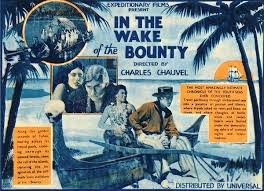
MOVIE OF THE DAY: "IN THE WAKE OF THE BOUNTY" (1933)

Every actor has to start somewhere, but nobody's movie debut was more meager than Errol Flynn's. Having never acted before, he was hired to play Fletcher Christian in the Australian picture In the Wake of the Bounty, an odd hybrid of melodrama, documentary and travelogue. Or, as the onscreen introduction informs us, "the first of a series of great travel films to be produced by Expeditionary Films depicting strange incidents, strange places and strange people." They should have started with the studio itself.

"Aye, those Tahitian women were lovely...
or so I hear."

Throughout the first half of its 64-minute running time, In the Wake of the Bounty jerks abruptly from a pub where blind seaman Michael Byrne holds forth on his adventures aboard the HMS Bounty decades earlier, to flashbacks on the ship, and then back again. Never explained is how he returned to England after the mutiny or passed the naval physical to begin with, considering that he's, uh, blind. 


"Avast! Who moved my cheese,
Mr. Christian?"

Unlike later depictions of the Bounty's notorious commander, here Bligh has lost a couple of stripes, being a Lieutenant instead of Captain. He's also something an 18th-century Capt. Queeg, ordering his crew flogged for allegedly stealing his cheese. Talk about being a petty officer!


"We love unhygienic white men!"
But all that is forgotten when the crew reaches Tahiti. In the Wake of the Bounty then becomes something like a 10-minute home movie shot on location, with real-life islanders as extras. When the half-naked women aren't making like they're hanging out at the Playboy Mansion grotto, they're dancing for the Bounty sailors, throwing their hands in the air like they just don't care. The native men are content to play their drums, although I wonder how they feel about their women going gaga for these greasy Limeys who haven't seen a bar of Lifebuoy since setting off to sea. 

Then another 10 minutes are devoted to the mutiny and its aftermath -- returning to Tahiti to pick up some babes and sailing to nowhere. But the men soon realize that a floating Plato's Retreat isn't all it's cracked up to be. As blind Michael Byrne puts it, "We drank heavily and fought over the women," which sounds an awful lot like your average New York bar any night of the week. Unlike the location shots, the "native girls" on board the Bounty are fully-dressed white actresses. It's an old Western custom: naked white women bad, naked darker women OK.

"Why did white men mate with the dark-
skinned women of Tahiti"? Take a guess, Skippy.
And there, at the 30-minute mark, In the Wake of the Bounty becomes a semi-documentary of life on Tahiti and Pictairn Islands (the location of Fletcher Christian's last stand) in 1932. On Pitcairn, we meet the real-life descendants of the Bounty's mutineers, where inbreeding had been rampant for 160 years. (We see the wedding of Alan Christian to Eva Christian, presided over by Edgar Christian. Eww.) And if you think all they do is hang around eating breadfruit all day, the narrator informs us, "There's no slackers on this little island!" -- despite the kids, we're told, having only a two-hour school day.

Not even all that cool native
jewelry can ease Fletch's pain.
But then, without warning, it's back to Bounty-full melodrama, as life after mutiny is no paradise in paradise. Fletcher Christian bemoans his fate to one of his sidekicks: "Death would be a release from the remorse that dogs my footsteps -- day and night, night and day!" Who knew people were singing Cole Porter in the 18th-century?


And then it's back to 1932 once more, this time for the scripted climax. A Pictairn couple tries to SOS a passing ship to bring medicine for their sick baby, but the distance is too great for the message to carry. The baby dies, the mother weeps melodramatically, and the father recites a prayer at fade out. That's what you get for marrying your sister.

When In the Wake of the Bounty's intro promises that Expeditionary Films "has not spared time or money" in making the movie, it seems to mean that they didn't spare any money at all. The sets look like something out of a Thomas Edison short from 1903, while much of the acting is strictly 19th-century stage melodrama. When one of the Bounty's sailors says of Lt. Bligh, "If I could only live to see him suffer like we've been suffering," he might as well be quoting the audience's opinion of the director.

"Don't worry, ladies, you'll be swooning
over me soon enough."
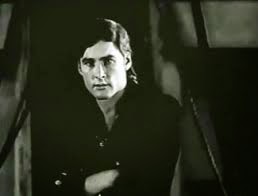
But what of 24 year-old Errol Flynn in his movie debut?  He's a little gaunt -- did he have one of his bouts of malaria before shooting? He sports his real, pre-Hollywood teeth, which he wisely keeps hidden most of the time. And he's kind of awkward, often looking down at his feet while keeping his arms folded. Still, he's easily the best actor in the movie, with his smooth, familiar voice trying to make sense of the risible dialogue he's been given. ("Mutiny... piracy... Oh God, where will it all end?" Believe me, I asked the same thing.) Even if you had never heard of Errol Flynn, you'd pick him as the only one in the movie who had any chance of success.

Two years later, Flynn's first starring role in an American movie, Captain Blood, was released, launching his legendary career. That same year, M-G-M released Mutiny on the Bounty starring Clark Gable and Charles Laughton, immediately becoming a seafaring classic. But In the Wake of the Bounty, little seen outside Australia, left no wake at all.

                                                       ********************* 

Monday, May 19, 2014

MOVIE OF THE DAY: "GREEN LIGHT" (1937)

One of the more irritating bromides of our time is "Everything happens for a reason." This is spoken by people who would otherwise find it impossible to accept the unfair, awful, horrendous events that happen to them or the world in general; a deliberate denial of reality in order to prevent a swan dive off the nearest bridge. It's also the basis of Green Light, Errol Flynn's third starring American movie, and the first that didn't involve buckles being swashed.

Flynn plays Dr. Newell Paige -- only in movies (and the forgotten books they're based upon) do sawbones have names like Newell Paige -- who willingly takes the fall for Dr. Endicott, an older surgeon, when a patient dies during an operation. So you know this is definitely a work of fiction, right? 

"I love you too, baby. Let's just
keep your mother out of it."
The unfortunate patient's daughter, Phyllis Dexter, falls in love with Paige until he she finds out that he's supposedly the guy who killed her mother. Some offspring might thank such a guy, but apparently she grew up in a normal family. Deciding that it's time to find a more noble calling, Paige joins a former colleague in Montana in trying to find a cure for spotted fever, where he puts his life at risk by allowing himself to be bitten by a poisonous tic in order to test a new serum. As if just moving to Montana isn't sacrifice enough.


While Flynn pays close attention, director Borzage
demonstrates how to ask a dying patient for her
group number.
All this would be pure soap opera -- is pure soap opera -- but director Frank Borzage, a master at enveloping such stories with a mystical glow, keeps the suds percolating at a low simmer. He apparently ran through several pounds of gauze for the camera lens, for nearly every shot appears to be taking place in a romantic dream. Flynn's first appearance in particular must have set women's hearts swooning, seeing that he is unearthly handsome and ungodly charismatic. (My
wife was immune to his charms in Green Light, sensing the predator underneath.  I'm better at hiding that kind of thing.)

He's got a 104-fever -- let the guy rest, for
Chrissakes!
Borzage's touch never falters, even as Dr. Paige comes down with spotted fever. While he lies in bed for a week, his fever rising and respiratory condition worsening, Paige's face glistens with near-holy perspiration. His hair remains in place, complete with a boyish curl on his forehead. Not a hint of stubble grows on his face.  Damn, why don't I look this good when I've a 104-degree fever? In no time, Phyllis and seemingly half Paige's former hospital staff are at his bedside, leaving one to wonder who's running the show back home. 

It won't surprise you to learn that everything works out in the end. Phyllis learns through Endicott himself that Paige had nothing to do with her mother's death. When Paige recovers, he and Phyllis get the hell out of Dodge, and, instead hopping into the nearest sack, go to church. You gotta be kidding me.

Dean Harcourt consoles Phyllis over her
mother and that hideous hat.
In keeping with Green Light's spirituality, Sir Cedric Hardwicke plays Dean Harcourt, the story's God stand-in, a theologian whose weekly radio broadcasts provided great comfort for Phyllis' mother. He also winds up being the go-to guy for all the main characters, his gentle philosophical advice boiling down to, "Don't ask, don't tell. Now go home and think about it." He's also what we used to call back in the day a cripple, and, like all cripples in old movies, is more psychologically-whole than anyone else. Even if he is, like I said, a cripple.

And she looks better in profile than either
of them.

By my wife's contention, the best performance was given by Green Light's other God stand-in, Sylvia, Dr. Paige's Irish Setter. Showing more emotion than Paige's love interest, Phyllis (played by Anita Louise), Sylvia takes direction better, and possesses nicer hair to boot. She's also the only one in the movie who gives Flynn a run for his money in the looks department. By the end of the movie, you'll believe a dog can look soulful on cue.


I collect movie posters from the U.S., but I'd make
an exception for this bizarre French one-sheet.
Being something of a sucker for both Errol Flynn and old movies with a spiritual bent, I admit to enjoying Green Light more than most audiences today probably would. As with Keeper of the Bees, made two years earlier, there's a certain delicacy afoot that doesn't fly in today's cynical times. 

It's also a chance to see the 27 year-old Flynn in one of his rare, low-key, modern-dress roles, proving that there was more to him just pirates, swordsmen and cowboys. He may be fully aware of his seductive qualities, but that makes guys like me enjoy him all the more. Flynn is everything we'd like to think we are, only we know we never will be. When he's almost dying in Green Light, he not only looks like a saint, he consoles everyone around him with a debonair accent. I can't even catch a cold without collapsing on the couch and moaning like an asthmatic ghost. I don't think my wife would mind if I had a little of Flynn's charm.

                                                 ***********************
To read about the equally-unusual Keeper of the Bees, go here.

Green Light's original preview. It's an "x-ray of unquestioning love." Today, it would be an MRI: