Showing posts with label WALLACE FORD. Show all posts

Monday, August 11, 2025

THE EARLY SHOW, PT. 55

 Today's menu consists of two pre-codes, a B-movie starring a blog favorite, and a short best watched with the sound muted. Time to binge!

AFRAID TO TALK (1932): Just when you think pre-codes couldn't get more cynical, up pops Afraid to Talk. Bellboy Eddie Martin witnesses the murder of gangster Jake Stransky by fellow criminal Jig Skelli. What appears to be open and shut case becomes dead and buried, since Skelli has proof that the city's mayor, police commissioner, judges and the D.A.'s office were on Stranksy's payroll. Ergo, the bellboy has to take the fall. After hours of mental and physical torture, Eddie signs a confession. The Mayor and Judge, happy to collect kickbacks as long as mobsters are killing each other, want no part of this, and risk their own careers in order to free Martin. District Attorney John Wade, on the other hand, decides to arrange Martin's jailhouse murder to make it look like suicide. Your tax dollars at work!

Even for a misanthrope like me, Afraid to Talk was a disquieting 75 minutes. Not even the previously-discussed Vice Squad presents lawmakers in such a tawdry light. So much so that where it takes place is never made clear, since references are made to cities like Chicago, Detroit, and New York. (Pay no attention to Times Square's electric headline tickertape that's often seen.) Too, constant reference is made to protecting "the party" at all costs -- just don't ask which party. No wonder some Depression-hit jobless characters hope for a red revolution. The latter is due to Afraid to Talk's writer, Albert Maltz, being a real-life member of the Communist party. And we all know that lawmakers in Stalin's Russia were the most integrous of people.

Forget about the leads playing the bellboy and his bride; it's the bad guys (some pretending to be good) who own Afraid to Talk. Master character actor Edward Arnold, who could play nice guys when he wanted to, chews up the joint as Jig Skelli, the jolly gangster who enjoys bantering with the D.A. as much as he does killing off rivals. And speaking of the D.A., the underrated Louis Calhern is oilier than a tin of mackerel as John Wade, who marks the innocent Eddie Martin for death with the ease of ordering one of the countless cigars smoked here. And it won't be the last time you'll find yourself saying, "Oh my God!" either.

Yup, Afraid to Talk swings for the disreputable fences time after time. The only problems are its current so-so condition, and that it lacks the more downbeat alternate ending allegedly filmed for its European release. Even in its current state, though, Afraid to Talk puts to lie any talk about the "innocent days" of movies and how the studios were afraid to confront audiences with the hard truth about what their government leaders were (and still are) capable of. 

BONUS POINT: The corrupt cops giving poor Eddie the third-degree. Not that they're doing it, but how it's photographed in one take, the camera slowly tracking closer as the harsh overhead light swings lazily back and forth. We're spared seeing the subsequent torture, having to be content with hearing Eddie's agonized off-camera screams.


EAST OF FITH AVENUE (1933):  Sure, that "Grand Hotel of a New York boarding house" hype on the East of Fifth Avenue one-sheet is accurate. But it also feels like Columbia's answer to Sam Goldwyn's Street Scene, right down to the Gershwinesque opening theme. Both movies focus on the denizens of lower-middle class New York neighborhoods in a compressed timeline. Characters have money and family problems. But while Street Scene was a big budget adaptation of an acclaimed Broadway drama, East of Fifth Avenue is... well, like I said, a Columbia picture. 

No need to give the names of most of the characters or the actors. And while there are a lot of them -- the layabout poet, the elderly couple, the snake oil salesman among others -- two carry much of the movie. Kitty (Dorothy Tree) eagerly awaits the return of Vic (Wallace Ford), the fast-talking gambler who unknowingly knocked her up. And Vic does indeed show up -- with his wife Edna, a cracked Southern belle. It doesn't take long for Edna to get tired of the boarding house life, leading Vic to desperately find a thousand bucks to bet on a surefire 10-1 nag at the track. Kitty, still in love with him, borrows from the elderly couple, which sets into motion the climactic events that affect most of the boarders in different, shocking ways.

While most of the characters are more like caricatures, Dorothy Tree brings Kitty to life in East of Fifth Avenue's most believable performance, holding the story together during the goofy first half before it gets increasingly dramatic. Familiar utility actor Wallace Ford gives his typical wiseguy flair, only less grating than usual. Even better, he often gives hints of his better dramatic style that would dominate his future supporting roles. I came close to turning off East of Fifth Avenue (118 East 56th, to be exact) in the first half hour but was glad to stick with it, as it didn't necessarily play out as expected, especially with the elderly couple. It might not be a grand hotel but it's pretty good.

BONUS POINTS: By the end of the movie, you will have learned a dozen or so pre-code ways to say a woman is pregnant without really saying it. Best example: when Kitty is kicked out of a chorus line, one of the dancers sneers, "Say, I thought you had a lot of experience." To which Kitty replies, "Yeah, too much!"


THE SIX DAY GRIND (1935): Some not-so-good pictures are worth seeing just once
because they're short. Others, because they have historical significance. Still others because they're proof that what was once considered witty has aged like camembert sitting on the windowsill for a year. 

The Six Day Grind is all three. It's a one-reeler; it features genuine newsreel footage of the six-day bicycle race held in Madison Square Garden in 1935, an event at once fascinating and boring beyond human standards; and it stars the married comedy team of Goodman and Jane Ace, known on their radio sitcom as the Easy Aces. The couple were similar to Burns & Allen, with the long-suffering straightman playing off his scatterbrained wife. But while George Burns clearly adored Gracie and her "illogical logic", Goodman seems to have married the incredibly stupid Jane just to have someone to insult on a regular basis.

The "Ace High" shorts made for the Van Buren Studios in New York anticipate Science Fiction Theater 2000. In all of them, The Aces are at a movie theater, where Jane reads the opening credits in her Southern drawl, before commenting about the newsreel onscreen. Goodman needs to correct her throughout, eventually using his catchphrase, "Isn't that awful?" Well yes, it is, but not in the way he's implying. If these two were sitting near you in a real movie theater, you'd demand the usher throw them out on their unfunny butts. Comedians and writers alike held Goodman Ace in high regard back in the day, so either he was funnier writing for other people, or his style doesn't hold up.

But you know what? The bicycle race footage is fun to watch for 10 minutes. These guys zip around track at a lot of miles per hour, with the teams trading off riders in order to sleep and eat. Watch The Six Day Grind with a friend, turn off the volume, and make your own wisecracks. It'll be funnier than what the Easy Aces have to say. 

BONUS POINTS: During a break, biking champ Alfred LeTourneau sleeps in an "oxygen therapy service tent," allowing Jane to complain, "Oh, why can't he breathe the same air as the rest of us?" It's the closest thing to a funny remark she makes here. 


BETRAYAL FROM THE EAST (1945): Lee Tracy was nearing the end of his movie career and spending more time on stage when he made this patriotic drama based on the non-fiction book of the same name. In pre-Pearl Harbor Los Angeles, carnival barker Eddie Carter is approached by his old army buddy Kato -- you can guess his ancestry -- for information regarding U.S. military plans on the Panama Canal. When Carter approaches U.S. Naval Intelligence with his suspicions that Kato is up to no good, he eagerly accepts Uncle Sam's request to go undercover in the Japanese spy ring operating on the West Coast. Sure, it's dangerous, but's more exciting than bringing customers inside a tent at two bits per rube.

Hollywood was churning out anti-Japanese movies like ramen noodles during the War, usually making the "Japs" out to be barely one step above apes. Betrayal From the East goes in a slightly different direction. The spies are -- or at least pretend to be --respectful and well-mannered. And unlike the usual "ah so" characters of the time, Carter's friend Kato speaks perfect English without a trace of an accent. And while you might not recognize the names of the "enemy" character actors -- Richard Loo, Philip Ahn, Victor Sen Yung, Abner Bieberman (who wasn't even Japanese but could pass in a pinch) -- they fall into the "oh, that guy" category. Regis Toomey's eight-minute role as an American spy might disappoint his fans, but how many of them are there, anyway?

It wouldn't be a '40s spy drama without a little romance, so Eddie falls hard for fellow undercover agent Peggy Harrison -- who, as played Nancy Kelly, is about a quarter-century his junior. Her apparent death -- and later reappearance hanging out with German spies -- gives the movie an unexpected Vertigo-ish twist. (Her character's real death is genuinely unsettling.) 

No longer the motormouth from his pre-code days, Lee Tracy is now a little slower and paunchier. Still, his B-pictures like Betrayal From the East offer a welcoming presence for fans like me who wonder when he's going to get the look-who-we-discovered treatment by johnny-come-latelys like the New York Times and the Film Forum.

BONUS POINTS: Betrayal From the East is introduced by Drew Pearson, the muckraking political journalist whose newspaper column, "Washington Merry-Go-Round", was the talk of Washington. Over a decade earlier, his book of the same name was the basis of a great movie starring Lee Tracy. 

                                                         *******************

Wednesday, March 26, 2025

THE EARLY SHOW, PT. 48

 Add three Bs with one A, and what have you got? Need I explain?

THE MYSTERIOUS MR. WONG (1935): Come with me to the Chinatown area of
Monogram Pictures, where cinema cliches long-gone reside. Actors of every ethnic persuasion except Chinese. The wisecracking reporter. The wisecracking dame he's got the hots for. The dimwitted Irish flatfoot. And holding court, the criminal kingpin with the thin droopy moustache, flat-brimmed hat, and evil intentions. But the only thing mysterious about him is: why does the Chinese guy have a Hungarian accent? Ah so! He's Bela Lugosi!

Only three years after Dracula, Lugosi was already making himself familiar in the dusty streets of Poverty Row, churning out B's like The Mysterious Mr. Wong. Like Fritz Lang's mastermind Dr. Mabuse, Mr. Wong has minions doing his bidding -- or, rather, killing, as he tries to collect 12 coins once owned by Confucius that, when gathered together, will give him special powers (like sounding Chinese?). Maybe if the cops owned the things, they'd have the power to break this case instead of leaving the job to a reporter and his sidepiece: Wallace Ford (the poor man's Lee Tracy) and Arline Judge (the poor woman's Joan Blondell). 

Unfortunately, Bela Lugosi was already becoming the poor man's Bela Lugosi. Perhaps to compensate for the ridiculous dialogue in much of The Mysterious Mr. Wong, Bela overenunciates his dialogue in order to prevent audiences from falling asleep, his mouth twisting open and shut as if chewing a dozen pieces of bubble gum at once. Yet surrounded by henchmen who look and sound about as Chinese as Edgar Buchanan, Lugosi at least can almost pass for what was once called Asiatic; only the extras are the real thing. Embarrassed as they likely were, at least they got five or ten bucks, a sandwich, and the chance to hang with Bela Lugosi for a week. As with watching The Mysterious Mr. Wong, it's better than a day-old eggroll.

BONUS POINTS: A few years later, William Nigh, the director of this masterpiece, also directed Boris Karloff in three other Mr. Wong movies at Monogram. Only that Mr. Wong is a detective and has nothing to do with this Mr. Wong. I'd say something about "two Wongs don't make a right" but it's too easy, unfunny, and has been done to death, kind of like every Mr. Wong plot, criminal or detective.


MY SON IS GUILTY (1939): Ham-fisted title aside, this is actually a pretty good B, sincere and human, thanks to the leads: Harry Carey as beat cop Tim Kerry; Bruce Cabot as his mildly sociopathic ex-con son Ritzy; Jacqueline Wells as Julia Allen (the girl who inexplicably loves Ritzy), and Glenn Ford as aspiring author Barney (the nice guy who explicably loves Julia). 

Ritzy, sprung from a two-year stint in the slammer, is determined to go straight -- straight to a criminal gang run by femme felon Claire Morelli. Ritzy, having gotten a job at the police station thanks to his dad, turns off the two-way radio system to help the crooks successfully pull off a robbery. Two cops are shot -- one fatally by Ritzy -- while the one with the slug in his shoulder is you-know-who. Eventually that you-know-who is face to face with Ritzy, both of them with gun in hand. Talk about dysfunctional families!

At least half of My Son is Guilty's success is due to Harry Carey. His portrayal of good-hearted cop Tim Kerry (he buys a little roller-skating girl a new bottle of milk to replace the one she dropped after colliding with him) is real and utterly sympathetic. The script might be predictable - is predictable - but you can't help but feel bad that, through no fault of his own, he raised a son who went sideways in life. (It helps Carey looks at least 15 years older than his actual age of 60.) Bruce Cabot, 34 but appearing closer to 50, pulls off the no-good offspring trope better than you usually see in movies like this; just by the way he enters his first scene, you strongly dislike the guy. Jacqueline Wells is cute and engaging, but her character is such a poor judge of Ritzy it's kind of difficult to work up any empathy for her. As for Glenn Ford (in his second feature) --- like his male co-stars, he doesn't quite match his real age: 22 but looking 14. You can see traces of the actor he was going to become, even if he sounds like a better-educated Leo Gorcey. He likely scrubbed My Son is Guilty from his curriculum vitae and memory, but there's nothing to be ashamed of here. Between the stars and a bunch of familiar faces from Columbia Pictures' character actors file, the movie is a step or two above the usual 60-minute fare.

BONUS POINTS: A sequence featuring the legendary tap dancers the Nicholas Brothers was originally shot for, but cut from, the 1934 Columbia picture Jealousy. 


THE SPIDER WOMAN STRIKES BACK (1946): In 1943, Universal released the
Sherlock Holmes mystery The Spider Woman, with Gale Sondergaard in the title role. A year later, The Pearl of Death, another Holmes picture, featured a performance with Mr. Acromegaly himself, Rondo Hatton. It took another year for some genius at the studio put the two actors together in The Spider Woman Strikes Back, hoping to lure in suckers who thought they were getting a sequel to the "original". By the time Universal bothered to release it a year later, both Hatton and the Sherlock Holmes movie series were dead. 

Jean Kingsley takes a job as paid companion to Zenobia Dollard, a blind woman beloved by everyone in the village of Domingo -- beloved because nobody knows Dollard is faking her blindness, and has been murdering every young woman who has worked for her by draining their blood in order to feed her poisonous flowers. These flowers are given to the farmers' cattle to eat by her mute flunky Mario, in order to force the farmers to leave town, allowing Zenobia to buy their property. Hal Wentley, a local yokel who loves Jean, figures out something is rotten in Domingo (or at least in Zenobia's greenhouse), and sets things to right. That is, Zenobia and Mario are burned to a crisp when their abode goes up in flames. As for what the spiders have to do with it -- well, I remember seeing some spiders, but I'm not sure what their purpose was. And besides, Poisonous Flower Woman doesn't have the same ring. You want a detailed analysis of "film", go read the collected works of Pauline Kael.)

You gotta feel a little bad for the classy Gale Sondergaard. Here she was, the first winner of the Best Supporting Actress Academy Award, now slumming in nuttiness like the 59-minute The Spider Woman Strikes Back. It's a credit to her talent that she plays it as if it was worthy of her. For Brenda Joyce (as Jean), it's difficult to figure out if it was a step up or down from playing Jane in RKO's Tarzan B-pictures. Unsurprisingly, Rondo Hatton steals the show as Mario the Monster (as his character is billed). Unlike most of his movies, Rondo has plenty of screentime here. Even better, he's not lit or dressed to make him look frightening. Often wearing a suit (or at least tie and clean shirt), there are times he looks startingly like Ed Sullivan. But as usual, his looks apparently prevent his character from speaking, while his sign language resembles someone doing hand shadow animals. In other words, outside of Sondergaard, Rondo gives the most believable performance in the picture. 

BONUS POINTS: Future TV legends Kirby Grant (Sky King) and Milburn Stone (Doc Adams in Gunsmoke) co-star respectively as Hal Wentley and a scientist). 


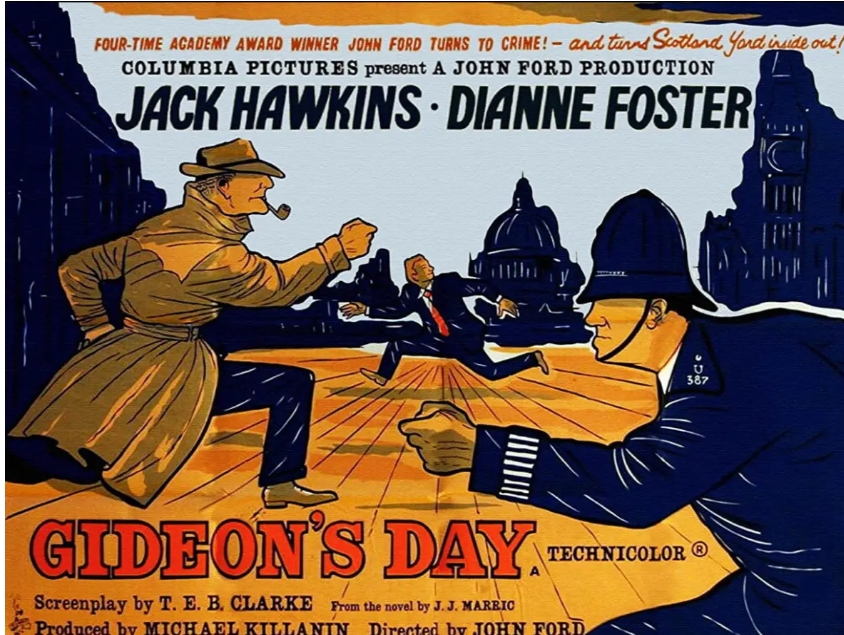
GIDEON'S DAY  (A/K/A GIDEON OF SCOTLAND YARD) (1959): It's a rare event finding a comedy/drama done right, especially one featuring not one, not two, but three murders (one involving the rape of a teenage girl), along with various other crimes that don't usually raise a chuckle (unless you get a kick out of an old man getting his skull bashed with a hammer). But damn if Gideon's Day isn't one of the breeziest movies I've seen in some time. And it's directed by John Ford! What's he doing on this blog?

Pipe-smoking Scotland Yard Inspector George Gideon starts the workday getting a traffic ticket from an eager-beaver young bobby. From there, it's all downhill, as he bounces from one case to another, starting with a colleague accepting bribes from a heroin dealer. From then on are the aforementioned violent crimes, along with a bank robbery, and probably a couple others I'm forgetting. There's also a school concert featuring his 18 year-old daughter he wants to attend; showing up in court to make a statement regarding an earlier case; and a fish in his filing cabinet (don't ask). And astonishingly, most of these disparate events wind up being linked in the most unexpected ways.

Gideon's Day (retitled Gideon of Scotland Yard for its American release) doesn't resemble a John Ford production. In fact, with its occasional fast, overlapping dialogue, it could pass for a Howard Hawks movie. Filmed in London with British talent, it lacks the director's usual familiar actors he usually worked with. (Jack Hawkins, as Gideon, is the only actor here I was even vaguely recognized.) Columbia Pictures, had so little faith in the project that they released stateside with a shorter runtime and in black & white. Nice way to treat the only director to win four Academy Awards (six if you include two documentaries). Fortunately, Gideon's Day is available now in its original length and vivid three-strip Technicolor (although with the American credits). No matter the title, it deserves mention along with John Ford's more famous productions. 

BONUS POINTS: Dialogue you'd never hear in an American movie, such as this exchange between Gideon and a thief pointing a gun at him: 

GIDEON: If you were fool enough to fire that gun --                              CRIMINAL: I don't see why you should speak in the subjunctive. I am going to fire this gun!

Even the criminals are classier in the UK.


Thursday, August 24, 2023

THE EARLY SHOW, PT. 22

 The little lady was out of town for a week, allowing me to catch up on several movies building up on the DVR queue that wouldn't necessarily be up her alley. But how much of what I like really are? Here are just four of them:

CURTAIN CALL (1940): Broadway producer Jeff Crandall and director Donald Avery want to get even with actress Charlotte Morley, who's leaving their employ at the end of her contract, by demanding she star in a terrible play written by the young, first-time writer Helen Middleton. Crandall and Avery believe Morley will refuse the part, thus allowing them to sue her. Unfortunately, she loves the play, forcing Avery to woo Middleton in order to let him rewrite it into a farce in order to save his and Crandall's reputation.

Unlike dramas or gangster pictures, B-comedies tend to be a tough watch. But Curtain Call is the rare exception that, with 15 extra minutes and a bigger budget, could easily have passed for an A release. Barbara Read, as the clueless playwright, happily allows the rest of the cast chew the scenery as if they hadn't eaten in weeks, with Donald MacBride and Alan Mowbray (Crandall and Avery) having the biggest appetite of all. Dalton Trumbo's dialogue is so sophisticated and often hilarious that the quieter scenes with Helen Middleton and her hometown suitor John Archer seem like they were written by someone else.  

The idea of a middle-aged guy faking love with an innocent woman barely out of her teens sounds iffy today, but is played so absurdly that only the usual hair-trigger Twitter crowd would take offense. And while Helen Middleton proudly stands up for herself by refusing any rewrites, it's also made quite clear that her play really does stink from here to Sunday. (Avery's fast-talking press agent describes it as "a hangover on paper.") While it wouldn't necessarily work as a movie today, a smart Broadway producer could turn Curtain Call into a crowd-pleasing stage farce without having to pretend to fall in love with the writer.

BONUS POINTS: The always-welcome Frank Faylen (Dobie Gillis' father on TV) from Natzy Nuisance and Address Unknown plays the press agent, while Alan Mowbray portrayed Satan in The Devil with Hitler.


BLUES IN THE NIGHT (1941): Anticipating Syncopation by a year, Blues in the Night is the story of a New Orleans-inspired band led by Jigger Pine. Only here, the musicians are playing in a New Jersey gin joint run by Sam Payras, who, along with the club's thrush Kay Grant, two-timed their cohort Del Davis after a bank robbery years earlier. Davis has returned with the band in order to open an illegal gambling room upstairs. Jigger finds himself falling hard for the no-good Kay, and takes off with her to join a money-making orchestra. After a stint in the psych ward (playing dopey music for Manhattan swells literally drives him crazy) Jigger returns to his old band in Jersey, where a showdown involving him, Del, Kay, and the bar's clean-up guy Brad Ames, turns fatal for three of them.

Just one of countless examples of a poster promising one thing and the movie delivering another, the semi-noir/musical Blues in the Night should have a better reputation. Director Anatole Litvak (City for Conquest) does a great job with the camera, whether using it as the keyboard's point-of-view for Jigger's hands as he plays piano, or his bizarre mental breakdown. Litvak also cast the movie with plenty of interestingly unattractive character actors: Richard Whorf as the hot-tempered Jigger; Lloyd Nolan as the slimy Del Davis; Howard da Silva as Sam Payras (who makes the mistake of wanting to drop a dime on Del); Billy Hallop, Peter Whitney, and Elia Kazan as members of the band; and, perhaps best of all, Wallace Ford as Brad, described more than once as Kay's "crippled stooge." Once an annoying comedic actor, Ford's talent grew as he eased into dramatic supporting roles. He gives the most subdued performance here, not exactly stealing the movie but being the most grounded in reality.

Jack Warner probably panicked when he saw this defiantly non-box office crew and insisted on tossing in audience favorites Jack Carson and singer/starlet Priscilla Lane as trumpet player Leo Powell and his wife named Character. (I bet ten bucks this was an in-joke by writer Robert Rossen.) While just missing the designation of "classic" by a G-major chord, Blues in the Night is definitely worth its $2.99 price on streaming services. And yes, the legendary title number was written for the movie. It lost the Academy Award for Best Song to "The Last Time I Saw Paris", which nobody sings anymore. Not-so fun fact: A decade after Blues in the Night's release, Elia Kazan, Howard da Silva, and Robert Rossen were caught up in the HUAC red scare investigation.

BONUS POINTS: Don Siegel, credited with the movie's montages, would later become a director, best known for Dirty Harry 30 years later.


STOLEN FACE (1952): Take a jigger of Hitchcock's Vertigo, mix with a shot of Steve
Martin's The Man with Two Brains. Shake well and pour yourself a tangy Stolen Face. Dr. Phillip Ritter falls in love with concert pianist Alice Brent. Learning that she's engaged to another man, Ritter returns home and performs plastic surgery on Lily Conover -- a prisoner whose crime wave started after an accident left her face badly scarred -- to make her look like Alice. Of course, marriage immediately follows because, well, he's a doctor, he knows what he's doing, even when he chooses her wardrobe. But Ritter learns the hard way it takes more than a pretty face and a nice dress to change a sociopathic criminal. Oh, and guess what concert pianist returns to Ritter's life after her engagement breaks up? 

A UK production from Hammer, and something of a preview of their later horror movies, Stolen Face makes sure we know early on that Ritter isn't some crazy doctor because... um... he doesn't charge poor patients! Therefore, it's perfectly understandable that the lovesick guy wants to physically recreate the woman he loves onto someone else's face. And he's played by Paul Henreid, the heroic fighter of Nazis in Casablanca, which only increases our sympathy, especially when Alice takes on the habit of shoplifting furs and jewelry, turning their home into her own private dance hall, and taking up with a new lover. Come to think of it, this doc is too stupid to deserve anybody's sympathy.

The double role of Alice/Lily goes to Lizabeth Scott, who was created herself by Warner Brothers as a Lauren Bacall substitute, right down to the throaty delivery. But while she never really got the same acclaim, Scott pulls off a performance that Bacall couldn't have matched; even though her "Lily" voice was dubbed by someone else, Scott looks different in both roles even while, of course, identical. You can tell, however, Stolen Face's modest budget when, at the climactic showdown between the two women, Scott is never seen as both women in the same shot. No matter -- one of them gets what she deserves.

BONUS POINTS: A bit of production sloppiness occurs when Henreid is walking in front of a back projection of Picadilly Circus. A movie theater in the background is running Joan of Arc starring Ingrid Bergman, which was released five years earlier. And no, I don't know why this is a bonus, other than it shows what a smarty-pants I am.

MACHINE GUN MCCAIN (1969): Freshly sprung from prison after 12 years, armed robber Hank McCain is offered a lucrative "job" by his 20 year-old son Jack: clean out the safe from the Royal Casino in Las Vegas. What Hank doesn't know is that Jack is working for Charlie Adamo, a Mafia lieutenant trying to take over the Royal without the permission of his bosses. But Hank has his own plans for what he's going to do with the money, while "the boys" back East are going to deal with these jokers their own way.

If B-movies were still a thing 1969, Machine Gun McCain would have been one of them. It's one of those European productions -- in this case, Italian -- where the producers hired a couple of recognizable American actors as the leads in order to make gullible Yanks think it was a Hollywood movie. John Cassavetes (McCain) probably took the job to finance Husbands, while telling Peter Falk (Adamo), "What the hell, it's easy money and we spend a few weeks in Vegas shooting guns." They, Britt Ekland and "guest star" Gena Rowlands (Mrs. Cassavetes) pretend to take it seriously, and are probably the only actors who dubbed in their own dialogue, typical on Italian movies where it always seems like the voices are coming from somewhere other than the set.

There's plenty in Machine Gun McCain that wouldn't fly today, like a typical boy-meets-girl scene of the time where McCain's attempted rape of Irene actually turns her on and leads to marriage the next day. McCain's plan to set off several bombs throughout Vegas to distract cops from the robbery would be condemned for inciting a round of homegrown terrorism. Probably the most interesting thing in the movie is how the Mob, still controlling Vegas in 1969, has more or less the entire population on their payroll, as everybody from cab drivers to college students are given photos of McCain and Tucker after the couple pull off the robbery. 

Machine Gun McCain is no Godfather, but fits the bill if, like me, your wife is away and you're in the mood for some entertaining trash made by professionals who can at least keep the camera in focus. (By the way, if you're interested in seeing a movie that shows the genuinely ugly gangster life, watch the 1971 Michael Caine drama Get Carter. It's too good for this blog.)

BONUS POINTS: Machine Gun McCain is the only movie I've ever seen where the credits admit it was "freely adapted from" rather than "based on" a novel, while the cinematographer is listed under the old school appellation of "cameraman". In fact, I don't think I've ever seen that word in any other movie.

                                                           ************


Friday, December 31, 2021

MOVIE OF THE DAY: "HYPNOTIZED" (1932)

Hypnotized has possibilities for a wacky movie. American Circus worker Bill Bogard has to choose between getting married to his sweetheart Mitzi or sailing to the UK to cash in a sweepstakes ticket worth 150,000 pounds. 

Naturally, he goes with the latter scheme, with his idiot colleague Egbert Jackson in tow, and Mitzi giving chase. Prof. Horace Limberly, learning of Bogard's windfall, hypnotizes him into handing over the sweepstakes ticket. Through a series of inevitable mishaps, Bogard retrieves the ticket and marries Mitzi onboard the steamship. 

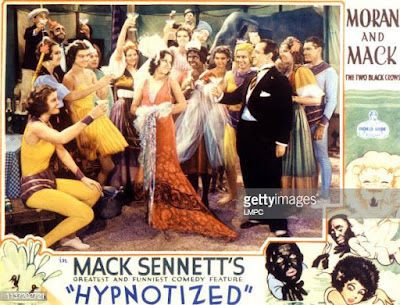
Sounds like an OK proto-screwball comedy. But this blog being what it is, Hypnotized has to be either an obscure curio or something bordering on abominable. One look at the poster will tell you which.

Since 1932, Hypnotized has been considered by many to be the worst movie ever made. As I recall from a book about comedy teams (published circa 1972), Leonard Maltin quoted a prominent movie critic who, upon the film's original release, said, "If you haven't seen Hypnotized, you cannot realize how bad a motion picture can be."

Look fast, folks, because that's the last you're going to
see of George Moran (right).
The main contributors to its reputation were Moran & Mack, a/k/a The Two Black Crows, a bush league Amos & Andy, who lacked the latter's attempt at humanity. That Moran & Mack were even attempting a grotesque blackface movie career as late as 1932 is shocking. At least Amos & Andy's creators stuck with radio after washing out in features two years earlier.

But what's even odder is that George Moran makes only a 15-second appearance early on before disappearing, handing over the rest of the picture to Charles Mack. I've never been able to discover the thinking behind this idea or if audiences sued movie theaters for false advertising. 

I needn't point out where Marjorie Beebe is.
In place of Moran, Mack is given a love interest, Mitzi's maid Pearl. There's no way a black
woman would be cast opposite a white guy (no matter what color he's playing), so B-list actor Marjorie Beebe blacked up for the part. While her make-up is less jarring than Mack's, it's still obvious that this is a white woman in the role, like Natalie Wood in West Side Story only without being provided words by Stephen Sondheim to sing. 

Here's hoping she hid a large piece of lead inside the
tip of the broom.
Therefore, it's all the more fascinating to see the great Hattie McDaniel as (what else?) the ship's maid sharing scenes with Charles Mack. One wonders what was going through her mind -- was she insulted, or just happy to get a couple day's work? Whatever, McDaniel really gets into beating Mack with a broom. No surprise it's the most satisfying scene in the picture.

You pretend you're sitting on a chair if you think it's
so easy.
In order to live up to its title, Hypnotized features several scenes with our "heroes" under the control of Prof. Limberly, played by Ernest Torrance (who, perhaps ashamed by the experience, died within a year). 

It's useless to expect little things like motivation or realism in this piece of junk. But why would an honest-to-gosh hypnotist make these two idiots sit on imaginary chairs, play imaginary xylophones, and convince them they're cats instead of just stealing the winning sweepstakes ticket and making himself scarce for the rest of the voyage?

When this is the best thing in the movie,
it's time to call it a day.
Easy! It allows them to partake 
in stupid sight gags like the ones described above. And in doing so, we get to see a troupe of bizarrely animated mice tease them by doing a soft shoe routine. 

This bit, which really must be seen to be believed, doesn't come out of left field as much as it does a whole different star system, and offers the one genuine laugh in Hypnotized's 76 minutes. At a time when studios were trying to create cute Mickey Mouse clones, these freakish rodents actually stand out in welcome relief. 

And the mutt probably didn't even get stunt pay.
A low budget comedy from this time wouldn't be complete without some animal abuse, and Hypnotized delivers not once but twice. The first time, Egbert, hypnotized into thinking he's a cat, gets into a fight with a dog, going so far as to bite its tail. Depending on your tolerance for such things, it's either made palatable or disappointing that the dog is obviously wearing extensions.


Blackface, animal abuse -- just another day in
Hollywood.
The second example happens during the climax, when a lion from the ship's entertainment act -- unlikely to be found on any Princess Cruise -- gets loose. After Egbert and Pearl jump into the pool to escape certain death, the lion insists on hanging around. Genius that he is, Egbert retaliates by pulling on its tail.

This time, there is no attachment. What we're watching here is Charles Mack (or his stuntman) really and truly pulling on this poor lion's tail. In a movie filled with dozens of moments where you mutter I can't believe this, this particular scene takes the cake. Fun fact: Wallace Ford, who plays sweepstakes winner Bill Bogard, would star that same year in Central Park, another movie where an escaped lion plays a key role. Strange typecasting.

Sennett asks for your
forgiveness.
The mastermind behind Hypnotized was Mack Sennett, the one-time self-proclaimed King of Comedy. While Hollywood comedies were becoming more sophisticated, Sennett's style hadn't developed in decades. His greatest discovery, Charlie Chaplin, must have been appalled by his former boss's fall from slapstick grace.

Also not helping is Hypnotized's low budget and lack of technical expertise. Wearing its crudeness almost proudly on its sleeve -- I would have sworn it was made in 1929 -- Hypnotized is perhaps the only movie that would look even worse if restored. 

What is the definition of "laugh"?
Yet despite all my carping, I would be hard-pressed to name Hypnotized the worst movie ever made. At least two others on this blog, Son of Dracula and Another Nice Mess, lack even an historical interest for viewing. Plus, they're boring as hell. But you almost can't help watching Hypnotized, as if it's daring you -- hypnotizing you -- to believe this really isn't some strange hallucination. 

Two years after the release of Hypnotized, Mack Sennett was seriously injured in an auto accident while driving in Mesa, Arizona. His passenger, Hypnotized' star George Mack, was killed. Sennett really knew how to treat a friend.

                               **********

To read about Son of Dracula, go here.

To read about Another Nice Mess, go here.

To read about Central Park, go here.

Monday, November 22, 2021

MOVIE OF THE DAY: "CENTRAL PARK" (1932)

Broke, starving Rick and Dot meet cute in Central Park over a couple of stolen hotdogs. Meanwhile, two gangsters, posing as cops, hire Dot to unwittingly take part in a robbery. 

Meanwhile, a park cop is trying to keep his bad eyesight a secret so he can retire in a week with his pension. Meanwhile, a former park zoo employee has escaped from the nuthouse to seek revenge on a former colleague. Meanwhile, a lion from the Central Park Zoo escapes from its cage. Meanwhile...

Ah, to be young and in love and starving and
homeless and broke!
Oh man, I could keep up with the meanwhiles for the next hour, which is how long Central Park lasts. Today's movie-makers, who somehow deem comic book features important enough to last close to three hours, could learn from the writers and directors who had to keep things snappy so theaters could also run a comedy short, cartoon,  newsreel, and a brief live stage show. Had to give audiences their 25-cents worth of entertainment, you know.

"No, lady, I'm not Jon Lovitz!"
Speaking of comic books, there are no super heroes in Central Park. Typical of Warner Brothers movies of the time, the two leads are victims of the Depression. And they fall in love on the spot, because, as in wartime, things could go kablooey at any moment. Like a lion running loose in Central Park.

They also take any job offered to them. For Rick, it's washing 40 police motorcycles for two bucks. (Sounds like the cops were defunded 90 years ago.)  For Dot, it means being hoodwinked into taking part in a charity event, so the gangsters can amscray with the dough that's been raised. That the two criminals look and sound nothing like real policemen tells you how desperate people were to make a buck in the Depression.

Gee, no wonder they call him Smiley.
Even more dangerous than the gunsels is the unexpected arrival of the maniac named Smiley, fresh from breaking out of the Mattewan Insane Asylum. Charlie the park cop, too busy going blind and tickling the zoo's baby tigers, doesn't notice Smiley throwing Luke the lion keeper into one of the cages, where he's quickly turned into lunch, a scene that still shocks today. Shoulda been nicer to ol' Smiley when you had the chance, Luke!


The band decides to take five.
Luke's stuntman does an impressive job of not getting killed in that scene. But
what's really astonishing -- or frightening or foolhardy -- is the climax. The lion, who's been hiding in the backseat of a parked cab (as all escaped lions do), crashes through a window of the Central Park Casino restaurant, where he runs amok among the society swells at the charity dinner. 

While the editor makes it seem like the lion is running through the crowd for the entire scene, it's equally clear that the lion and the actors really are within feet of each other in many shots. 

The two questions that spring to mind are: 1) How much bonus pay did the extras get for putting their lives on the line?, and 2) Is this supposed to be funny or dramatic? Perhaps Depression-socked audiences enjoyed rich people nearly getting killed by a lion. Because even after watching this movie three times, it still makes me laugh like hell.

Millions of men in 1932 would have killed to have
this dish gaze at them this way.
For all of Central Park's weird detours, Joan Blondell and Wallace Ford make an absolutely believable couple, right to the end when they're both mistakenly arrested for being part of the criminal gang. 

Blondell has a really nice moment, when, during the police interrogation, she initially makes like she was in on the crime and that Ford was just a big sap, just so the cops don't arrest him. But once Ford turns to talk to the cops, Blondell's hard expression immediately softens into love, an allegedly simple piece of acting few of today's young actresses are likely capable of.

Central Park's supporting actors -- including Guy Kibbee as the cop, Harold Huber as the fast-talking gangster, and John Wray as the really scary nutjob -- are wonderful to watch. But for present-day New Yorkers, the most interesting parts of the movie are probably are the few exterior shots filmed on location in Central Park itself. The little farm (long gone) in the zoo; joggers and bikers together on the paved (now dirt) path circling the reservoir; and, best of all, sheep being led to, yes, Sheep Meadow in the morning. During the Depression it was cheaper than paying humans to trim the grass.

Depression? How can anybody be depressed in Central Park?

Central Park is just one of countless movies of the past, considered throwaways even by their studios, that are great fun to watch today, especially with their brief running time. And little things still fascinate. Like how Ford is able to take Blondell out for dessert and coffee, while still having enough left over for dinner and a movie later -- all on two dollars! Sounds like it's worth getting chased by a lion.

                                                        ****************

Go here for the original Central Park trailer. Dig that snappy music from the Warners orchestra!