Showing posts with label BELA LUGOSI. Show all posts

Saturday, March 7, 2026

THE EARLY SHOW, PT. 65

Frank Capra makes his Early Show debut, an honor he likely would have refused, while Bela Lugosi, Walter Huston, and Edward G. Robinson return to join an antediluvian vaudeville act in their first (and last) appearance. 

THEY LEARNED ABOUT WOMEN (1930): Here's a story you've never seen before: two lifelong friends are torn apart by a no-good dame. The twist: the friends are professional baseball players who moonlight as vaudeville entertainers. Or the other way around, it's never made clear.

One doesn't watch a picture like They Learned About Women for entertainment any more than archeologists explore pyramids to find a new place to live. It's strictly historical study, for this is the only feature starring Gus Van & Joe Schenck -- in their time (c. 1915-1930) the most popular singing duo in show business, who are now as au courant as the allosaurus. 

And here's where it gets fascinating for nerdy amateur showbiz historians. Put aside for a moment that Van has the face of a human bulldog, and Schenck possesses the voice of Neil Sedaka turned up to 11. They are great at what they do if -- and this is important -- you remember what audiences enjoyed a century ago, like harmony as loud as the lead voice, or songs featuring dialect humor. They Learned About Women feature three of the latter: African-American (despite the potential offense, a fantastic number you can watch 
here), Irish, and Italian, (You can find Van & Schenck shorts where they do their "tributes" to Jews and Chinese as well.)

Not all the music in They Learned About Women is culturally unacceptable in the 21st century; it's artistically unacceptable as well, although I enjoyed them tremendously. Without Van & Schenck, They Learned About Women would be an exercise in ennui. It's best to fast-forward through the "drama" and go straight to the songs -- IF you have any interest in the kind of pop music that was already going out of style by the time of the movie's release (Schenck himself died six months later). Don't miss leading lady Bessie Love's jazzy solo "I Got Me a Real Man", either. She's kind of a hot mama in her own innocent way.

BONUS POINTS: Authentic footage of the old Yankee Stadium is featured in the climactic ballgame. 


AMERICAN MADNESS (1932): For a director remembered for uplifting movies, Frank Capra had a pretty cynical (meaning accurate) eye for corruption, unbridled capitalism, and the sheer idiocy of the average American. His movies' tacked-on happy endings are nothing more than fairytale codas meant to make you forget the reality you just experienced. 

American Madness may be the first entry in that quasi-genre, and is definitely better than its forgotten status would have it. It also plays like the blueprint for It's a Wonderful Life, seeing that it focuses on a down-to-earth bank president facing a hostile takeover and a hostile clientele when hysterical rumors lead to a run by panicked depositors. 

Walter Huston, as usual, knocks it out of the park as Thomas Dickson, the big city bank president with a heart of gold and a knack for seeing the good in everybody -- even when one of them, cashier Cyrill Cluett, engineers the bank's robbery to pay off a debt to a gangster. Pat O'Brien is Matt, a colleague who believes Cluett is fooling around with Dickson's wife, winds up being the prime suspect in the robbery. But it's Huston who's the star of the show; his casual chit-chat and gangly walk suggest a friendly small-town businessman who goes by his gut feeling when it comes to loaning money. He's the boss you've always dreamed of having yet has never existed in real life. 

Strangely, American Madness feels at times more like a Howard Hawks picture, with realistic overlapping dialogue and fast paced action, leading an eye-popping climax with what looks like the biggest group of extras since the Babylon scene in Intolerance.  Brimming with humor, drama, and outright misanthropy, American Madness is the work of a moviemaker still questioning the so-called wisdom of both the ruling class and middle class. 

BONUS POINTS: American Madness is one of the last movies to feature the credit DIRECTED BY FRANK R. CAPRA. Maybe he dropped the "R" because it didn't have the same ring as Darryl F. Zanuck or Louis B, Mayer. 


THE DEATH KISS (1932): Gangsters are setting up a hit. As the target exits a nightclub, their moll gives him an unexpected kiss, allowing the hitmen to ready, aim, fire. CUT! It turns out we're on a movie set. As the director arranges for a second take, the crew realizes the actor was killed for real. Is Alec Baldwin on the loose again?

Cheap joke aside, The Death Kiss is actually quite a decent picture, reuniting the stars of the previous year's hit, Dracula: Bela Lugosi, Edward Van Sloan, and David Manners. Disappointingly, Lugosi, as studio manager Joseph Steiner, doesn't have a lot to do other than seem awfully anxious to pin the murder on the leading lady, who had been divorced from the now-dead actor. Van Sloan (as director Tom Avery) merely wants the set locked down, while Manners (wisecracking scriptwriter Franklyn Drew) wants to find the real killer since he's in love with the sexy suspect, as all scriptwriters are.

For a Poverty Row production from Sono Art-World Wide (the abhorrent Lucky Boy and Peacock Alley), The Death Kiss is a quite the meta-mystery in that it gives a behind-the-scenes look at the picture business, making good use of the equally-low-budget Tiffany Studios (where The Death Kiss was filmed) as we visit the sound stages, screening room and back lot. 
And typical of "inside" movies of the time, the guy running the studio is a malaprop-slinging Jewish caricature. (His response upon hearing about the murder of his star: "Oy, that's going to cost me a fortune!"). Figuring out whodunnit is beside the point; The Death Kiss is a fun watch, with some clever camerawork and familiar character actors helping to speed things along -- literally. You won't realize until the end that it all takes place in one day.

BONUS POINTS: As with The Vampire Bat, The Death Kiss uses the occasional hand-tinted sequences for cheap but interesting effects, especially when a movie reel goes up in flames. And did you know that the iceman often slid his delivery into the icebox through a special door in the wall of the house? The things you learn in old movies!


NIGHT HAS A THOUSAND EYES (1948): Sometimes a movie can make you rethink
your admiration of an actor (like Robert de Niro in most movies not directed by Martin Scorsese). Night Has a Thousand Eyes, on the other hand, increased my appreciation for Edward G. Robinson.

Its story isn't anything new, A phony showbiz psychic named Triton acquires a sudden gift (if you can call it that) of real prognostication which eventually sets off a chain of events that prevents the death of one person and causes the death of another --an idea previously explored in The Clairvoyant with Claude Raines. And as with The Clairvoyant, Night Has a Thousand Eyes deliberately makes you wonder if the tragic climax was inevitable or caused by the psychic's own actions: a cop-out ending to please the censors, I'd say. 

None of this negates my belief that Edward G. Robinson was the best of the major tough-guy actors of his time, including Humphrey Bogart and James Cagney. Because while those two gentlemen are great at what they do, Robinson goes one step further by creating enormous empathy for characters like Triton. You can picture Robinson in, say, The Caine Mutiny or White Heat, but neither Bogart nor Cagney could have starred in Night Has a Thousand Eyes -- or Scarlett Street, The Woman in The Window, Tales of Manhattan, and other dramas where Robinson shows a side painful in its melancholy. Kind of lost in the shuffle among the "classic" Robinson movies, Night Has a Thousand Eyes needs a million more viewers.

BONUS POINTS: William Demarest has a rare "straight" role as Police Lieut. Shawn, occasionally cracking wise as a sop to his fans.

                                                        *************

Wednesday, March 26, 2025

THE EARLY SHOW, PT. 48

 Add three Bs with one A, and what have you got? Need I explain?

THE MYSTERIOUS MR. WONG (1935): Come with me to the Chinatown area of
Monogram Pictures, where cinema cliches long-gone reside. Actors of every ethnic persuasion except Chinese. The wisecracking reporter. The wisecracking dame he's got the hots for. The dimwitted Irish flatfoot. And holding court, the criminal kingpin with the thin droopy moustache, flat-brimmed hat, and evil intentions. But the only thing mysterious about him is: why does the Chinese guy have a Hungarian accent? Ah so! He's Bela Lugosi!

Only three years after Dracula, Lugosi was already making himself familiar in the dusty streets of Poverty Row, churning out B's like The Mysterious Mr. Wong. Like Fritz Lang's mastermind Dr. Mabuse, Mr. Wong has minions doing his bidding -- or, rather, killing, as he tries to collect 12 coins once owned by Confucius that, when gathered together, will give him special powers (like sounding Chinese?). Maybe if the cops owned the things, they'd have the power to break this case instead of leaving the job to a reporter and his sidepiece: Wallace Ford (the poor man's Lee Tracy) and Arline Judge (the poor woman's Joan Blondell). 

Unfortunately, Bela Lugosi was already becoming the poor man's Bela Lugosi. Perhaps to compensate for the ridiculous dialogue in much of The Mysterious Mr. Wong, Bela overenunciates his dialogue in order to prevent audiences from falling asleep, his mouth twisting open and shut as if chewing a dozen pieces of bubble gum at once. Yet surrounded by henchmen who look and sound about as Chinese as Edgar Buchanan, Lugosi at least can almost pass for what was once called Asiatic; only the extras are the real thing. Embarrassed as they likely were, at least they got five or ten bucks, a sandwich, and the chance to hang with Bela Lugosi for a week. As with watching The Mysterious Mr. Wong, it's better than a day-old eggroll.

BONUS POINTS: A few years later, William Nigh, the director of this masterpiece, also directed Boris Karloff in three other Mr. Wong movies at Monogram. Only that Mr. Wong is a detective and has nothing to do with this Mr. Wong. I'd say something about "two Wongs don't make a right" but it's too easy, unfunny, and has been done to death, kind of like every Mr. Wong plot, criminal or detective.


MY SON IS GUILTY (1939): Ham-fisted title aside, this is actually a pretty good B, sincere and human, thanks to the leads: Harry Carey as beat cop Tim Kerry; Bruce Cabot as his mildly sociopathic ex-con son Ritzy; Jacqueline Wells as Julia Allen (the girl who inexplicably loves Ritzy), and Glenn Ford as aspiring author Barney (the nice guy who explicably loves Julia). 

Ritzy, sprung from a two-year stint in the slammer, is determined to go straight -- straight to a criminal gang run by femme felon Claire Morelli. Ritzy, having gotten a job at the police station thanks to his dad, turns off the two-way radio system to help the crooks successfully pull off a robbery. Two cops are shot -- one fatally by Ritzy -- while the one with the slug in his shoulder is you-know-who. Eventually that you-know-who is face to face with Ritzy, both of them with gun in hand. Talk about dysfunctional families!

At least half of My Son is Guilty's success is due to Harry Carey. His portrayal of good-hearted cop Tim Kerry (he buys a little roller-skating girl a new bottle of milk to replace the one she dropped after colliding with him) is real and utterly sympathetic. The script might be predictable - is predictable - but you can't help but feel bad that, through no fault of his own, he raised a son who went sideways in life. (It helps Carey looks at least 15 years older than his actual age of 60.) Bruce Cabot, 34 but appearing closer to 50, pulls off the no-good offspring trope better than you usually see in movies like this; just by the way he enters his first scene, you strongly dislike the guy. Jacqueline Wells is cute and engaging, but her character is such a poor judge of Ritzy it's kind of difficult to work up any empathy for her. As for Glenn Ford (in his second feature) --- like his male co-stars, he doesn't quite match his real age: 22 but looking 14. You can see traces of the actor he was going to become, even if he sounds like a better-educated Leo Gorcey. He likely scrubbed My Son is Guilty from his curriculum vitae and memory, but there's nothing to be ashamed of here. Between the stars and a bunch of familiar faces from Columbia Pictures' character actors file, the movie is a step or two above the usual 60-minute fare.

BONUS POINTS: A sequence featuring the legendary tap dancers the Nicholas Brothers was originally shot for, but cut from, the 1934 Columbia picture Jealousy. 


THE SPIDER WOMAN STRIKES BACK (1946): In 1943, Universal released the
Sherlock Holmes mystery The Spider Woman, with Gale Sondergaard in the title role. A year later, The Pearl of Death, another Holmes picture, featured a performance with Mr. Acromegaly himself, Rondo Hatton. It took another year for some genius at the studio put the two actors together in The Spider Woman Strikes Back, hoping to lure in suckers who thought they were getting a sequel to the "original". By the time Universal bothered to release it a year later, both Hatton and the Sherlock Holmes movie series were dead. 

Jean Kingsley takes a job as paid companion to Zenobia Dollard, a blind woman beloved by everyone in the village of Domingo -- beloved because nobody knows Dollard is faking her blindness, and has been murdering every young woman who has worked for her by draining their blood in order to feed her poisonous flowers. These flowers are given to the farmers' cattle to eat by her mute flunky Mario, in order to force the farmers to leave town, allowing Zenobia to buy their property. Hal Wentley, a local yokel who loves Jean, figures out something is rotten in Domingo (or at least in Zenobia's greenhouse), and sets things to right. That is, Zenobia and Mario are burned to a crisp when their abode goes up in flames. As for what the spiders have to do with it -- well, I remember seeing some spiders, but I'm not sure what their purpose was. And besides, Poisonous Flower Woman doesn't have the same ring. You want a detailed analysis of "film", go read the collected works of Pauline Kael.)

You gotta feel a little bad for the classy Gale Sondergaard. Here she was, the first winner of the Best Supporting Actress Academy Award, now slumming in nuttiness like the 59-minute The Spider Woman Strikes Back. It's a credit to her talent that she plays it as if it was worthy of her. For Brenda Joyce (as Jean), it's difficult to figure out if it was a step up or down from playing Jane in RKO's Tarzan B-pictures. Unsurprisingly, Rondo Hatton steals the show as Mario the Monster (as his character is billed). Unlike most of his movies, Rondo has plenty of screentime here. Even better, he's not lit or dressed to make him look frightening. Often wearing a suit (or at least tie and clean shirt), there are times he looks startingly like Ed Sullivan. But as usual, his looks apparently prevent his character from speaking, while his sign language resembles someone doing hand shadow animals. In other words, outside of Sondergaard, Rondo gives the most believable performance in the picture. 

BONUS POINTS: Future TV legends Kirby Grant (Sky King) and Milburn Stone (Doc Adams in Gunsmoke) co-star respectively as Hal Wentley and a scientist). 


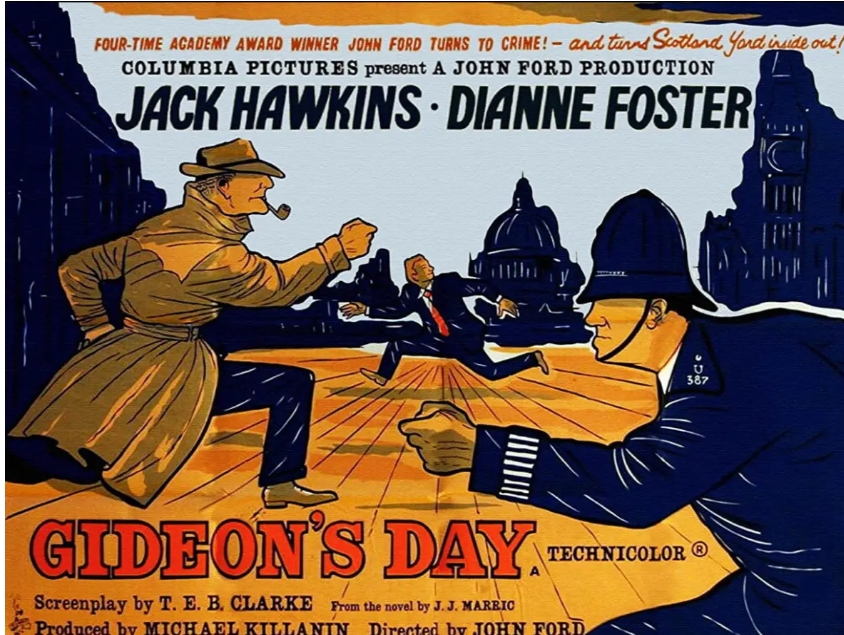
GIDEON'S DAY  (A/K/A GIDEON OF SCOTLAND YARD) (1959): It's a rare event finding a comedy/drama done right, especially one featuring not one, not two, but three murders (one involving the rape of a teenage girl), along with various other crimes that don't usually raise a chuckle (unless you get a kick out of an old man getting his skull bashed with a hammer). But damn if Gideon's Day isn't one of the breeziest movies I've seen in some time. And it's directed by John Ford! What's he doing on this blog?

Pipe-smoking Scotland Yard Inspector George Gideon starts the workday getting a traffic ticket from an eager-beaver young bobby. From there, it's all downhill, as he bounces from one case to another, starting with a colleague accepting bribes from a heroin dealer. From then on are the aforementioned violent crimes, along with a bank robbery, and probably a couple others I'm forgetting. There's also a school concert featuring his 18 year-old daughter he wants to attend; showing up in court to make a statement regarding an earlier case; and a fish in his filing cabinet (don't ask). And astonishingly, most of these disparate events wind up being linked in the most unexpected ways.

Gideon's Day (retitled Gideon of Scotland Yard for its American release) doesn't resemble a John Ford production. In fact, with its occasional fast, overlapping dialogue, it could pass for a Howard Hawks movie. Filmed in London with British talent, it lacks the director's usual familiar actors he usually worked with. (Jack Hawkins, as Gideon, is the only actor here I was even vaguely recognized.) Columbia Pictures, had so little faith in the project that they released stateside with a shorter runtime and in black & white. Nice way to treat the only director to win four Academy Awards (six if you include two documentaries). Fortunately, Gideon's Day is available now in its original length and vivid three-strip Technicolor (although with the American credits). No matter the title, it deserves mention along with John Ford's more famous productions. 

BONUS POINTS: Dialogue you'd never hear in an American movie, such as this exchange between Gideon and a thief pointing a gun at him: 

GIDEON: If you were fool enough to fire that gun --                              CRIMINAL: I don't see why you should speak in the subjunctive. I am going to fire this gun!

Even the criminals are classier in the UK.


Sunday, July 28, 2024

THE EARLY SHOW, PT. 39

Obscurities rule the day here, as, I suppose, they always do. All are worth a watch but for different reasons. Unfortunately, none of them apply to anybody but me.

BE YOURSELF! (1930): So associated is Barbra Streisand to Funny Girl is that
it's 
almost impossible to remember there really was a Fannie Brice. It doesn't help that she starred in only two movies (her first, made in 1928, is long lost), while took supporting or guest roles in just five others. As with her fellow Broadway star Frank Fay, Brice could never make a successful transition to film. If Be Yourself! is any indication, the problem could be bad scripts.

"Dopey" is the only description that could be given to the movie itself. Be Yourself! is the story of entertainer Fannie Field who, with her younger brother Harry, takes over the management -- and drops plenty of dough on -- punch-drunk boxer Jerry Moore, with whom she is inexplicably in love. Fannie's rival, Lillian, drops her boxer boyfriend McCloskey for Jerry as his star rises and head grows fat, which was likely supposed to remind audiences of Brice's ill-fated real-life marriage to layabout criminal Nicky Arnstein. I'm sure she appreciated the writers' thoughtfulness.

While Brice's comedic Yiddish accent comes and goes depending on her mood, Harry Green (as her brother) puts his into overdrive; initially amusing, it quickly becomes grating, as does his character -- Fannie paid for his education, and all he has to show for it is winning six cents in damages for a client. But nobody is worse than Robert Armstrong as Jerry, whose allegedly funny delivery is poor beyond belief. And neither he nor G. Pat Collins as McCloskey, are remotely believable as boxers -- or as professional actors. (Armstrong would do better in dramas starting with King Kong.)

This leaves Fannie Brice to save whatever day is left by singing six songs. What's most interesting is how her looks change with each style -- plain with pop, goofy as comic, and unexpectedly pretty with torch, thanks to a combination of camera angles, make-up, wardrobe, and acting. She's a talent, no question, but Be Yourself! is strictly for movie nerds and Fannie Brice fans -- are than any around for a woman who died in 1951? -- and is best appreciated as 62 minutes of history that give a faded idea of why she was popular everywhere but movie theaters. 

BONUS POINTS: Early on, Jerry Moore tells Fannie, "Gee, you're a funny girl." Coincidence?  


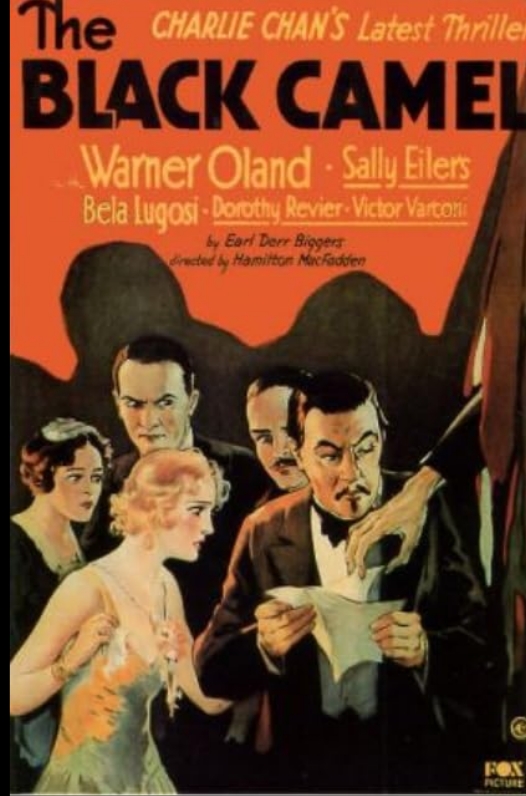
THE BLACK CAMEL (1931): Unlike other Charlie Chan movies, the real fun in The Black Camel is everything but the mystery. (If you're interested, actress Shelah Fane is murdered a few years after the murder of her lover, with a self-styled seer named Tarneverro being the likely suspect.)

OK, on to the good stuff. The Black Camel was one of the five original Chan movies thought lost in Fox Film's film storage fire in the mid-'30s, before a print unexpectedly turned up decades later. It was also the only one filmed on location in Hawaii (Chan being an Inspector on the Honolulu Police Department), allowing us to see the then-territory long before it became a relatively common tourist destination. The classy Royal Hawaiian Hotel allowed filming on its property as well; if it's still as beautiful as it was then, you just know the tourists aren't as well dressed.

But the cast! The cast! Bela Lugosi co-stars as Tarneverro, the same year as Dracula. Dwight Frye, legendary as Dracula's slave Renfield, is a suspicious butler. Robert Young, 40 years before Marcus Welby, MD, is Jimmy Bradshaw, dreaming of becoming a professional slogan writer (a typical '30s movie trope). Mary Gordon, the housekeeper in the Rathbone/Bruce Sherlock Holmes movies, who has information that helps Chan break the case wide open.  I almost needed a tranquilizer to handle The Black Camel's parade of iconic character actors. (A familiar character here is the starving artist with a British accent and pseudo-philosophical dialogue.) 

The movie also provides a rare scene with Chan's 12 slang-slinging children at the (long) breakfast table. None of the sons were old enough yet to be his incompetent sidekick, leaving that job to Otto Yamaoka as Kashimo, who spends most of the time running around Waikiki on wild nene chases. (If you know that the nene is Hawaii's state bird, it's a funny joke.) Yet for my money, the best moment is when Lugosi first meets Oland. Bela appears to genuinely enjoy their bantering, as if relieved to be rid of the Dracula cape in order to play a "normal" character part. While Charlie Chan at the Opera (co-starring Boris Karloff!) is often cited as the best Chan picture, The Black Camel is the most entertaining.

BONUS POINTS: In the strangest moment of any Chan movie, a bunch of real locals and tourists stand around gawking at the filming of The Black Camel on a beach. Good thing cellphones and TikTok hadn't been invented yet.


EL FANTASMA DE CONVENTO (THE PHANTOM OF THE MONASTERY) (1934): Well, that title
is one way to get audiences to think of an earlier horror movie. Still, this Mexican thriller stands on its own, and without a falling chandelier in sight -- even if, by the end, we see one has already fallen.

After getting lost on an evening hike, married couple Eduardo and Cristina, along with their friend Alfonso, are led to a centuries-old monastery by a strange monk. Hoping simply for a night's shelter and a little dinner, the trio encounter empty coffins, self-flagellation, the shadow of an invisible bat, and over a dozen of the weirdest old monks south of the border. As Cristina and Alfonso fall in lust, the padre tells them the story of a fellow monk who sought shelter there after desiring his best friend's wife... and summoning Satan in order to get the guy out of the way... only to have Satan kill the wife and eventually the monk, who now won't let himself stay buried. Cristina seems to believe this is a good risk for Alfonso to take, while he gradually comes around to her way of thinking. Ahh, young love!

As with other Mexican horror movies of the time, The Phantom of the Monastery is heavy on religious imagery atmosphere, eerie sounds, and an occasionally bombastic score which often distracts from the previous three things. But nothing can distract from the amorous looks Cristina gives Alfonso right in front of her husband, who is the only one who realizes that something very strange is happening all around them and wants to scram. (Sometimes what appears to be cowardice is actually intelligence.)

The scariest moments, other than the dead monk lying in his bed, are the most subtle. Two of them are courtesy of Marta Roel (Cristina), whose lust for Alfonso are signaled with just a brief change of facial expressions -- she's definitely under the control of something (or someone) otherworldly. The other is from Enrique del Campo (Alfonso), whose decision to hire Satan for Eduardo's murder is seen only in his eyes. I couldn't tell if it was a trick of the lighting, del Campo's acting skills, or both, but it's one of the movie's most memorable moments. While its predictable finale goes a little long, The Phantom of the Monastery proves that Mexico could, in its own way, match, and maybe surpass, the creep factor in Hollywood horror/thrillers, while throwing in a few surprises of its own.

BONUS POINTS: The mummified dead monk letting Alfonso know where to find Satan's instruction book. You have to see it to appreciate it.


HITLER: DEAD OR ALIVE (1943): Imagine Quentin Tarantino's Inglorious Basterds with a budget of a two-week car rental, and you've got Hitler: Dead or Alive. Three goofy gangsters -- Steve, Dutch, and Joe -- have been promised one million dollars by a patriotic American if they successfully kidnap Hitler and bring him back the US to face justice. Sound impossible? Not when the trio join the Canadian Army; hijacks a military plane to parachute into enemy territory, where every German speaks perfect English; and the country is filled with citizens willing to help them. Why didn't anybody think of this in real life?  

Contemporary audiences unfamiliar with movies like Hitler: Dead or Alive would likely be astounded how a silly, low budget piece of claptrap that made no sense entertained ticket-buyers in 1943. Easy! War-weary folks wanted to be distracted by silly, low budget pieces of claptrap that made no sense -- especially at a time when civilization was hanging in the balance. It was just one of many farces like Hal Roach's The Devil with Hitler and Nazty Nuisance turning Shicklgruber into a laughingstock. 

The biggest actor here, figuratively and literally, is Ward Bond as Steve, while familiar comedic wise guy Warren Hymer does his usual "Gee, boss" routine as Dutch. Bobby Watson, who portrayed Hitler in the two Roach comedies, repeats the role here, where he's billed as Bob Watson, perhaps reflecting his more serious portrayal. That is, as serious as can be when Ward Bond forcibly shaves off the moustache hiding a scar to make sure this Hitler isn't a body double. 

Things get dramatic at the climax when German soldiers, having captured the gangsters, mistakenly kill the clean-shaven Hitler before turning their rifles on four neighborhood children just because. Ward Bond gives an impassioned speech straight to the camera warning us that the Nazis must be stopped. When you consider Bond was one of Hollywood's most passionate right-wing antisemites, it's a brilliant performance. If nothing else, Hitler: Dead or Alive gives an idea of what movie audiences willingly sat through anything to get away from bad news. Which means you might enjoy it today.

BONUS POINTS: As cheap as any movie ever made, The Devil with Hitler was filmed at something called Fine Arts Studios.

                                                     *********************


Thursday, May 16, 2024

THE EARLY SHOW, PT. 35

Three Paramount pre-Codes, two John Carradine appearances, two stories involving soul transfers, and one Monogram B-picture. Is this heaven or what?

PICK UP (1933): Mary Richards (not the news producer in Minneapolis with the wacky friends) is let out of prison after serving time for an extortion racket -- which ended in a mark's suicide -- run by her husband John, who has three more years to serve. Having nowhere to go on a rainy evening, Mary ducks into a cab driven by Harry Glynn, who takes pity on her, invites her to move in with him, and gets her a job at the taxi garage as a phone operator. Mary, who hasn't told Harry of her unsavory past, urges him to pursue his dreams to open his own auto repair garage. Over time, they rise the up the social ladder. Just as Mary gets her marriage annulled, John breaks out of prison with the idea of killing Harry, who's fallen in love with a shallow rich divorcee. Mary manages to convince John to hit the road with her in order to save Harry's life. Tell it to the judge!

Pick Up has plenty of pre-code moments, starting with references to "the badger game" (where a woman entices a man to a phony romantic liaison, only to have her husband break it up and force the victim pay hush money). Because Mary is still married, she and Harry shack up for three years; while they're never seen in bed together, you get the idea they're not just roommates. The subplot of the wealthy woman who strings along a "caveman" for her own amusement was typical of the time, as was her horselaugh when the sap proposes marriage. (Pre-codes were often down on rich people, who do stupid things like throw parties where guests dress like children, play on see-saws, and drink out of baby bottles as they do here.) Even the typically sleazy opening theme by the Paramount orchestra promises a good time. 

So why is Pick Up just kind of meh? Other than the slow pace, the fault ultimately lies with George Raft as Harry. An actor's flat, low-key style can often be interesting, drawing you in, making you wonder what makes him tick. All you wonder about Raft is if he would have even gotten a movie contract had he not been best friends with Bugsy Siegel. A pro like cutie-pie Sylvia Sidney, as Mary, leaves him in the dust in every scene they share. In fact, everyone in Pick Up outshines Raft, whose one moment of drama -- hiring a lawyer to defend Mary when she runs off with John -- sounds no more emotional than ordering a new set of tires. Hell of a shiny head of hair, though. (If you're going to watch Pick Up, stick with it 'til the end just for its ludicrous only-in-the-movies courtroom climax.)

BONUS POINTS: An outrageous phallic symbol is provided by close-up of Harry's fuel pump overflowing into Muriel's gas tank. Honest.


SUPERNATURAL (1933): Supernatural's poster promises a great time, and by and large delivers, well, a good one. One doesn't expect a dish like Carole Lombard in a borderline-fantasy/horror movie, where she plays Roma Courtney, who has inherited her late brother's fortune. Desperate to know how he died, Roma falls for the promises of Paul Bavian, a sham psychic who tries to worm  his way into her heart money. His plans are interrupted by Dr. Carl Housan, who has revived the spirit of executed killer Ruth Rogen. Guess whose body she decides to park in? By the end of Supernatural's 65 minutes, Bavian learns the hard way that you don't want to get involved with a woman whose soul has been hijacked by a very unpleasant dead murderer.

Supernatural, a Paramount Picture influenced by Universal's horror shows, is unique by offering two views of the fantasy world. It presents psychics not just as scammers, but criminals -- Bavian kills his landlady when she threatens to spill the beans on his phony baloney. Yet it totally accepts the possibility of the revival of a dead person's soul. (You may recall Man With Two Lives passing off a similar idea as a coma-induced dream.) Perhaps to make sure audiences knew Dr. Housan wasn't a nutty scientist like Dr. Frankenstein, he's played by H.B. Warner, best known for starring in King of Kings six years earlier. How bad could he be if he played Jesus, right? 

Carole Lombard is quite good as the before-and-after Roma Courtney; her style -- even her looks -- change dramatically when becoming possessed by Ruth Rogen.  Roma is such an innocent that you kind of understand why she doesn't see through Alan Dinehart's Paul Bavian -- he has such a kind manner (for a murderer). Pre-cowboy Randolph Scott looks good in a tux, but it's difficult to picture Lombard falling for him. Supernatural is no classic, but it's an interesting change of pace from Paramount's usual sexy comedies and pre-codes. And from what I've read about the guys who ran movie studios then, they all could have used a soul transplant. 

BONUS POINTS: The bizarre, montage-heavy prologue featuring Ruth Rogen testifying in court and newspaper headlines playing up the trial. The rest of the movie doesn't live up to its promise, but it's a nice opening.

THIS DAY AND AGE (1933): So connected is Cecil B. DeMille to Biblical epics that it's a little stunning to stumble across his early pre-Code talkies, especially This Day and Age. A beloved tailor named 
Herman Farbstein is gunned down by gangster Louis Garrett for not paying up for a protection racket. After Garrett is found not guilty, three high school seniors look for proof of his crime, leading the gangster to murder one of them. Fully expecting that Garrett will once again get off scot-free, a bunch of the victim's friends decide that vigilantism is their only choice. But don't worry -- before they string him up, they'll make sure he gets a fair trial with a jury of every blood-hungry teenage boy in town. Wait, don't they know females are allowed to serve, too?

With a climax almost-embarrassingly influenced by Fritz Lang's M, This Day and Age plays on the crime-weary audience's disgust with pesky things like law, evidence, and guilt beyond reasonable doubt. Perennial heavy Charles Bickford plays Garrett as such an evil guy that you really don't mind seeing him lowered into a huge hole of hungry rats. Don't ask me to recount the name of the high school kids or the actors who play them -- most of them are interchangeable pretty boys who dress more like legal interns than highschoolers. 

There's enough spectacle and violence here to keep modern audiences alternately entertained and shocked. (The murders are particularly brutal, while a teen girl essentially volunteers to be possibly raped by Garrett's bodyguard in order to distract him from his job.) Per usual with DeMille pictures, every dollar of the budget is onscreen, with hundreds of extras, large sets, and handsome cinematography making This Day and Age an unusually impressive-looking Paramount production. 

And don't worry about the girl and the bodyguard. When he learns that she's a virgin, he shakes his head and mutters, "I like my olives green, but I don't pick 'em." See, he's a nice guy after all!

BONUS POINTS: The brief role of the extraordinarily articulate school Vice-Principal is credited to John Peter Richmond, who would soon change his name to John Carradine.

VOODOO MAN (1944): It's an adage first spoken by Aristotle: a movie doesn't
have to be great to be a great movie. Exhibit one: Voodoo Man, wherein two fellows named Nicholas and Toby are kidnapping young women in order for their boss, Dr. Marlowe, to transfer the right soul into the body of his wife who's been dead 20 long years, yet kept in excellent condition somehow or another. Plenty of people would like anybody's soul transferred into their living spouses, but that's another story entirely.

A major studio would have made a B-picture like Voodoo Man an utter bore thanks to writers, directors and actors who were ashamed of the assignment. But the behind-the-scenes folks at Monogram knew exactly how to excite the audience and find the right actors who could sell the product. And in this movie, Bela Lugosi (Marlowe), George Zucco (Nicholas), and John Carradine (Toby) not only sell it, they offer a money-back guarantee if you aren't entertained. 

As usual, Lugosi plays it totally straight, putting memories of his stage days in Hungary out of his head for the sake of the movie. Zucco is hilariously out of place as the owner of a gas station (where the women are kidnapped) who doubles as a boogity-boogity-chanting shaman during the attempted soul transfers. The relatively young (38) whippersnapper Carradine successfully goes to toe with these two legends, channeling Lennie from Of Mice and Men as the IQ-deficient Toby, running around with his arms stiffly at his sides with his mouth agape like the Bryce Canyon. 
Movie snobs who go gaga for Godard or run tout suite to Truffaut don't know what they're missing by turning up their snooty noses at Voodoo Man. It even features a subplot about a screenwriter named Ralph who's trying to solve the mystery of the disappearing women in order to write a movie about the disappearing women starring Bela Lugosi! That's kind of Fellini, isn't it?

BONUS POINTS: The legendary director William "One Take" Beaudine lives up to his nickname when the gas-ration sticker on a car windshield changes from shot to shot.

                                                          ***************

Friday, December 22, 2023

THE EARLY SHOW, PT. 28

 Two silent moves (one of them Russian), one B-noir, and early television drama starring a legendary movie actor. I don't know what more you could ask for. Maybe something you've heard of? Sorry, that ain't my game.


THE DEVIL (1921): Young actors, take note. George Arliss didn't make his first movie, The Devil, until he was 52. And that was 13 years after he originated the part onstage -- his first leading role since becoming a professional actor in 1887! Good things take time.

Arliss is the mysterious Dr. Muller. For no reason other than his own amusement, Muller manipulates two couples, artist Paul De Veaux and his model Mimi, and wealthy businessman Georges Roben and Marie Matin, into thinking they're not really in love with their partners. Faster than you can say, "The devil made me do it," Paul and Marie become lovers, while Muller makes sure Paul and Mimi catch them in the act, all the while acting like a benevolent bystander. When the couples reunite with their former flames, the angry Muller once again plays a game of human chess, arranging for Paul and Marie to innocently meet, while telling Georges they've renewed their affair -- and handing him a gun, just so the cuck can stop their nonsense once and for all. 

After watching George Arliss play enough real-life heroes to fill a history book, it's nice to see him as the personification of evil. The tips of his hair curled up ever so slightly to look like horns; his strange grey eyes looking like
they're piercing into people's souls; a smile that doesn't look quite human; the weird dress jacket with lapels resembling bat wings -- you'd think the guy might want to be a little more on the downlow. And while The Devil is a silent picture, anyone who's watched enough of his talkies can "hear" him speak his dialogue via the intertitles. (As for his costars, only Edmund Lowe is recognizable.)

There's not a lot of subtlety in The Devil, especially at the climax when Mimi literally sends Muller back to hell with a Christian prayer that magically creates a crucifix from out of nowhere. But what do you expect from a 1921 melodrama based on a play from almost two decades earlier? George Arliss, both in character and as an actor, looks like he's having one hell of a time in The Devil, which is more than enough reason to watch it.

BONUS POINTS: While the star is called "Mr. George Arliss" in the credits, his wife and co-star Florence, is identified only as "Mrs. Arliss". A producer should suggest Nicole Kidman be credited "Mrs. Urban" in her next movie. You know, just as a joke.


Космический рейс (SPACE FLIGHT, A/K/A COSMIC VOYAGE) (1935): It's interesting that in 1935, the Soviet-era movie industry could produce a remarkably accurate movie about space travel, while still making silent movies. I guess that's an irony similar to a worker's paradise where millions are starving to death. 

The story of Space Flight isn't all that revolutionary (hey, another Soviet irony!) In the futuristic year 1946, Prof. Pavel Sedikh ignores the warnings of others by flying his rocket to the moon, taking along a female professor named Marina, and the adolescent stowaway Andryusha. Upon landing, the three explore the moon's surface, where Sedikh is briefly separated from the others when falling into a crater. After the three are reunited -- and Andryusha retrieves a cat that had been sent up in a previous flight -- the three cosmonauts return home to be welcomed as Commie heroes.

You can't make a Soviet-era movie without a message, and Space Flight's seems to be that space travel isn't just for young men: old guys, women, and children are perfectly capable of making a lunar flight, even if the experts who run the space lab have no faith in them. In fact, Andryusha seems like the kind of kid who'll grow up to put the doubters in front of a firing squad. 


Forget about the story (and the actors' names). What oddballs like me have come for are the visuals. Space Flight impressively predicts spacesuits, weightlessness, and returning to earth via parachute. What it gets totally wrong are Sedikh and Marina packing suitcases for their flight, and the three large water tanks the characters get into to withstand the shock of taking off and landing. Modern viewers used to CGI would probably laugh at the moon set and the miniatures standing in for rockets. To me, the work that went into creating them is far more impressive than programming a computer. Something else I really enjoyed was the occasional use of stop motion to replicate the cosmonauts bouncing around the moon, often with the camera smoothly tracking along with them. But in yet another Soviet irony, Space Flight was soon pulled from release by censors because stop motion was antithetical to "socialist realism". How does a comrade say, "Oh, brother!" in Russian?

BONUS POINTS: The aforementioned suitcases are pretty cool, seeing that the hinges are at the far end, so they open like car trunks. 


I WOULDN'T BE IN YOUR SHOES (1948): Finally -- a film noir where the murder clue is provided by muddy imprints of tap shoes! The police trace them to dancer Tom Quinn, who's also in possession of some of the money that had been stolen from the victim. All this circumstantial evidence leads to Tom's appointment with the hot squat. Police Detective Clint Judd tracks down a more likely suspect -- not so much out of the goodness of his heart but because he has the serious hots for Tom's wife Ann, who recklessly promises to marry him if he reopens the investigation. When the second suspect doesn't pan out, Detective Judd consoles Ann the best way he knows how: getting her a new, furnished apartment that he can also move into as soon as hubby gets fried. What's a soon-to-be-widow to do at a time like this? Maybe take a good look at the money that the horny, crazy cop is carrying...

Don Castle, the Clark Gable of low budget noirs (the previously discussed Roses are Red and Lighthouse among them) is the hapless Tom Quinn, who not only can't catch a break, but almost seems to welcome his pending execution. As with fellow B-lister Tom Neal, Castle's character appears to mirror his real life acceptance of his position in the movie world (both began at MGM before taking the down elevator to Poverty Row studios). As such, he brings some genuine emotion to I Wouldn't Be in Your Shoes, making it one of the few noirs where I was kind of hoping for a happy ending. We know the guy is innocent of the crime, and, frankly, Don Castle deserves some joy, even if it's only in a movie. 

I Wouldn't Be in Your Shoes
' other star, Regis Toomey, clicks big as the creepy dick Clint Judd, a combination of his other detective roles with a splash of his psycho killer from Dark Mountain. Early on, he portrays Judd as an honest hardworking cop, while gradually allowing his dark side to seep through. By the climax, even his eyes start to look whacked-out. Toomey wasn't necessarily a great actor, but in roles like this, he was terrific -- one of the few actors, like Richard Dix, whose best performances were flat and lowkey. (Depending on your age, you may remember him as Det. Les Hart in Burke's Law. Yes, another detective.) 

Elsye Knox sells the character of Ann just enough -- you believe a sap like Judd would fall for her false promise of marriage. Ann's guilt for helping to get her husband in this mess, by convincing him to keep the stolen money he found, comes through as well. And she's got an interesting look -- Lizabeth Scott minus the hard edge. Familiar character actors appear, too, inside and outside the prison walls, making I Wouldn't Be in Your Shoes a good fit for a pre-dawn 70 minutes of noir.

BONUS POINTS: In case you were wondering, Tom's shoes wound up in the alley when he threw them at a howling cat. Did anybody ever do that other than in movies, cartoons, and comic strips?

SUSPENSE: A CASK OF AMONTILLADO (October 11, 1949): Rome, V-E Day. A man named
Montresor tells American soldiers that he witnessed the murder of a fascist General named Fortunado. The latter was once a stableboy for him until the war, when he commandeered both Montresor's castle and sister. Having started an affair with another woman, Fortunado killed the sister. In return, Montresor leads the alcoholic general to the basement of the castle with the promise of a cask of you know what. Getting the upper hand on him, Montesor chains Fortunado to the wall and entombs him.

Anyone familiar with A Cask of Amontillado will recognize that Suspense took a few liberties with Poe's short story. But who cares about that when Bela Lugosi stars in his first-ever TV appearance as Fortunado?  Like George Arliss, nobody else matters here -- except maybe for Ray Walston in one of his earliest TV roles as the army officer taking Montesor's confession. You could say Walston gives the best (i.e., most realistic) performance. But only the most fervid Poe fans would watch this if Bela Lugosi didn't have the lead, giving us the rare chance to see him not just on live TV, but in a dramatic role that has nothing to do with horror or the supernatural. He is a character actor, first and foremost. It's a shame that, unlike, say, Boris Karloff, he didn't have more chances to appear on television dramas.

This episode of Suspense (with spooky organ music similar to the still-airing radio version) is also a memento of early televised plays, when brick walls were no more believable than a school play, and walking down a long winding stairway was done on one simple set shot from different angles. Lugosi twice has trouble with his pistol, and also accidentally kicks over a wine bottle -- typical moments when viewers were reminded that they were watching something live with no retakes possible. A Cask of Amontillado, then, is the closest we'll come to seeing Bela Lugosi in a dramatic stage performance. And just to remind you how old this episode is, its setting -- V-E Day -- happened only four years earlier!

BONUS POINTS: The Suspense sponsor, Auto-Lite, reminds us that its spark plugs cause less radio and television interference.

                                                           ****************