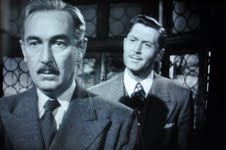
Showing posts sorted by relevance for query frank faylen. Sort by date Show all posts

Thursday, March 21, 2013

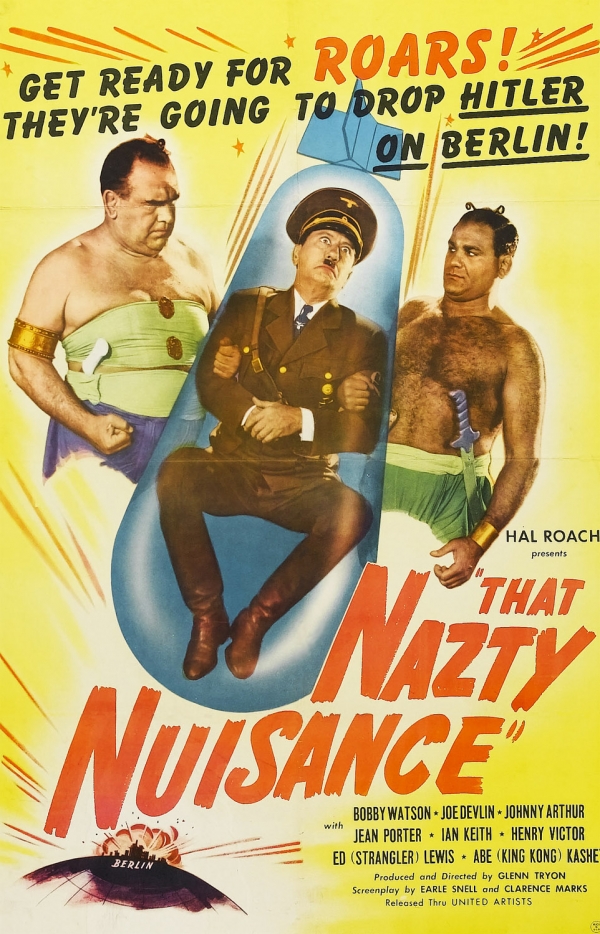
MOVIE OF THE DAY: "NAZTY NUISANCE" (1943)


When last we saw Adolf Hitler, he was being tortured by Satan's minions in the finale of The Devil with Hitler, Hal Roach's 45-minute "Streamliner" comedy. Either there was overwhelming demand for another Hitler farce or Roach's writers were unable to come up with anything new, because two years later came Nazty Nuisance, another slapstick epic featuring the axis punching bags getting their comeuppance, only this time by American soldiers and an orangutan. With a logline like that, you wouldn't expect it to be the 1943-model of Zero Dark Thirty, but that's exactly where it leads to. But more on that later.

Even though their characters were killed off in their previous appearance, Bobby Watson and Joe Devlin repeat their landmark roles as Hitler and Mussolini, making this perhaps Hollywood's first prequel. Johnny Arthur replaces George E. Stone as their Japanese counterpart Suki-Yaki. (What, two years since the first movie and the writers still hadn't heard of Hirohito?) Once again, Der Fuhrer is trying to double-cross his fascist friends, this time by signing a worthless peace treaty with Chief Paj Mab, the ruler of Norum (pronounced "No room"), an island in the Pacific. Mussolini and Suki-Yaki tag along to keep an eye on things. Only when a clever group of American seamen are washed-up on Norum are things set to right via a phony magic act.

Clearly, anyone expecting another The Devil with Hitler won't be getting their money's worth here. As movie follow-ups go, Nazty Nuisance isn't even The Godfather 3, and that featured Sofia Coppola in a major role. The problem, as usual in these kinds of situations, is the idea itself. Nazty Nuisance lacks not only the bizarre story of its predecessor, but an exact title as well. The posters say That Nazty Nuisance. The movie credits read simply Nazty Nuisance. Maybe somewhere there's a preview where it's called Nuisance.

Ma, he's making eyes at me...
Striving for the bloodcurdling verisimilitude that The Devil with Hitler by and large avoided, Nazty Nuisance opens with a scene featuring Hitler meeting with his inner circle. Unfortunately, the prop man must have been at lunch, since the opening tracking shot is disrupted by a very obvious bump by something on the floor. In his brief role, former Laurel & Hardy director/gagman Charley Rogers actually bears a resemblance to Josef Goebbels. Had the movie focused on Hitler's gang, it would've made for a more interesting satire. But then it wouldn't have been a cut-rate Hal Roach movie.

Almost the real things.
Joe Devlin's Mussolini, as usual, doesn't disappoint -- he looks more like Il Duce than Il Duce -- and gets cheap laughs pretty easily through sheer, idiot bluster. Unfortunately, after George E. Stone's outrageously insulting "yellowface" Suki-Yaki in The Devil with Hitler, Johnny Arthur's attempt at realism is something of a letdown. Your definition of realism, however, may have to do with your ethnic background.

Frank Faylen (right)  puts the double-whammy
on Johnny Arthur.
On the other hand, it's always a treat to see Frank Faylen (Address Unknown) as your stereotypical  down-to-earth American -- here, Seaman Benson, who disguises himself as a magician in order to entertain, then capture, the axis leaders. One of those great utility actors, Faylen was believable in comedies, dramas and whatever Nazty Nuisance is.


Benson messes with the three despots by making them physically ill at dinner. I admit, without shame, to have found Hitler's reactions -- pop-eyed from eating a stew filled with hot pepper, pretending to enjoy a glass of kerosene substituted for wine -- hysterically funny. Having been laid low with an intestinal flu at the time, my only excuse is that my defenses were down. Yet that photo on the right still makes me laugh every time I look at it. So, yes, it is funny whether I'm sick or not.

Three men and a monkey.
Once the orangutan turns up, it's every homo sapien for himself. Benson initially convinces Hitler and Mussolini that he's turned Suki-Yaki into the simian, who proceeds to get drunk on a flask of wine. Naturally, this leads to a pillow fight involving the remaining two axis leaders and Hitler's aide, all of who are dressed in their long-johns -- a comedy standby when you run out of other ideas. Come to think of it, so is drinking kerosene. Did people really keep cans of that stuff lying around the kitchen back then?

"Don't worry,  Code Pink will bail us out."
The bad guys return to their submarine, only to discover that it's been taken over by the American sailors -- and here's where it starts to resonate with today's unsuspecting audience. Locking them in an airtight area aboard the sub, Seaman Benson is ready to go all Abu Ghraib when he hears Hitler boasting of the German navy torpedoing a refugee ship and machine-gunning the lifeboats. But the Captain stops him, reminding him, "It's against the rules of international warfare. Prisoners of war have gotta be treated with respect." I had to rewind to make sure this guy's name wasn't Eric Holder.

Once the Captain is out of earshot, though, Benson engages in psychological torture, making the prisoners believe that the sub is sinking to the bottom of the ocean. Frightened like little girls, the three quickly blame each other for their predicament, driving them to physically abuse each other without Americans getting involved. Memo to CIA: That's the way it's done.

You'll believe a fascist really can fly.
Benson avoids being frogmarched to a court-martial only because the sub really does blow a gasket. The crewmen help the axis "escape" by shooting them out of the torpedo launcher. (The Captain reluctantly allows Benson to kick Hitler in the rear before the hatch closes.) The sight of them flying out of the sub is provided by the Roach animators, who hadn't improved one iota since they created a mouse for Laurel & Hardy's Brats in 1930. The fascists land heads-down in the sand, their legs kicking like mules above them... and that's where the movie stops, the Streamliner having reached its required 45-minute mark. The studio was probably hoping the critics would demand another follow-up just so they could refer to Hal Roach's Hitler Trilogy.


Admitting that The Devil with Hitler is better than Nazty Nuisance is like preferring ballpark franks to dirty water hot dogs. Really, what can one say about a movie where the comic highlight is Mussolini getting socked in the face with a pillow wielded by a drunken orangutan? And yet, overall the movie plays pretty well in my memory. Even the sets, no more believable than a grade-school play, provide a pleasant reverie. I'm a sucker for such things.

The cast went on to other, though not necessarily bigger and better, things. Joe Devlin put his Mussolini to use in two other comedies throughout his 30-year career. Johnny Arthur racked up over 100 roles but, like Devlin, his most familiar character was the reliable Uncredited.  

Bobby Watson portrayed Hitler, sometimes in dramas, nine times. He made his final movie, Vincent Minnelli's The Four Horseman of the Apocalypse, in 1962, playing -- well, whaddaya know -- Hitler. He was 74, almost 20 years older than Der Fuhrer at the time of his death. By then, the actor was billed as Robert Watson -- as if trying to escape a past that Hollywood would never let him forget.


                                                  **************************** 
New to the blog? Click here to read about The Devil with Hitler. Your life will never be the same.

Thursday, August 24, 2023

THE EARLY SHOW, PT. 22

 The little lady was out of town for a week, allowing me to catch up on several movies building up on the DVR queue that wouldn't necessarily be up her alley. But how much of what I like really are? Here are just four of them:

CURTAIN CALL (1940): Broadway producer Jeff Crandall and director Donald Avery want to get even with actress Charlotte Morley, who's leaving their employ at the end of her contract, by demanding she star in a terrible play written by the young, first-time writer Helen Middleton. Crandall and Avery believe Morley will refuse the part, thus allowing them to sue her. Unfortunately, she loves the play, forcing Avery to woo Middleton in order to let him rewrite it into a farce in order to save his and Crandall's reputation.

Unlike dramas or gangster pictures, B-comedies tend to be a tough watch. But Curtain Call is the rare exception that, with 15 extra minutes and a bigger budget, could easily have passed for an A release. Barbara Read, as the clueless playwright, happily allows the rest of the cast chew the scenery as if they hadn't eaten in weeks, with Donald MacBride and Alan Mowbray (Crandall and Avery) having the biggest appetite of all. Dalton Trumbo's dialogue is so sophisticated and often hilarious that the quieter scenes with Helen Middleton and her hometown suitor John Archer seem like they were written by someone else.  

The idea of a middle-aged guy faking love with an innocent woman barely out of her teens sounds iffy today, but is played so absurdly that only the usual hair-trigger Twitter crowd would take offense. And while Helen Middleton proudly stands up for herself by refusing any rewrites, it's also made quite clear that her play really does stink from here to Sunday. (Avery's fast-talking press agent describes it as "a hangover on paper.") While it wouldn't necessarily work as a movie today, a smart Broadway producer could turn Curtain Call into a crowd-pleasing stage farce without having to pretend to fall in love with the writer.

BONUS POINTS: The always-welcome Frank Faylen (Dobie Gillis' father on TV) from Natzy Nuisance and Address Unknown plays the press agent, while Alan Mowbray portrayed Satan in The Devil with Hitler.


BLUES IN THE NIGHT (1941): Anticipating Syncopation by a year, Blues in the Night is the story of a New Orleans-inspired band led by Jigger Pine. Only here, the musicians are playing in a New Jersey gin joint run by Sam Payras, who, along with the club's thrush Kay Grant, two-timed their cohort Del Davis after a bank robbery years earlier. Davis has returned with the band in order to open an illegal gambling room upstairs. Jigger finds himself falling hard for the no-good Kay, and takes off with her to join a money-making orchestra. After a stint in the psych ward (playing dopey music for Manhattan swells literally drives him crazy) Jigger returns to his old band in Jersey, where a showdown involving him, Del, Kay, and the bar's clean-up guy Brad Ames, turns fatal for three of them.

Just one of countless examples of a poster promising one thing and the movie delivering another, the semi-noir/musical Blues in the Night should have a better reputation. Director Anatole Litvak (City for Conquest) does a great job with the camera, whether using it as the keyboard's point-of-view for Jigger's hands as he plays piano, or his bizarre mental breakdown. Litvak also cast the movie with plenty of interestingly unattractive character actors: Richard Whorf as the hot-tempered Jigger; Lloyd Nolan as the slimy Del Davis; Howard da Silva as Sam Payras (who makes the mistake of wanting to drop a dime on Del); Billy Hallop, Peter Whitney, and Elia Kazan as members of the band; and, perhaps best of all, Wallace Ford as Brad, described more than once as Kay's "crippled stooge." Once an annoying comedic actor, Ford's talent grew as he eased into dramatic supporting roles. He gives the most subdued performance here, not exactly stealing the movie but being the most grounded in reality.

Jack Warner probably panicked when he saw this defiantly non-box office crew and insisted on tossing in audience favorites Jack Carson and singer/starlet Priscilla Lane as trumpet player Leo Powell and his wife named Character. (I bet ten bucks this was an in-joke by writer Robert Rossen.) While just missing the designation of "classic" by a G-major chord, Blues in the Night is definitely worth its $2.99 price on streaming services. And yes, the legendary title number was written for the movie. It lost the Academy Award for Best Song to "The Last Time I Saw Paris", which nobody sings anymore. Not-so fun fact: A decade after Blues in the Night's release, Elia Kazan, Howard da Silva, and Robert Rossen were caught up in the HUAC red scare investigation.

BONUS POINTS: Don Siegel, credited with the movie's montages, would later become a director, best known for Dirty Harry 30 years later.


STOLEN FACE (1952): Take a jigger of Hitchcock's Vertigo, mix with a shot of Steve
Martin's The Man with Two Brains. Shake well and pour yourself a tangy Stolen Face. Dr. Phillip Ritter falls in love with concert pianist Alice Brent. Learning that she's engaged to another man, Ritter returns home and performs plastic surgery on Lily Conover -- a prisoner whose crime wave started after an accident left her face badly scarred -- to make her look like Alice. Of course, marriage immediately follows because, well, he's a doctor, he knows what he's doing, even when he chooses her wardrobe. But Ritter learns the hard way it takes more than a pretty face and a nice dress to change a sociopathic criminal. Oh, and guess what concert pianist returns to Ritter's life after her engagement breaks up? 

A UK production from Hammer, and something of a preview of their later horror movies, Stolen Face makes sure we know early on that Ritter isn't some crazy doctor because... um... he doesn't charge poor patients! Therefore, it's perfectly understandable that the lovesick guy wants to physically recreate the woman he loves onto someone else's face. And he's played by Paul Henreid, the heroic fighter of Nazis in Casablanca, which only increases our sympathy, especially when Alice takes on the habit of shoplifting furs and jewelry, turning their home into her own private dance hall, and taking up with a new lover. Come to think of it, this doc is too stupid to deserve anybody's sympathy.

The double role of Alice/Lily goes to Lizabeth Scott, who was created herself by Warner Brothers as a Lauren Bacall substitute, right down to the throaty delivery. But while she never really got the same acclaim, Scott pulls off a performance that Bacall couldn't have matched; even though her "Lily" voice was dubbed by someone else, Scott looks different in both roles even while, of course, identical. You can tell, however, Stolen Face's modest budget when, at the climactic showdown between the two women, Scott is never seen as both women in the same shot. No matter -- one of them gets what she deserves.

BONUS POINTS: A bit of production sloppiness occurs when Henreid is walking in front of a back projection of Picadilly Circus. A movie theater in the background is running Joan of Arc starring Ingrid Bergman, which was released five years earlier. And no, I don't know why this is a bonus, other than it shows what a smarty-pants I am.

MACHINE GUN MCCAIN (1969): Freshly sprung from prison after 12 years, armed robber Hank McCain is offered a lucrative "job" by his 20 year-old son Jack: clean out the safe from the Royal Casino in Las Vegas. What Hank doesn't know is that Jack is working for Charlie Adamo, a Mafia lieutenant trying to take over the Royal without the permission of his bosses. But Hank has his own plans for what he's going to do with the money, while "the boys" back East are going to deal with these jokers their own way.

If B-movies were still a thing 1969, Machine Gun McCain would have been one of them. It's one of those European productions -- in this case, Italian -- where the producers hired a couple of recognizable American actors as the leads in order to make gullible Yanks think it was a Hollywood movie. John Cassavetes (McCain) probably took the job to finance Husbands, while telling Peter Falk (Adamo), "What the hell, it's easy money and we spend a few weeks in Vegas shooting guns." They, Britt Ekland and "guest star" Gena Rowlands (Mrs. Cassavetes) pretend to take it seriously, and are probably the only actors who dubbed in their own dialogue, typical on Italian movies where it always seems like the voices are coming from somewhere other than the set.

There's plenty in Machine Gun McCain that wouldn't fly today, like a typical boy-meets-girl scene of the time where McCain's attempted rape of Irene actually turns her on and leads to marriage the next day. McCain's plan to set off several bombs throughout Vegas to distract cops from the robbery would be condemned for inciting a round of homegrown terrorism. Probably the most interesting thing in the movie is how the Mob, still controlling Vegas in 1969, has more or less the entire population on their payroll, as everybody from cab drivers to college students are given photos of McCain and Tucker after the couple pull off the robbery. 

Machine Gun McCain is no Godfather, but fits the bill if, like me, your wife is away and you're in the mood for some entertaining trash made by professionals who can at least keep the camera in focus. (By the way, if you're interested in seeing a movie that shows the genuinely ugly gangster life, watch the 1971 Michael Caine drama Get Carter. It's too good for this blog.)

BONUS POINTS: Machine Gun McCain is the only movie I've ever seen where the credits admit it was "freely adapted from" rather than "based on" a novel, while the cinematographer is listed under the old school appellation of "cameraman". In fact, I don't think I've ever seen that word in any other movie.

                                                           ************

Wednesday, February 6, 2013

MOVIE OF THE DAY: "ADDRESS UNKNOWN" (1944)


Many, perhaps most, B-movies were content to stay in their own little boxes -- quick little pictures meant to entertain with little thought as to quality. Nothing wrong with that, of course; not every movie can be The Magnificent Ambersons. Or should be, for that matter.

Then there are others, like Address Unknown, that go beyond their genre into full-fledged greatness, demanding to be recognized as such. Address Unknown fits its title -- a movie that over time, perhaps in its time, was lost in the shuffle. It is a movie about the destruction of one man's soul, where family takes second place to power, evil literally steps out of shadows, and the simple ringing of a mailman's bicycle bell creates feelings of dread. It's the best Hitchock film that Hitchcock never made.


Taking place shortly after Hitler's rise to power, Address Unknown is the story of Martin Schultz, a German immigrant living in California who returns to the Fatherland, leaving behind his business partner, Max Eisenstein. Accompanying Martin are his family and Max's daughter, Griselle. Griselle intends to study acting in Europe before returning to the USA to marry Martin's eldest son, Heinrich, who's staying in California.

A good man by nature, Martin soon comes under the spell of Baron von Friesche, a mid-level government official. Over time, Martin becomes a happy cog in the Nazi machine,  eventually cutting off all communication with his Jewish friend Max. When Martin refuses to give shelter to Griselle, who is on the run from stormtroopers, we know that he's lost any sense of humanity.


Soon, strange coded messages, with Max's return address, start arriving at Martin's door. As these letters are read by government censors, Martin comes under suspicion of treason. His wife Elsa, sickened by Martin's transformation from family man to Nazi monster, leaves Germany with their children.

The coded messages come faster, as do the threatening visits by Baron von Friesche. One night, Martin's growing paranoia finally gets the better of him -- for good reason, as he hears the grim march of stormtroopers approaching his front door.


While there is no doubt that Herbert Dalmas' adaptation of Kressman Taylor's novel deserves commendation, the power of Address Unknown ultimately comes from director William Cameron Menzies and cinematographer Rudolph Mate, two talents not generally associated with B-movies. Menzies' credits (as director and art director) include Things to Come, The Thief of Baghdad and 1933's Alice in Wonderland. Mate was no slouch in the classics department, either, having worked with, among others, Alfred Hitchcock, Ernst Lubitsch and Orson Welles. That Address Unknown was a labor of love (if that's the right phrase) is undeniable from the very beginning. The unusually tight close-ups of Martin and Max toasting a new future signal that this is will be no ordinary programmer. 

Menzies and Mate must have studied Citizen Kane long and hard, for Address Unknown visually evokes that masterpiece throughout its 75-minute running time. Still, it's vital to point out that Address Unknown stands on its own two feet -- rarely has a movie with such a short running time been so jam-packed with memorable images.

A recurring image in Address Unknown is the little Nazi who looms large simply by his surroundings: Martin in his office (left) and the government censor at a theater where Griselle is rehearsing her play (right). 


The motif is echoed in the Baron's first scene 
(left) and ironically when Max receives news of his daughter's death (right).


Yet close-ups play a vital role in creating terror, whether it be the government censor       (left) or the mob at the theater going after Griselle (right).


Movies made following World War II often portrayed the Nazi high command with cool, ironic detachment. Those released in the thick of it, however, had no problem portraying the ugly world of Nazi Germany. (That's the difference between trying to win a war and win an Oscar.) Address Unknown is no different. Again, the visuals come into play. Whether standing in the shadows or looming over Martin threateningly, Baron von Friesche is never less than a frightening presence.


Along with Baron von Friesche, the horrors of Nazi Germany are reinforced when Jewish shop-owners cower in fear as their store window is smashed (left) while "good" Germans look on in approval (right).

While Martin is the key figure in Address Unknown, it's the character of Giselle who has some of the strongest scenes -- and unwittingly sets the stage for Martin's downfall. She's been rehearsing her play when the censor (Charles Halton, in a brilliantly demonic performance -- just watch the way he spits out the word "artists") demands three Biblical passages be cut from the play: Blessed are the meek for they shall inherit the earth. Blessed are the peacemakers for they shall be called the children of God. Blessed are those who are persecuted for righteousness' sake for theirs is the kingdom of Heaven. When Giselle recites the lines on opening night, the censor stops the show and forces her to announce her real last name (Eisenstein) rather than her stage name (Stone). Cries of "Juden!" come from the audience, which rushes the stage in an attempt to kill her.

Giselle makes her escape to Martin's house. With the troops in hot pursuit, Martin turns her away, whispering, "Go away! You will destroy us all!" As Griselle's registers a sad acceptance of her fate, Martin shuts the door. A moment later, we hear a woman's scream and three gunshots. Martin stares blankly at the bloody handprint she left behind on the wall.

Helping create a sense of realism in Address Unknown is the unfamiliarity of today's audience with the cast. To put it another way, when the character of Rick is introduced in Casablanca, our immediate thought is, "Ahh! Bogie!" Paul Lukas (Martin), Morris Carnovsky (Max), K.T. Stevens (Griselle), Carl Esmond (von Friesche), on the other hand, are unknown now and, thus, are immediately accepted as their characters first, rather than as themselves. The only actor remotely recognizable is Frank Faylen (right), who was to gain lasting fame on TV as Dobie Gillis' exasperated father.


Interesting, too, is Paul Lukas. His resemblance to Walt Disney is at times startling -- all the more so since Disney was said to have been an early admirer of Hitler. Was this the moviemakers' way of sending a subtle message to otherwise uknowing audiences?

When I started writing this, I was both excited and hesitant to go into detail about the movie. Excited because it unexpectedly, wonderfully knocked me out of my seat. Hesitant, because I wanted people to notice its treasures with fresh eyes. Excitement won the day.

Address Unknown is on Amazon, presumably in the same pristine version recently run on TCM. Break out the credit card; it'll be the best eighteen bucks you've ever spent. Ripe for resdiscovery, Address Unknown is a classic hiding in plain sight and is guaranteed to stand up to repeated viewings.

And as for the meaning of its title -- well, that's all made clear in its shocking denoument...

Which you'll have to find out for yourself.


                                                                  ****************
(Note: all photos with the bluish tint were taken by me off our TV.)