Showing posts with label LEW AYRES. Show all posts

Monday, May 11, 2026

THE EARLY SHOW, PT. 68

 Two features, two shorts, two dictatorships. You'll understand.


IRON MAN (1931): No, this isn't the pre-code version of the Marvel Universe franchise. And just because it was directed by Tod Browning doesn't make it a horror movie, either. Iron Man is simply a run of the mill boxing melodrama made interesting only by 20-year-old Jean Harlow as Rose, the no-good wife of boxer Kid Carson. After having left him during his lean years, Rose suddenly shows up when he becomes the champ. Kid's manager George knows the score and tries warning Kid that the missus is using him strictly as a gravy train -- and as a new client for her sleazy sidepiece named Lewis. 

I don't know what drew Browning to Iron Man, seeing that it was outside of his usual wheelhouse. In fact, the only reason I stuck with it was because I had just finished reading the novel on which it was based. It was actually impressive how the movie included all the main characters (although Kid Carson is named Coke Carson in the book) and successfully compressed the story into its runtime. Too, the actors -- Harlow, Lew Ayres as Carson, Robert Armstrong as George, and John Miljan as Lewis -- fit my vision of the lead characters. 

The problem comes with everything else. Tod Browning's direction is sluggish, with zero style differentiating it from anyone else's work. Acting veers between awkward and histrionic. On the written page the story in involving, while onscreen is depressing, made worse by current unrestored prints being more beat up than Kid Carson after his climatic fight. (The many splices shorten the run time from its original 73 minutes to 68.) At the final bell, Iron Man loses by decision (mine). For Lew Ayres completists only. And you know who you are,

BONUS POINTS: While I usually object to movies changing a novel's ending, the very brief tacked-on scene offering a glimmer of hope to Kid and George was welcome after such a dismal experience. 


ATTORNEY FOR THE DEFENSE (1932); The early '30s were lousy with legal movies
-- Counsellor-at-Law, 
State's Attorney, The Mouthpiece, For the Defense, Lawyer Man -- and those are just the ones with Warren William, John Barrymore, and William Powell. 

Columbia got into the act with Attorney for the Defense starring Edmund Lowe as former New York D.A. William Burton, who has been caring for the widow and son of an innocent man he sent to the hot squat. Paul, the now-college age son, is seduced by Burton's ex-sweetie Val in order to get her hands on evidence that would convict her current bf guilty of extortion. That same evening, Burton, having found Paul passed out in the presence of Val's dead body, tells the kid to hit the road, but sticks around at the crime scene in order to get arrested. Burton defends himself in one of those climactic courtroom scenes that are more exciting than the real thing and would likely lead to a mistrial. 

Evelyn Brent is quite good as Val, the biggest jezebel since the real Jezebel and, at 36, was Hollywood's idea of a "middle-aged" well-dressed floozy. And what was likely a one-day shoot, Dwight Frye steals the opening scene as the innocent man put to death by Lowe. 

As with William, Barrymore, and Powell, Edmund Lowe is sophisticated, dressed to the nines -- maybe the tens -- even when he's sitting in the stir waiting for his trial. He also has the same crisp diction that gives his racy pre-code dialogue a real snap, especially when, early on, he catches Val with another man in her apartment. That Lowe has been forgotten is a crime itself, for he's the equal of the other three actors, making Attorney for the Defense a worthy addition to your next pre-code legal film festival.

BONUS POINTS: A lawyer named Abe Steiner trots out the usual Jewish tropes, even dropping the word "tsuris" while speaking to Burton's secretary. And in her own non-Jewish trope, she disgustedly wipes her face where he affectionately rubbed his hand. Yeesh.


RED REPUBLIC (1934): Back in the early days of the Depression, gullible people in the media tried to sell America on Russia's "worker's paradise" balderdash. Photographer Margaret Bourke-White did her bit by making the one-reel travelogue Red Republic. The color refers to the Communist flag, not the blood of the six-to-nine million people killed by Stalin. 

Red Republic starts innocently enough with a brief look at a village on the Caspian Sea, where camel-driving workers live in apartments outfitted with shower baths -- "and in Russia," the narrator adds, "shower baths stand for culture!" I thought running water stood for hygiene. Seems like you learn something new every day in the Motherland!

We then check out the oil fields. Whoever wrote the narration doesn't seem to understand the concept of irony when explaining that after taking over the fields from the rapacious Western countries, the Communist government had to hire Americans to build wells that actually worked. Same thing with the massive Dnieper Hydroelectric Station constructed under the supervision of "the same Col. Cooper who built the Hoover Dam". Seems like capitalism had its positives after all.

There are a few bits and pieces that sound good, such as how the government pays couples to get married, go to college, and help cover the cost of apartments with, of course, shower baths. The problem comes during the "workers parade" when we're told, "Russia is going onward and upwards at a steady pace." So were the show trials, executions, and government-created famines. But the women got to work side by side with men, so that made up for it.

BONUS POINTS: Rare footage of Stalin's mother, who, the narrator promises, is "proud of the tremendous things he is doing". Do I have to make another joke about government-sponsored killings?


TRAN UND HELLE (1940): And speaking of garrison states... Starting in 1939, newsreels from Germany's UFA studio featured an occasional segment featuring characters named Tran and Helle. Kind of a Deutsch Abbott & Costello, Tran was a chump forever listening to the Allies' propaganda or taking advantage of wartime challenges on the homefront, while sophisticated straightman Helle eventually put him on the straight and Nazi.

In this chapter, a well-lubricated Tran weeps about the French populace suffering under the Nazi jackboot. Downing his seventh cognac, he recounts all the wonderful things the alleged enemy had contributed to world culture. Helle patiently explains that the French were asking for it; if Hitler withdrew, France would only invade Germany like they always do. Tran sees the error of his ways and decides to hate the French after all. 

Just under six minutes long --twice the average length of these shorts -- this was one of the last Tran und Helle releases. Someone in the government must have realized that Tran was starting to make sense to most clear-thinking Germans. (In other shorts, Helle had to convince Tran it was a good thing Hitler lied to his citizens and made listening to the BBC punishable by two years in prison.) Moviegoers were probably wondering, too, if the war was such a great thing, why wasn't Helle gung-hoing to the frontlines instead of knocking back Lowenbraus with a supposed dolt who didn't know what he was talking about? If you ever want to understand what "unintended consequences" means, Tran und Helle is example nummer eins

BONUS POINTS: A year later, Ludwig Schmitz -- the former SS member who plays Tran -- was banned from movies for "unworthy behavior". As with the French, I'm sure he was asking for it.

                                                             ###############


Friday, April 12, 2024

THE EARLY SHOW, PT. 34

 Strictly by coincidence, this Early Show has two "bringing the dead back to life" movies, and two TV shows from the early 1960s. If you've seen any of these, the next drink's on me. On a Zoom call, I mean.


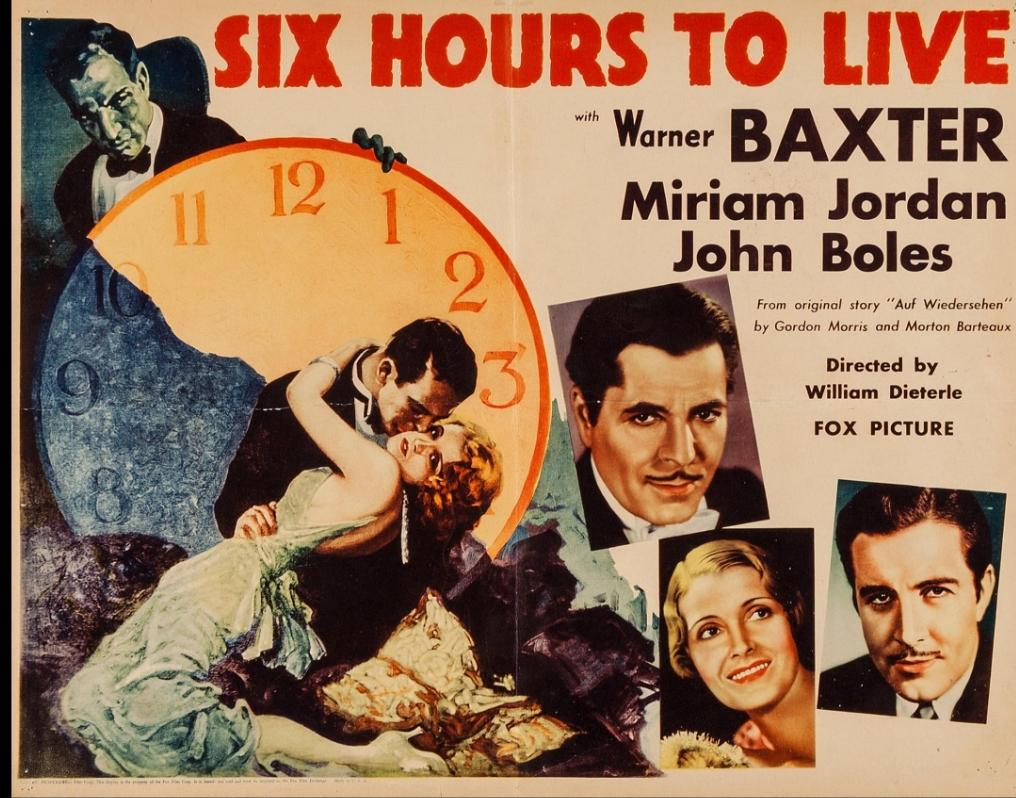
SIX HOURS TO LIVE (1932): Paul Onslow, an ambassador of Sylvaria, has been assassinated by an unknown person. Good news: The police commissioner has a friend who's invented a machine that can bring the dead back to life. Bad news: They can stay alive only six hours. (You'd think he'd have worked a little harder on fixing that glitch.) Onslow will use that time to have dinner, explain to the woman who loves him that he's no longer the marrying kind, find the guy who killed him, and remind the police commissioner that death is scary only in your mind. I'd have dropped a couple of tabs of acid, but to each his own.

Sci-fi, horror, and politics were hot stuff in the early '30s movies. Six Hours to Live manages to combine all three genres, along with a dash of romance. Onslow is the only representative who refuses to sign a pact involving international finance, believing that it's a cover for the major governments to make out like bandits while their citizens get nothing. He isn't wrong -- that's why someone at the table wants him out of the way in order for a substitute to vote yea. Otherwise, the pact is null and void, as Onslow will be in a few minutes. Once revived, he has a new appreciation for life, taking a moment to help a streetwalker (money only!) and a little flower girl (ditto). Onslow doesn't even kill his assassin, preferring that the guy suffers "a living death". Today, that's known as, well, life as we know it.

Six Hours to Live's political angle was typical for its time, being a mildly progressive subplot that drives the story. Warner Baxter makes Onslow the rare rich guy in a silk cape who's on the side of the little man. (The cape also gives a Dracula-vibe when he's closing in on his killer.) Nor does he overdo his (second) death scene. Wilting like a flower, Baxter rests alongside a tree as a beatific gaze passes over his eyes as the end comes. Director William Dieterle (Syncopation) provides style perfectly fitting all the genres the movie covers -- the life-revival scene could fit in any horror movie of its time. It's just too bad that, as usual, Six Hours to Live's print on YouTube is bleary and over-pixilated. The Musuem of Modern Art possesses a restored version, but you have to be, you know, a scholar to access it. Ergo, I advise you to skip Six Hours to Live as it appears online and wait for someone at MOMA to drop dead for six hours so you can sneak in and see their print. (Kidding, MOMA, kidding!)

BONUS POINTS: Two years earlier, co-stars John Boles and Marilyn Harris were in Frankenstein, as Victor Moritz and the little girl who gets thrown in the lake respectively (if not respectfully).


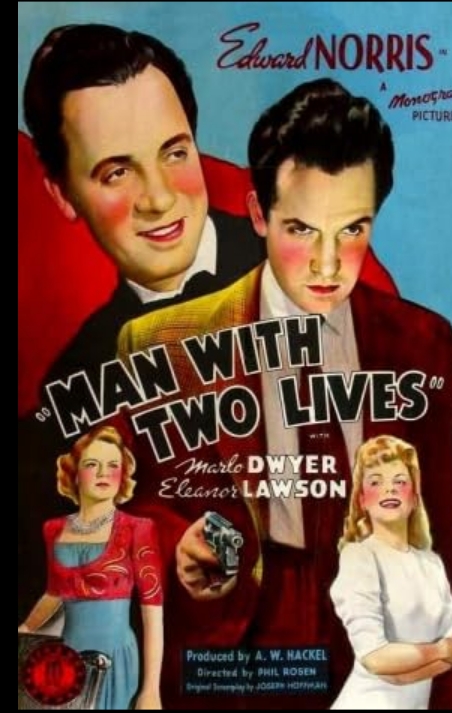
MAN WITH TWO LIVES (1942): When nice guy Phillip Bennett dies in an auto
accident, his father asks Dr. Richard Clark to make good on his reviving-the-dead experiments. Good news: it works! Bad news: the soul of a gangster named Panino, who was executed at the same time, enters Phillip. Why don't these scientists ever take these things into consideration? 

By the 1940s, only a B-movie outfit like Monogram would try pulling off a sci-fi/ gangster hybrid like Man with Two Lives. And gosh darn it, the thing works -- up to a point. One-time A-list supporting actor Edward Norris plays the title role -- or roles -- convincingly; his transformation into a cold-blooded gangster is something of a shock, as is his blunt romancing of Panino's trashy moll Helen, along with his growing hatred of his loving family and fiancée Louise. Even Panino's gang is scared of him. Yet you can see something of the good Phillip underneath the monster from time to time, giving his character a complexity not usually seen in B's. You actually start feeling sorry for him -- here's a guy through, no fault of his own, is on a very obvious self-destructive path, thanks to an ill-considered wish from his loving father and twisted brilliance of a scientist...

Which is probably why at the very end, Man with Two Lives goes kablooey when the story turns out to be a nightmare suffered by Phillip during a four-day coma following the accident. I hate when that happens, especially in a movie as good as this. Had Man with Two Lives (couldn't Monogram afford a "The" in the title?) been a pre-code from a decade earlier, Phillip would have been shot by a cop as he was here, but too damn bad about how it wasn't his fault. His father and the scientist would be condemned to a lifetime of guilt; his fiancée would never know a day's happiness from then on. Doesn't that sound like a better picture?

BONUS POINTS: Phil Rosen, the director of Man with Two Lives, showed how powerful a gloomy climax could be with his previously-discussed Monogram pre-code The Phantom Broadcast. 


DR. KILDARE (UNAIRED PILOT) (1960): It isn't unusual for a TV series to undergo cast
changes before its premiere. Dr. Kildare went a step further to change the lead actor and concept. For the pilot, Lew Ayres was brought back to recreate his starring role from MGM's nine Kildare movies from 1938 to 1942 (and 1950 radio series).  No longer a young intern, he's now chief diagnostician at Blair General Hospital. And as Dr. Gillespie mentored him decades earlier, so Kildare mentors the young intern Dr. Grayson. The circle of life and all that.

Lionel Barrymore, the original Gillespie, was six years dead but not forgotten, as his portrait hangs in Kildare's office. Ayres even quotes a line of dialogue Barrymore spoke in one of the movies (a reference to a "mentally retarded ringtail baboon" wouldn't make the cut today). The story itself -- Kildare wanting to keep Dr. Grayson at the hospital rather than allowing him to go into private practice -- is a remake of one of the early Kildare movies. (Don't ask me which; they all blend together in my memory.) Kildare goes behind Grayson's back to upset his plans, causing a brief rift between the two before amends are made during a run-up to brain surgery, no doubt a common event in busy hospitals during the overnight shift.

As when he was the young Kildare, Lew Ayres is a warm, comforting presence; you'd want him as your GP even if he didn't accept insurance.   Joe Cronin is serviceable the role of Dr. Grayson -- but why didn't that part go to the charismatic, 24-year-old Robert Redford instead of the brief uncredited role he has here? No matter. Lew Ayres and MGM parted ways when his request that Dr. Kildare not be sponsored by cigarettes was refused. (Who did this guy think he was, a doctor?) The studio revived the original idea of young Dr. Kildare mentored by the wise Dr. Gillespie, giving Richard Chamberlain and Raymond Massey a comfortable five-year run shilling cancer sticks between visits to the O.R. It's my personal diagnosis that this was the first example of TV producers trashing the older audience in favor of younger, primarily female viewers. Now pay the receptionist on the way out.

BONUS POINTS: The Kildare pilot was directed by John Newland, the director and host of One Step Beyond. Olan Soule, one of the most familiar character actors in TV history, plays a doctor. Do a Google Image search; if you're of a certain age, you'll automatically say, Oh, that guy! 


ONE STEP BEYOND: "THE SACRED MUSHROOM" (1961): Next to The Twilight
Zone,
 One Step Beyond was my favorite spooky show during childhood. The difference between the two was that One Step Beyond was based upon true stories -- maybe. As host John Newland explained at the end of the episodes, nobody could prove or disprove their veracity. For a gullible eight year-old, that was good enough.

One episode, titled "The Sacred Mushroom", couldn't be disproved, though, because it wasn't a dramatization at all. Newland and his crew travelled to a village in Mexico to investigate a 'shroom that, when ingested, allegedly provided the gift of ESP.  After bribing some locals with medicine, Newland and his pals are able to meet up with a shaman at a midnight ceremony, where a missionary and two American scientists eat the 'shroom. Aside from the missionary getting an embarrassing case of the giggles, the Yanquis show zero side effects. The shaman does correctly diagnose one of the scientist's heart problems and, while he's at it, solves a local burro theft, which makes me wonder if med schools and police academies are a waste of time and money.

Eventually it's time for Newland himself to get in on the action. Under the care of a certain Dr. Baharish, Newland first needs to take an ESP test while sober. When he flunks that, it's time for the mushroom, which leaves him feeling "fine" and "strong", along with a sense of "well-being". (My experiences with mushrooms leaned more toward "goofy as hell".) Following a round with a strobe light, which leaves him seeing colors while his eyes are closed, it's time for a repeat of the ESP test, where he now scores higher than before. Personally, I would have been more convinced if he had found a stolen burro. "The Sacred Mushroom" promises more than it delivers -- I was hoping for Newland to yell, "The walls are melting!" -- but when was the last time you saw a 1961 TV show where someone ate a (semi) magic mushroom?

BONUS POINTS: "The Sacred Mushroom" was One Step Beyond's most popular episode. It was also the only one not to go into syndication after its original network run. I wonder if John Newland saw that during his 'shroom trip. 

                                                               ************

Thursday, March 28, 2024

THE EARLY SHOW, PT. 32

 It pays to have subscriptions to arcane YouTube channels. They allow me to discover movies and TV shows that I would have otherwise missed, and you to learn about. Lucky you(?).

NIGHT WORLD (1932): Got an hour? Drop by Happy's Club on East 53rd Street, where owner Happy MacDonald is dealing with a bootlegger trying to muscle in on his territory. Club choreographer Klauss is having a little horizontal refreshment with Happy's wife Jill, who's trying to get her husband out of the way, permanently. Tough guy Ed Powell is putting the moves on showgirl Ruth Taylor. Ruth, immune to his "charms", is trying to nurse Michael Rand back to sobriety following the love-triangle murder of his father by his mother. And club doorman Tim Washington is waiting for word on the condition of his hospitalized wife. Make sure to duck when five people in a row are shot to death. Check, please!

How is it that a studio could release a 57-minute movie that packs more storylines than this year's lengthy Oscar-nominees combined, yet takes place in just one evening? Night World is kind of a prototype of the previously discussed Club Havana but with pre-code elements: sex, violence, bootleg booze, adultery, double-entendres, sexy showgirls in skimpy outfits under the tutelage of Busby Berkley, and a running gag involving a gay man. While the budding romance between Ruth and Michael is the main plot point, it's the other characters and situations that keep that Night World chugging along. I mean, what do you want to see, a couple of kids falling in love, or gangsters, guns, and slinky dancers in their dressing room?

Lead actors Lew Ayres and Mae Clarke are fine as Michael and Ruth, but it's the co-stars we've come to see. Fresh from his star-making turn in Frankenstein, Boris Karloff is no less threatening as Happy MacDonald, whose nickname and friendly smile don't disguise the violence lurking underneath. George Raft makes what he can of his brief appearance as the slick yet crude Ed Powell, one of his earliest credited roles. As Mike's shockingly cruel mother, Hedda Hopper gives us a taste of her future gossip columnist style. But it's black character actor Clarence Muse who, as in Black Moon, proves himself at least the equal of his white co-stars (and better than most), bringing humanity and wisdom to his role of Tim Washington, the club's philosophical doorman. Forget the lovebirds -- it's him you're rooting for. Yes, there's a lot going in Night World, all of it worth watching.

BONUS POINTS:  Night World's dizzying opening montage of Times Square theaters, streetwalkers, speakeasies and murderers is still an unexpectedly wild sequence. And look for a young Jack LaRue as a jittery gunman at the climax. 


HISTORY IS MADE AT NIGHT (1937): Good title, strange movie. Comedy! Romance! Drama! Murder! Cultural stereotypes, marital violence, disaster... Only an independent producer like Walter Wanger could have released something this schizophrenic; no studio would have understood it. I'm not sure any would today. 

While in Paris, shipping magnate and all-around nut Bruce Vail frames his estranged wife Irene's new lover, Paul Drummond, for a murder that he committed. Irene is forced return to New York with Bruce; Paul, still unidentified as the alleged murderer, gives chase along with his Chico Marx-style friend Cesare. Irene eventually crosses path with Paul, who, when finding out he's wanted for murder, does the noble thing and returns, with Irene, to Paris on a cruise ship built by Bruce. But midway through the voyage while sailing through a heavy fog in cold waters...

Forget it, you wouldn't believe it. In fact, everything in History is Made at Night is unbelievable, even by Hollywood standards. If it works at all it's because of Charles Boyer and Jean Arthur in the leads -- somehow you believe them even if everything else is ridiculous. Colin Clive is flat-out sociopathic as Bruce, throwing the movie even more off-balance whenever he's onscreen. His is a fascinating, unsetting performance; it's hard to tell if it's due to Frank Borzage's direction or Clive's real-life alcoholism (which killed him weeks after the movie's release). Today, many people name History is Made at Night as their favorite movie ever. Your mileage may vary. Mine sure did, but not enough to end the trip before it was over.

BONUS POINTS: Fourteen years later, History is Made at Night's producer Walter Wanger pulled the jealous husband routine himself by shooting the guy he suspected having an affair with his wife, actress Constance Bennett. 


FINDERS KEEPERS (1955): You can't expect any game show called Finders Keepers to possess a morsel of sophistication. But my God, my God, my God!  It's astonishing people actually carved 30 minutes out of their lives every week to watch dreck like this. If you wonder why its network, DuMont, eventually went out of business, look no further.

As with DuMont's other dreadful game show, the previously-discussed Auction-Aire, the New York-based Finders Keepers depends on the telephonic participants at their homes in the tri-state area, each of whom are certain that they will win the top prize: a piano, a new Westinghouse kitchen ("every woman's dream"), and a trip for two to Paris (combined worth: $3,000!).  "Girl Friday" Peggy O'Shea hides a tag somewhere on a set that resembles a living room and kitchen. The jolly house organist then plays a few bars of a song to provide a hint of the hiding place. The contestant at home then has to tell an audience member where to look, while also responding to the audience's cheering or silence. Then the home contestant has to identify a photo of a building to win the big prize. Otherwise, they get a tea set and a carton of Coca-Cola. Lower gift taxes to pay, I suppose.

Over-caffeinated host Fred Robbins really gets the thrills when introducing guest Richard Egan as tag hunter for one round. Egan, doing a pretty good job hiding his embarrassment, is almost as creepy here as he is in Hollywood Story. As he runs around the set trying to find the tag, you can almost hear him think, "This is what I have to do to plug my latest movie?" Airing only five months, Finders Keepers probably provided vital clues for Goodson-Todman Productions in creating hit game shows like To Tell the Truth, Password, and I've Got a Secret: Let celebrities be the contestants, have them play in person, and keep the damn thing simple! 
And for those who care, the "mystery" photo no one can identify is the Museum of the City of New York on Fifth Avenue. 

BONUS POINTS: One of the audience contestants is a nervous girl no older than ten. For her participation, she wins a dog. Her reaction signals that she already has a dog her parents hate, and this one will get tossed in the nearest alley.

THE INVISIBLE CITY (1961): Made for WCBS-TV, the Emmy-nominated The Invisible City is not a sci-fi cheapie -- it's a documentary cheapie. And it's about New York. Or, rather, the areas and people the average city dweller never saw or met in 1961, and still don't today. The captain of the Staten Island Ferry. A guy who washes the windows of the Chase Manhattan skyscraper. The lucky folks who live in the Turtle Bay area with their own private park. A seamstress still happily working at Bergdorf Goodman since forever. And it's a fascinating snapshot of not only of a city on the cusp of radical change, but of a style of non-fiction TV as forgotten as its subjects are today.

The narration, gently spoken by Eddie Albert, is the same style used in the intros to the then-current Naked City series -- prose poetry, lifting up rather than speaking down to the audience. The New Yorkers examined are the folks who keep the city humming -- or, like the Turtle Bay residents, provide us with insight to what life was like compared to growing up 30 or 40 years earlier. And you can see some of those changes. Older businessmen still wearing hats, as the up-and-comers go without. Middle-aged women donning white gloves, while their daughters prefer the casual look. Commuters reading the Times on paper rather than iPhones. And smokers. Lots of smokers.

Producer Warren Wallace interviews his subjects with respect and genuine interest. Filmed on black & white 16mm film in cramped quarters -- the window washer's wife is in her modest kitchen -- these sequences are simple and unglamorous, the voices echoey or competing with ambient sound. 
The music accompanying Albert's narration is very 1961, bordering on modern classical. Compare The Invisible City to today's scrubbed and scripted "reality" series, and weep for current TV viewers. Actually, don't bother. They wouldn't understand anything this good.

BONUS POINTS: The score is performed by the CBS Chamber Orchestra. Yes, there was a time when TV networks had such a thing.

                                                                ********************************

Wednesday, June 2, 2021

MOVIE OF THE DAY: "THE KISS" (1929)

One minute into recently watching The Kiss, I realized I had seen it a few years earlier, but totally forgot having done so. There's your review right there.

Having never been a member of the cult of Greta Garbo, I decided that The Kiss
would be an easy enough second viewing, thanks to its five-reel (50 minute) length. Not that the familiar story demanded anything longer.

A beautiful young woman in an unhappy marriage to an older rich guy (gee, when did that ever happen?) is having an affair with the man she truly loves.

The twist? The husband catches her in an unwanted kiss from an 18 year-old who's madly in love with her. A fight ensues, followed by a gunshot. The husband lies dead on the floor. 

Who did it? Was it an accident? And why do people in old movies always keep pistols in the desk drawers?

Feyder tells Garbo she isn't miserable enough.
 Half of Garbo's popularity at the time must have been because audiences loved seeing a classy, rich woman so unhappy on screen. Being a silent movie, The Kiss appeared to have allowed director Jacques Feyder to shout "OK, Greta, look miserable!" while occasionally adding "... while running your hand through your hair!" and "... while curling your upper lip!" Never has any woman looked so unhappy being the most popular movie star of her time.


Advice to the ladies: Never a touch man's tie
if you aren't interested in him.

 This is rather a shame, since when she's not being miserable, Garbo is actually kind of engaging, not to mention possessing a beautiful smile.  Her few happy moments lighten The Kiss several notches. Her character, Irene Guarry, is fully aware that her teenage admirer, Pierre Lasalle, is just a boy, yet is charmed by his silly yet sincere attraction toward her. And at 21, actor Lew Ayres likely understood Pierre's feelings. (Garbo was only 24 but a decade and a half more sophisticated.)

"I love suffering with you."
Irene's secret lover, Andre Dubail, played by Conrad Nagel, is, understandably, as miserable as her. Whether meeting secretly in museums or on the patio outside a party, the two don't enjoy each other as they do wallow in the impossibility of their situation. While 1929 audiences enjoyed suffering with Garbo and Nagel, cynics like me shout, Why did you get married to the old goat to begin with?!  

And while Irene offers to run away with her lover, Andre plays the noble sap with the reminder that it will cost her her place in society. Oh, please. If you want sympathy from me, you're going to have to do better than the possibility of losing your invitations to afternoon tea.

Charles prepares to beat Charles to death with what seems
to be a very large turkey bone.
Irene's husband, Charles, is no picnic. Older than Irene by three decades, and heavier by a couple hundred pounds, Charles has a short fuse and the face of a constipated bulldog. And, unbeknownst to his wife, he's currently on the verge of bankruptcy, thus making whatever marriage material he might have been utterly nil. 

This is why my heart makes no emotional room for The Kiss. Here's a beautiful, classy woman who knowingly married an ogre -- for what? Money? Her lover, Andre, is a successful lawyer for God's sakes! Just in terms of judgement, this dame is no catch.


Jacques Feyder reminds Garbo that if you're on
trial for your life, you might as well be
glamorous.
I mean, she winds up on trial for the murder of her husband with Andre defending her, Pierre's father lying under oath to make it look like Charles killed himself, and Pierre sniveling in the gallery. The things some guys will do for a woman!

What's most impressive about the France-located The Kiss is that all the bit players and most of the extras look European. Far more than the all-American Lew Ayres, for instance, or even the debonair Conrad Nagel. Yup, I even look at extras who have been dead since before I was born.


If you consider a tinny
orchestra, phone, and a thump
thrilling.


The Kiss, released in December 1929, was Garbo's and M-G-M's final silent movie. Silent, that is, except for a synchronized score, a ringing phone, and what sounds like a suitcase falling over in replication of a gunshot.

I don't know if Garbo's performance in The Kiss is held in the same high regard as her others. Frankly, I got more of a thrill when I found myself just standing next to her in Manhattan 40 years ago while waiting to cross the street. (Never underestimate the long-lasting power of a legend.)

What I find interesting about The Kiss is the fate of her co-stars. Conrad Nagel would soon go from being Garbo's lover to B-movies like Yellow Cargo. Lew Ayres appeared to have better luck the following year in the classic All Quiet on the Western Front, while, as with Nagel, eventually moving to Bs like Metro's Dr. Kildare pictures.

Garbo got out while the going was good, retiring in 1941. But she's got only one star on Hollywood's Walk of Fame, while Ayres has two and Nagel has three plus an honorary Academy Award. So who's the real star of The Kiss?

                                                         ********************  

A review of Conrad Nagel's Yellow Cargo can be found here.

A review of Lew Ayres' The Strange Case of Dr. Kildare can be found here.

 
                                                    *****************


Tuesday, September 30, 2014

MOVIE OF THE DAY: "DR. KILDARE'S STRANGE CASE" (1940)

If you find yourself in need of medical attention the next time you're in New York, you can't do any better than Blair General Hospital. That is, if you like soap opera shenanigans, gossipy switchboard operators, violent ambulance drivers, smokers outside the operating rooms, and ethically-dubious procedures.

Dr. Kildare's Strange Case, starring B-movie leading man Lew Ayres, was the fourth entry in M-G-M's popular series about the dreamy diagnostician learning his craft at the side of the crotchety cripple, Dr. Gillespie (the crotchety cripple Lionel Barrymore). By now, enthralled audiences were getting to know these people better than their own families. Kildare's growing love for nurse Mary LaMonte; Gillespie's life-threatening melanoma; Kildare's parents dispensing wisdom the way pharmacists do Valium; and all the other supporting characters who seem to be paid to stand around and yak all day instead of doing their jobs. If all hospitals were this much fun, I'd go to med school right now.


Joe Wayman looks forward to physically
abusing Sally after work.
But not all is well at the House of Blair. Molly Byrd, the Superintendent of Nurses, is giving Gillespie a hard time. ("If I don't drink one glass of milk a day," he grouses to Kildare, "she hides my cigarettes.") Ambulance driver Joe Wayman is known to smash the skulls of alleged miscreants with an industrial-sized monkeywrench. And Dr. Gregory Lane, a supposedly brilliant brain surgeon, has been on something of a cold streak lately, his nickname around the hospital being "The undertaker's best friend." (Wouldn't you like to work in a warm, supporting atmosphere like that?) Lane himself bitterly comments after his latest botched surgery, "The operation was a success, but the patient died!" Good to keep a sense of humor at times like this. 

Lane redeems himself by saving the life of an unidentified hit-and-run victim. Unfortunately, the surgery appears to have left the guy a babbling idiot, yelling "Friday!" incessantly. Kildare decides to save Lane's career by proving that the patient was a babbling idiot before the surgery as well.


You'd be pissed-off like Nurse LaMonte
if you were stuck between a chain-smoking,
wheelchair-bound grouch and the dreamboat
who won't give you a tumble.
It wouldn't be a Kildare movie without enough subplots to fill a cemetery, and this Strange Case is no exception. Gillespie diagnoses a woman's rash as a reaction from the lacquer on her mah-jongg tiles. Joe the ambulance driver gets Sally the switchboard operator drunk at the local hash-house.


And this being only the fourth movie in the series, Kildare, still an intern, hasn't made a major move on Mary LaMonte yet, thanks to his meager $20-a-month salary. (And you wonder why your medical bills are so expensive!) Yet, he turns down a chance to work at the prestigious Messinger Institute at $6,000 per annum, just so he can continue stick around with Gillespie, and to watch Dr. Lane date the horny Nurse LaMonte. Audiences in 1940 were supposed to approve Kildare's decision, but looking at things from a 21st-century perspective, all we can think now is, What a 24-karat sap!

But whence the strange case we've been promised? Well, remember the hit-and-run patient? Kildare has a theory that the guy is suffering from schizophrenia -- or, as he pronounces it, "SKEEZ-o-frenn-ya," like the punchline of a joke about a crazy Irishman. Going behind Gillespie's back, Kildare consults with his own father, a small-town doctor, about the possibility of curing the patient via insulin shock therapy. Kildare père has seen the effects of the procedure first-hand: "One of the most terrifying things I've ever seen in my life!" Insulin shock therapy, he explains in an off-handed way typical for the Kildare pictures, "causes patients to go backwards through evolution -- ape, bird, lizard, and so forth." What. The. Fuck.

Even for a Kildare movie, this is some weird medical shit. So of course Kildare fils is eager to jump into it. Moving the patient to a private room without permission, Kildare convinces Mary LaMonte to help him perform a procedure better suited to Island of Lost Souls. Mary, being the only sane person at the hospital, demands an explanation. "Buried deep in the brain," Kildare says gravely, "is the brain of our human ancestors." Also the brain of anyone who thinks this is a good idea. 
"Man, I love torturing people for my own
professional edification!"

What follows the insulin overdose is the strangest sequence in the entire Kildare series. Filmed partly in silhouette, the patient indeed goes back in time to his Alley Oop origins and beyond, twisting, shuddering and squirming in agony, his eyes popping out as if being pushed from the inside, like something out of a Universal horror movie. 

There's no accompanying music, just Kildare doing a quiet play-by-play for the terrified LaMonte. "The hands are beginning their first primitive movements... The body is trying desperately to obey the impossible demands of the brain..." That sounds like me every morning. Audiences probably thought this bizarre scheme was S.O.P. in hospitals at the time -- they trusted doctors to pull off stunts that would get their licenses revoked today. But guess what. It works!


Kildare performs an emergency
appendectomy on Gillespie while
Nurse LaMonte applies

 anesthesia

To recap: This is a hospital where the chief diagnostician is a heavy smoker; the ambulance driver is a sociopath; the chief brain surgeon keeps his job despite killing patients; and an intern seriously ignores protocol and performs a procedure out of Dr. Mengele's notebook.  

And people loved it! So much so that five more Kildare movies with Lew Ayres followed, before Lionel Barrymore's Gillespie continued on his own for another five. In 1949, they re-teamed for a radio series, The Story of Dr. Kildare. I shudder to think of the misguided men and women who were inspired to enter medical school by these quacks.


                                                       ******************** 
Two Dr. Gillespie movies are discussed here and here.