Showing posts with label PSYCHOTRONIC MOVIES. Show all posts

Tuesday, March 31, 2026

THE EARLY SHOW, PT. 66

 Pre-codes dominate today's quadruple feature, with one semi-noir rounding out the show.


CHINATOWN NIGHTS (1929): This must be the only movie where its source material -- in this case, Samuel Ornitz's Tong War -- is given almost equal billing on the one-sheets and opening credits, making me think either the guy had a lot of pull at Paramount or the phrase was on everybody's tong -- er, tongue.

Two tong leaders -- nightclub owner Chuck Riley (Wallace Beery) and Chinese businessman Boston Charley (Warner Oland) -- are on the Zhan tu (that's warpath to you white devils).  Chuck falls hard for uptown dame Joan Fry; before you can say "dim sum", the two are shacking up, Chinatown-style. But the couple are from two different worlds -- you might call them a dim sum -- and it seems inventible they're going to break like a bamboo chopstick. 

The William Wellman-directed Chinatown Nights has potential but is an utter mess. Filmed as a silent, the Paramount bosses ordered it reshot as a talkie. Dialogue was simply dubbed in over some silent footage, with real talking scenes added only when necessary. By my estimate, it's 50/50 split, and a bad one at that. Much of the dubbed dialogue is out of synch with the actors' lips; the back and forth between the two styles is jarring, often happening in the middle of a scene. Chinatown Nights would have worked better one way or the other rather than an awkward hybrid that likely fooled nobody.

As with the truculent Louise Brooks in The Canary Murder Case, Chinatown Night's leading lady Florence Vidor left the dubbing to someone else. Wallace Beery had no problem yakking his lines as the gangster whose hard heart softens with love. And you can never go wrong with Warner Oland in one of his stereotypical Asian roles. Unless you're Asian. Then you can join the non-movie nerds of today who will find nothing of interest in Chinatown Nights except wondering why people in 1929 paid 10 cents a ticket to watch it.

BONUS POINTS: In an effort to get Chuck out of the crime business, Joan tells the authorities that the tong members are illegal immigrants and suggests mass deportations. Say, that sounds familiar....


SAFE IN HELL (1931): New Orleans chippie Gilda Carlson, accused of murdering a john, is dropped off in Tortuga by her seaman sweetie Carl Bergen, who promises to return to her when the coast is clear. It's hard enough for Gilda to keep away from the horny criminal hotel guests without the local hangman Bruno figuring out how to get his paws on her as well. The unexpected arrival of a certain man from Gilda's past offers the chance of her escape from this island. But just try telling Bruno the hangman that.

Let's get this out of the way: Safe in Hell is one of the grimiest, sweatiest, squirm-inducing studio releases of its time; you've never seen so much spitting or sexually-depraved behavior on celluloid. Every glimmer of hope is killed with all the joy of a New Yorker stomping on a spotted lantern fly. And talk about racy! When Gilda checks into the hotel, one of the male guests warns his pals to avoid using "words ending in 'it', 'itch', and 'er'." While modern day viewers may think Gilda is being punished for her sins, Safe in Hell's original trailer describes her "The Little Girl Who Tried So Hard To Be Good -- And The World Wouldn't Let Her"; pre-code movies usually cut slack to Depression-hit janes who did what they had to in order to survive.

The long-forgotten Dorothy Mackaill gives the doomed Gilda the right balance of cynicism and faith; it's the kind of pre-code character that anticipates Jane Fonda's turn in Klute decades later. The ever-boyish Donald Cook, as Carl, really looks like the kind of guy who'd forgive his girlfriend's trespasses. Yet for all the greasy goons who populate Safe in Hell, it's the two black actors -- Nina Mae McKinney as the barmaid and Clarence Muse as the porter -- who stand out. Not only are they terrific actors whose careers were unfairly confined to roles like these due to their race, their characters seem to be the only decent people on the island. Maybe they need their own ICE troops to throw out the white illegals.

BONUS POINTS: Safe in Hell is the earliest studio movie I know of that begins only with the title card, saving the other credits for the end. Director William Wellman seemed to want to get the movie going pronto.


NARCOTIC (1933): Dwain Esper, the Emperor of Exploitation, never met a social problem he couldn't cash in on. But unlike his delirious 1934 screed Maniac, Narcotic takes a fairly serious if seriously cut-rate look at drug addiction, while providing enough just enough tawdriness to entice audiences who patronized the more declassee grindhouses. 

This "true biography" follows the downward spiral of Dr. William G. Davis from brilliant surgeon to hopeless addict, starting at the local opium den before moving on to the harder stuff, and eventually hawking his own heroin-laced snake-oil remedy. Soon, he's surrounded by junkies ("If I don't get a pop right away, I'm gonna go nuts!"), hopheads, coke fiends, and -- gasp! -- prostitutes. And thanks to the graphic close-ups that would never be featured in studio releases, Narcotic makes it easy to learn how to puff, snort, and shoot up. Thanks for the instructions, Dwain!

Narcotic
 contains everything expected from Esper's
 grimy productions -- flimsy sets, women's gams, rickety silent movie footage of car chases and freak shows, and the requisite stilted line-readings from actors ranging from amateur to washed-up. Special commendation to J. Blackton Stuart, Jr., whose absurd portrayal of a "Chinaman" couldn't be less convincing if he played him as Australian. 

Oddly for the already-odd Esper movies, I recognized character actor Harry Cording (in a rare lead role as Dr. Davis) from his later appearances in the Rathbone/Bruce Sherlock Holmes movies. Having appeared in well over 200 movies, he's the probably the only actor in Narcotic capable of a decent performance, but only when not instructed by the director to chew scenery, mainline heroin, or smoke opium.

BONUS POINTS: In a brief sequence you'll never see on The PittNarcotic also includes documentary footage of a real cesarian birth. When I later described the scene to my wife (a retired nurse), she said, "Oh, that was the old-fashioned way!" 


CRISS CROSS (1949): Burt Lancaster, Yvonne DeCarlo, and Dan Duryea make for
the most dangerous triangle outside Bermuda in this grade-A noir. 
Steve Thompson (Lancaster) returns to L.A. after odd-jobbing around the country, getting back his old job as armored truck driver, while doing likewise with his ex-wife Anna (DeCarlo), despite her being involved with gangster Slim Dundee (Duryea). Thompson gets the bright idea of arranging for Slim's gang to hijack his truck, split the dough with them, and run off with Anna. Sure, no way that plan won't go off the rails.

All noir elements -- doomed lovers, flashbacks, lust confused with love, greed mistaken for genius -- feature in the fast-moving Criss Cross. Director Robert Siodmak handles every aspect, from actors to lighting to framing, with the same skill that made his previous picture Cry of the City such a great watch. And just when you think you've reached the climax, the story continues into another, unexpected direction followed by another and another -- all within the final two reels. 

As for the cast, the incredibly young, curly-haired Lancaster likely never looked better. He and the borderline trashy DeCarlo have a real connection; they look like a couple who know they're doomed yet unable to resist their unhappy fate. And it's always a treat when Dan Duryea turns up in slimy roles like this, giving off sinister vibes with just his eyes. I don't know how Criss Cross never made it on my radar until now, but it was worth the wait.

BONUS POINTS:  Unbilled bit player Tony Curtis (still answering to the name of Bernie Schwartz) makes his very brief movie debut as DeCarlo's dance partner. And Alan Napier (all together now: Alfred the butler on the Batman TV series), has a small but key role as the classy dipso who organizes the truck hijacking. 

                                                                        *********

Monday, November 24, 2025

THE EARLY SHOW, PT. 60

Two more obscure European movies take their place alongside a pre-code political drama and a legendary early talkie that marked the beginning of the end of one of the most popular silent actors of his time.


HIS GLORIOUS NIGHT (1929): You might not have heard of His Glorious Night, but if you're a fan of Singin' in the Rain, you're definitely aware of it. You know the scene when Gene Kelly's character bombs in his first talkie while moaning, "I love you, I love you, I love you"? This movie was the inspiration. To quote Paul Harvey, now you know the rest of the story.

The mockery inflicted on Gilbert at the time of His Glorious Night's release was unfair and cruel (even if he over enunciates the word "cruel" with two syllables throughout the movie.) Yes, the love scenes between Gilbert and leading lady Catherine Dale Owen are overwrought, and in need of rewrites. But contrary to legend, Gilbert doesn't have a squeaky voice. Rather the deep resonance that his silent movie roles implied, he sounds like a normal person. Too, the romance genre he specialized in during the silent era became a thing of the past in favor of musicals, gangster pictures, and wisecracking comedies.

So after nearly a century of being buried in the MGM vaults, the biggest realization of the recent restoration of His Glorious Night -- a truffle of a trifle about royal love lives, mix-ups, and the like -- is that it's a comedy. It's supposed to be funny, and, when Gilbert and Owen aren't pitching woo, they're funny, too, as are the supporting characters, including Owen's mother and a perpetually squabbling couple who appear throughout. Shout out, too, to Gustav von Seyffertitz, hilarious as the nervous, confused police commander. I laughed out loud a good half dozen times during His Glorious Night, and always on purpose. 

The production's problems lie not with Gilbert but the technical crudeness inherent in early talkies, along with the pedestrian direction by Lionel Barrymore. Had Ernest Lubitsch, the master of the sophisticated sex comedies, called the shots, His Glorious Night would have turned out better all around, and maybe have given John Gilbert a better transition to sound. His later movies, like the edgy pre-code Downstairs, proved he was as good as many of his contemporaries. His Glorious Night might not be glorious but doesn't deserve the negativity from by wiseasses who don't know any better. (You can tell what kind of a life I lead when I sob Leave John Gilbert alone!)

BONUS POINTS: Gustav von Seyffertitz's pledge, "I know nothing!" would later be echoed by Sgt. Schultz in Hogan's Heroes. Must be a German thing.


THE BILLION DOLLAR SCANDAL (1933): At a time when it seems like the 1% can
get away with anything, up to and including murder, it's nice to see when one of them gets it, even if it's only in a pre-code picture. The big money scandal here involves the fleecing of the American taxpayers by a group of oil magnates led by John Masterson. His live-in physical trainer, ex-con "Fingers" Bartos, turns states evidence against them at the behest of a crusading newspaper publisher. Knowing their lives will be ruined if Bartos testifies before a closed-door Congressional committee, Masterson and his pals hire a fixer named Carter B. Moore to keep the guy's yap shut. And by fixer, I mean hitman.

The one-sheet on the right implies that The Billion Dollar Scandal is based on a true story, although my research can't confirm it. This doesn't prevent the movie from being an interesting slice of life drama when Depression-era audiences had it in for the uber-rich who never seemed to pay for their crimes while petty transgressors like Bartos and his pals Ratsy Harris and Kid McGurn spent years up the river simply for lack of a good lawyer. Almost a century later, the oil barons portrayed here are as hateful as any of today's tech billionaires -- they boast of their illegal behavior and how they're out to help only each other while screwing over the rest of America.

Robert Armstrong (the poor man's Victor McLaglen) kind of overdoes the "dese and dose" routine as Fingers, who will do anything to protect his kid brother, right down to trying to break up his romance with Masterson's daughter Doris -- which Masterson himself is trying to do as well. Still in pre-MGM befuddled character days, Frank Morgan shows what a good dramatic actor he was as the despicable Masterson, the oily oil oligarch who destroys people's lives simply for sport. Wardrobe and slang aside, The Billion Dollar Scandal resonates that the wealthiest among us will always pull society's strings because no matter how much money they have, it's never enough.

BONUS POINTS: The Billion Dollar Scandal is one of the few movies where I recognized damn near everybody. In addition to Frank Morgan (The Wizard of Oz) and Sidney Toler (the Charlie Chan Monogram mysteries), and dozen or so character actors, there are representatives from a slew of classic horror movies of the time: Robert Armstrong (King Kong), Edward van Sloan (Dracula), Olga Baclanova (Freaks), and Irving Pichel (Dracula's Daughter). For me, this is cinematic comfort food.


SZIRUSZ (SIRIUS(1942): Recently I was in the mood for a 1940s Hungarian time-
travel/romantic-comedy/sci-fi musical. Lucky me, I stumbled across Sirius. See what happens when you wish hard enough? 

Count Tibor Akos is taken to 1784 Austria in eccentric Professor Sergius's mini-rocket. Still dressed in his era-appropriate costume party outfit, Tibor spends his time at a royal party, where he falls in love with Italian opera singer Rosina Beppo, and insults everybody else. Tibor's misbehavior climaxes in a duel with his own great-grandfather. As Tibor is wounded, Sergius returns in time to bring them both back to 1942 Hungary.

Other than the shockingly diaphanous slips worn by ballerinas in a dance sequence, there's nothing in Sirius that wouldn't have been out of place in a Hollywood movie of its time. Tibor continually mentioning future events to the baffled 18th-century royal court; the only-a-dream copout; and the climactic reveal of Sergius's daughter being Rosina's lookalike great-granddaughter (which anyone familiar with old movies would have predicted before the mini-rocket even took flight to the past). 

Well, so what? Sirius is a charming, witty movie, similar to Leslie Howard's time-travel move of a decade earlier, Berkeley Square, only with laughs. Even when Sergius is carted off to the bughouse, babbling about how he stood beside Atilla the Hun and witnessed the creation of earth on his travels, you want to believe the men's adventures. That whole "explanation" of how the mini-rocket crashed after two seconds in the air? Hungarian goulash, if you ask me!

BONUS POINTS: Viewers can come up with their own ideas of a 1942 Hollywood version of Sirius. Fredric March insults the royal court of 1784 Germany while falling in love with a French opera singer played by Alexis Smith. Alan Mowbray as March's great-grandfather, George Zucco as the nutty professor -- why didn't Warner Bros. buy the American remake rights?

KRAKATIT (1948): Attention, fans of science fiction, film noir, obscurities, and all-around strange stuff. The year American studios were churning out detritus like The Babe Ruth Story and My Dog Rusty, the Czechoslovak Film Company released Krakatit, a production that anticipated the atomic bomb scare of the 1950s the hallucinogenic 1960s, and the all-round paranoia of 1970s. And to make it that much more futuristic, it's based on a 1924 novel, long before Robert Oppenheimer had even heard of a place called Los Alamos. 

Krakatit's opening scenes could be right out of a typical Hollywood film noir of the time. A dangerously ill unidentified man has stumbled into a hospital. Strapped with an oxygen mask to stay alive, he falls unconscious, leading to a flashback that carries the rest of the movie. He's a scientist named Prokop, and has developed Krakatit, a weapon (named after the Krakatoa volcano) that makes the A-bomb look like a water balloon. Falling ill after a small sample blew up in his lab, he had given the formula to a friend.  In short order, Prokop receives a letter from his colleague's girlfriend... stumbles to the home of a village doctor... is approached by a strange man named Carson acting as a representative for a country wanting the formula... creates another bomb made out of cosmetics...  and experiences still more adventures, climaxing with Krakatit destroying several European capitals. 

Is any of it real? Are they dreams? Hallucinations? Hallucinations of dreams? Dreams of real events? Real events made hallucinative through his illness? Take your pick, folks. All I can tell you is that Krakatit  doesn't resemble any other movie of its time. 

Karel Hoger gives Prokop a haunted, guilty demeanor throughout, ashamed of his "talent" for creating explosives out of anything handy.  Worthy of mention is Eduard Linkers as the chatty, nattily-dressed Carson. His lighthearted performance is similar to the pre-Bilko Phil Silvers during his movie days, and gave me a smile every time he appeared onscreen. Had Krakatit been made in Hollywood by an independent studio like Monogram with a larger than normal budget, it would be considered a movie landmark, and the greatest American sci-fi noir (if there is such a genre) ever made. 

BONUS POINTS: Four years before the publication of the novel Krakatit, its author Karel Capek wrote the stage play R.U.R., which introduced the word "robot". This guy was really on to something.

                                              ************

Thursday, January 30, 2025

MOVIE OF THE DAY: "THE WAGES OF SIN" (1938)


On the surface just another low-budget exploitation picture disguised as a
morality tale, The Wages of Sin is in fact far more interesting and serious than one would expect from genre known for anti-classics with titles like Assassin of Youth, Gambling with Souls, and The Road to Ruin.

It also features a cast made up of actresses who knew from unfortunate experience that the information given in the movie's prologue was accurate -- that the majority of young women caught in similar problems weren't the victims of their own poor judgement, but rather of sociopathic men and the society that creates them.  Unlike other movies of its genre, there's very little ironic laughter to be had in its story.

Marjorie is about to really get taken
to the cleaners.
Marjorie Benton works at a gigantic laundry pressing clothes six days a week. She'd like to get an office job, but can't afford nice clothes, seeing that she has to fork over her weekly paycheck to her family consisting of a shrewish mother, a socialist father on strike, a lazy older brother too busy looking at the racing form to work, and a sympathetic younger brother who has to drink water because they can't afford milk, due to a shrewish mother, a socialist father... 

Is everybody happy?

 Marjorie's co-worker Florence invites her on a double date -- even loaning her some of her own clothes -- to a roadhouse out in the sticks. Not used to how the cool kids have fun, Marjorie is soon snozzled on Tom Collins and high on reefer. "Fortunately", she and Florence are given a lift back to the latter's apartment by the charmingly oily Tony Kolinus. 

"Marjorie, meet your new madam -- er, mother."
Tossed out on her keister by her mother for staying out all night, Marjorie moves in with Florence. Meanwhile Tony Kolinus (the more you say it, the more it sounds like an oath uttered by W.C. Fields) arranges for Marjorie to be fired from her job, just so he can turn her into a call girl. After six months of "entertaining" traveling salesmen, she decides that a new profession is in order. Tony agrees, selling her to Fat Pearl, the madam of a brothel. Pregnant with Tony's child, Marjorie is helped to escape by Roxie, another of Fat Pearl's captives. Making her way back to L.A., she finds Tony in the arms of a new hooker-to-be. One pistol and a couple of well-aimed shots later, Marjorie faces a possible date with Ol' Sparky in the local prison. Remember: not having nice clothes can lead you to death row.

You thought I was kidding, didn't you?
Wiseass comments aside, The Wages of Sin comes closer to any exploitation film of its time in terms of ugly reality (other than Florence warning Marjorie that marijuana is worse than cocaine). Marjorie's family is about as loathsome as you can find in any movie of the 1930s. The lengthy roadhouse scene features a stripper, a drunken old lady squawking "Listen to the Mockingbird", and a scary young woman yowling "Minnie the Moocher" while twisting herself into a pretzel and chewing on her foot, before getting into a disturbing fist-throwing, ear-chewing altercation with her boyfriend. The glamorous life this is not.

But it's the cast's real-life backstories that put the punch in The Wages of Sin. Constance Worth (Marjorie) was an actress from Australia who gradually drank herself to death after losing her shot at Hollywood A-pictures when sued for annulment a month after marrying Warners leading man George Brent. (I'll give you a moment to ask Hunh?) Clara Kimball Young (Fat Pearl) was a major star in silents until having the temerity to sue her movie-director boyfriend for losing all her savings in bad investments. (Another pause to ponder that.) And perhaps saddest of all, Betty Wonder (Roxie), forever blackballed by the movie industry for testifying on behalf of a young woman raped at a party thrown by M-G-M. See, Harvey Weinstein was just following in the footsteps of the guys who created Hollywood!

Despite a couple of the screenshots I lifted off the internet, the print of The Wages of Sin I recently caught at the Musuem of Modern Art is as close to brand new as you'll ever see. Suprisingly, there was little if any of the usual aren't-I-sophisticated titters from the New York audience. They actually took this movie seriously. 

Except for its climatic message, which advised us that the jury deciding Marjorie's fate was still undecided, and urging us to send our own verdicts (in 300 words or less!) to Reel Life Dramas (the production company), with $10,000 worth of prizes for the winners. When in doubt, always go for the cop-out ending.
                                                     *******************

Sunday, November 24, 2024

THE EARLY SHOW, PT. 44

 One movie from each decade from the '20s to the 50's, with only one starring an actor you might be familiar with. Hey, I've got to offer something to the masses


SEVEN FOOTPRINTS TO SATAN (1929): As a 12-year-old fan of old horror movies and
young dishy starlets, my heart raced at a black & white still of a bizarre creature with unkempt hair and bad teeth towering over Thelma Todd (seen below). I had no idea what the movie was about, nor did I even care. All I wanted was to see the production, tantalizingly titled Seven Footprints to Satan

Alas, this was an impossible dream, for it was apparently lost, or at least misplaced. Then, very recently, a restored version became available for a mere $8.99. I waited for the right time (the 75 minutes my wife would be out of the house), put it on and prepared to be scared witless by monsters and seduced by a sexy actress.

Well, at least I got the sexy actress. As with nearly every rediscovered "lost" movie, Seven Footprints to Satan --originally a silent/talkie hybrid now lacking its original Vitaphone soundtrack --proved to be two footsteps to disappointment. Not that it's bad. The general idea of a couple kidnapped and taken to a strange mansion where they are put through their paces by Satan's minions, monsters, and eventually the host himself, is a good one. But I quickly figured out that the whole thing was a ruse, and that all the "monsters" were actually people paid to scare the male half of the couple (Creighton Hale). 

It's not like I'm giving anything away. You'd figure it out, too, even if 1929 audiences didn't. I realize the comedy/thriller genre was a big thing at the time, but come on. You've got to have genuine thrills mixed with the chuckles. While the actors' make-up and the art design are impressive, conceptually Seven Footprints to Satan isn't much different than one of those pop-up "horror houses" that appear in your neighborhood every Halloween. Is it worth $8.99? For a quasi-legendary once-lost picture, sure. Is it worth watching again? With Thelma Todd in a lowcut dress, absolutely. But not until next Halloween. Or the Halloween after.

BONUS POINTS: One of the "scary" creatures is Angelo Rossitto, the dwarf from the previously-discussed Old San Francisco and Scared to Death. Sheldon Lewis, the guy in the memorable still with Thelma Todd, plays the title role in the genuinely terrible, not-worth-watching-even-once The Phantom. Oh, and a naked woman is tied up to a pole and whipped.


IT'S NEVER TOO LATE TO MEND (1937): 
Squire John Meadows is a malevolent, vindictive justice of the peace in a small town he holds in the palm of his hand. When he's not bribing people to break the law on his behalf, he runs the local prison, taking glee on doling out physical and psychological punishment on the inmates -- men, women, and adolescents alike -- with an alarmingly sadistic glee. His latest scheme is to win the hand of the lovely Susan Merton by framing her fiancé George for poaching. When the real poacher, George's friend Tom, confesses to the crime, he is imprisoned. George, meanwhile, goes to Australia to seek his fortune but promises Sue he'll return. Seizing his opportunity, Meadows pays off the postmaster to give him George's letters so they don't get delivered. Deciding that isn't enough, he spreads the rumor that George has married another woman in Australia.

If you want subtlety, you've come to the wrong movie, for It's Never Too Late to Mend -- not the most understated title, either -- stars Tod Slaughter, usually called Britain's answer to Bela Lugosi. You want scenery chewing? Slaughter chows down with the manners of a starving hyena, with his co-stars not very far behind. Even the lovebirds George and Susan engage sweet nothings that went out of style two decades earlier. But that's the whole idea behind Slaughter movies, as they deliberately recreate the over-the-top melodrama of 19th century British stage plays (which is likely why they were never released in the U.S.). And once you get into the groove, your oh-so-sophisticated attitude and heh-heh snickering will give way to emotions you'd rather not admit to possessing. 

Go ahead, you laugh at the  15-year-old boy, imprisoned for stealing a loaf of bread for his starving mother, dying in a metal straitjacket. You chortle at the chaplain protecting the prisoners with only the power of his faith. You giggle as Squire Meadows slips the heroic George a mickey in order to steal his newly-won fortune and fiancé. 

Trust me, It's Never Too Late to Mend -- considered one of Tod Slaughter's more "serious" movies --will have you hissing and booing the same way British audiences did when such behavior in the theater was not just accepted but demanded. And wouldn't it feel better to do that at an old, low-budget movie rather than the evening news?

BONUS POINTS: The 19th-century novel and play on which It's Never Too Late to Mend is based so moved Queen Victoria that she demanded the reform of the British penal system.


THE MONSTER MAKER (1944): PRC's The Monster Maker plays like a celluloid Mad-Libs game of countless poverty row movies: A PHONY DOCTOR from EASTERN EUROPE, who keeps a GORILLA in his LABORATORY, injects a CONCERT PIANIST with a dose of ACROMEGALY in order to marry THE PIANIST'S DAUGHTER, who resembles THE DOCTOR'S LATE WIFE, despite HIS ASSISTANT being IN LOVE WITH HIM

Credit the three(!) writers for coming up with the acromegaly angle to separate The Monster Maker from other low-budget B's of its type, even if its title damns anyone with the disease as, well, a monster. Very few people had likely even heard of it had it not been for actor Rondo Hatton, a real acromegaly victim. Here, Ralph Morgan has the honors, and only because we needed to see his before-and-after visage. Once a star at MGM (as in the adaptation of Eugene O'Neil's Strange Interlude), Morgan wasn't the only former A-lister who found himself slumming in stuff like The Monster Maker a decade later. A pro to the end, he gives his all for a concept that probably had everyone on the set dizzy from rolling their eyes.

Speaking of one-time A-listers on the skids, Bela Lugosi must have been busy making Voodoo Man at Monogram in order for J. 
Carrol Naish to win the lead role of Dr. Igor Markoff. Strictly in support throughout his career, he was probably thrilled to get top billing for a change. Hollywood's idea of a linguist, Naish played a wide variety of ethnic roles equaled only by his limited
talent. Italian, German, Russian, Sioux -- you can't tell one from another without the wardrobe and make-up departments cluing you in. (One of Naish's most absurd roles was in The Hatchet Man where his portrayal of a Chinatown resident consists of squeezing his eyelids nearly shut and over articulating his dialogue even more than usual.)

In order to pad out The Monster Maker to 65 minutes, co-star Wanda Blake (the object of Naish's affection) often repeats dialogue spoken to her, only as a question ("Your father visited me for a consultation." "My father visited you for a consultation?"). And we can't forget the ol' gorilla-in-the-lab gag, which serves no purpose other than for Dr. Markoff to try killing his love-starved assistant Maxine. These kinds of things make me love movies like The Monster Maker. It's short, utterly predictable, wildly implausible, and perfectly entertaining.

BONUS POINTS: They don't even try to convince us that the first scene in a Carnegie Hall-style theater is just a faux-loge 20 feet away from the faux-stage


BLACK TUESDAY (1954): The exceptionally violent 
Black Tuesday shows Edward G.
Robinson at age 61 still in all his glory as Vince Canelli, the star inmate of a West Coast prison where he and his fellow death row resident Peter Manning await their turn in the hot squat. One of the prison guards has been forced to help facilitate the escape of Canelli and others on death row in exchange for the freedom of his kidnapped daughter. But while the guard gets plugged anyway, the criminals look forward to splitting $200,000 in stolen loot Manning has hidden in a place only he knows -- even after he's been shot.

There's something poignant about Edward G, Robinson in Black Tuesday, still speaking with the N'yeah, see? delivery that made people sit up and take notice 25 years earlier. As for his character, Canelli's at an age where he should be enjoying his ill-gotten fortune by lounging on a beach in Acapulco, not breaking out of stir again with guns blazing. Not like Canelli's the reincarnation of St. Jude. While on his getaway from prison, Canelli kicks three of his death row pals to the curb in order to make sure he gets more of the stolen dough. He's willing to risk the life of the badly-wounded Manning for the same reason. Not even Father Slocum, the prison priest he's taken hostage, is safe from his threats. Maybe poignant isn't the right word after all.

Robinson overshadows his Black Tuesday co-stars, although the older, familiar character actors manage to hold their own. (No point in naming names -- you'd only know them by their faces anyway.) But the younger, less impressive supporting actors are straight out of a baby-boomer's Emmy Award "In Memoriam" segment. In addition to Peter Graves (Mission: Impossible) as Manning, there's Milburn Stone (Gunsmoke), Russell Johnson (Gilligan's Island), William Schallert (Patty Duke Show), and Stafford Repp (Batman). Black Tuesday is unlikely to be considered a classic in the Robinson canon like Little Caesar, but it still makes for fine entertainment and demonstrates how commanding an actor he was throughout his entire career.

BONUS POINTSSylvia Findley as Ellen Norris, one of the few actresses who looks like she would be Edward G. Robinson's girlfriend (which might be why her imdb profile lists only two movies).

                                                              ************

Thursday, October 31, 2024

THE EARLY SHOW, PT. 43

 One German silent movie + three short subjects = two hours of celluloid bliss.

THE STUDENT OF PRAGUE (1913): The poor, lovesick title character named Balduin is given a bag of money and the woman of his dreams, Countess Margit, by a mysterious stranger named Scapinelli. In return, Scapinelli is to take anything in the student's apartment. Sounds like a good deal -- until the guy steals Balduin's reflection from his full-length mirror. Things start getting even more hinky when the reflection starts turning up everywhere in town, even to kill Margit's fiancé in a duel. Getting a little tired of seeing himself everywhere but mirrors, Balduin shoots him (it?), not foreseeing the consequences for both of them. And as for Scapinelli? He just dances down the road for his next victim.

It's a fool's game to refer to a movie as "the first" in almost any category. So when web jockeys casually refer to The Student of Prague as the "first horror movie" and the "first German art film", take it with a sack full of salt and a side of fries. Nevertheless, The Student of Prague has a lot of good going for it, like the story itself, seeing that it's an interesting take on the Satan-taking-a-soul routine (even if Scapinelli is described as a sorcerer). And for a 1913 production, the double exposures of the two Balduins onscreen simultaneously are surprisingly effective. (The shot of his reflection leaving the mirror as he looks on in horror is one of the more memorable images I've seen in a silent fantasy.)  I'm not sure of the purpose of a Gypsy dancer named Lyduschka popping in and out like a wanna-be spy but she's certainly spooky that way.

Onto the negatives. Co-directors Hans Heinz Ewers and Stellan Rye hold almost every shot too long. And, at 39 (but looking 50), Paul Wegener doesn't look anything like a college student. While Gret Berger, as Margrit, was only 30, she's supposed to be a decade younger but appears to be middle-aged. As usual for the time, both actors chow down on the scenery -- Wegener doesn't react to situations as much as allow the top of his head fly off. Only John Gottowt as Scapinelli, taking delight in Balduin's destruction, gives a truly entertaining performance -- but isn't the bad guy always the best part? The 1926 remake of The Student of Prague starring Conrad Veidt is said to be better, but the original has its charms -- as well as a reminder that if a deal is too good to be true, you're never going to see your reflection again.

BONUS POINTS: Immediately following the opening credits, Paul Wegener and Student of Prague director/writer are seen as themselves visiting Prague, although why is never explained.


POETIC GEMS: THE OLD PROSPECTOR TALKS (1931): It's always a treat to
discover a series of short subjects you never knew existed. Then there's Poetic Gems. 

Produced by someone named William M. Pizor, Poetic Gems appear to have been focused on the works recited by seventh-graders at school assemblies until Bob Dylan blew up that crap but good. Pizor was clearly obsessed with the defiantly middlebrow "People's Poet" Edgar A. Guest -- well-loved in his day by Americans who probably considered Norman Rockwell an abstract artist -- since at least seven of the alleged "gems" in this series were from the poet's hackneyed hand.

The title alone, The Old Prospector Talks, warns that you're about to sit through ten minutes of twaddle, made even twaddler when recited by radio announcer Norman Brokenshire with the gravity of Laurence Olivier reading aloud from The Bible. "I've taken my gold with pick and pan/And sent it back to be stained by man"... Oh, brother. No wonder Guest was able to churn out a poem a day for 30 years like so much sausage. Each line is painstakingly recreated visually with a progressively grizzled prospector, aging before our eyes as he pans for gold, walks his donkey, smokes a pipe -- everything but take a leak in the outhouse behind his rundown shack.

Puerile poetry isn't enough to sustain even a one-reeler, so the tune "Take Me Home to the Mountain", composed for The Old Prospector Talks, is performed by Al Shayne, who should have lost his credentials as "The Radio Ambassador of Song" after the first verse. Accompanied by a queasy marimba, Shayne sings -- make that oscillates -- the saccharine lyrics with a melody resembling "Home on the Range" played sideways. If The Old Prospector Talks is any example, the Poetic Gems were strictly cubic zirconia.

BONUS POINTS: The lyricist of the too-treacly by 1,000 "Take Me Home to the Mountain" was pre-Academy Award/Pulitzer Prize winner Frank Loesser, who wrote the inane songs for Universal's Postal Inspector five years later. 


INFORMATION PLEASE (SERIES 2, #12) (1941): Now this is a short subject series I can get behind: RKO's 10-minute versions of one of the most popular radio quiz shows of its time. That's why people suddenly make themselves scarce when I ask if they want to drop by for a movie.

Hosted by Simon & Schuster editor Clifton Fadiman, Information Please featured three "intellectuals" as its regular panelists -- newspaper columnists Franklin P. Adams and John Kiernan, and composer/musician/actor/wit/pharmaceutical addict Oscar Levant, along with a different guest panelist each week -- in this case, a bespectacled Boris Karloff. Wheel of Fortune it was not.

Now, you couldn't spend even a one-reeler watching a panel of smarty-pants just answering questions read by the host. Therefore, in the Information Please shorts, panelists had to identify things, as, in this case, what kinds of drinks were served in the particular glasses they were shown. (No surprise that the drink Karloff correctly guesses is the Zombie.) They also have to identify nursery rhymes mimed by actors (a little boy with a bottle of rye and a bag of rye flower represents "Sing a Song of Sixpence") and act out literary characters. Would you have correctly guessed that a woman looking out a window as a man walked by was The Lady of Shallot? And did you know "Shallot" was pronounced "Shalay"? John Kiernan did! 

Unlike today, then, there was a time when the average person enjoyed listening to intelligent people. Audiences aspired to be well-educated, and supplied the questions themselves. The top prize for stumping the panel was the Encyclopedia Britannica, which most families probably treasured more than they would a new car. The information I want is when did people prefer to be stupid?

BONUS POINTS: Did you remember "Jack and Jill" had a verse involving vinegar and brown paper? Franklin P. Adams did!


HOW DO YOU LIKE THE BOWERY? (1960): If you were to ask a New Yorker today
that question, they'd probably say, "Not bad. Some of it's out of my reach." But it was way different in 1960 as this 12-minute, 16mm documentary demonstrates, when it was the home to countless bums before they were called homeless (and now, unhoused). 

What's striking about these men (and they're all men) is that many, if not most, are relatively well-dressed in hats, ties, occasionally suits, and overcoats that people would pay good money for in used-clothing stores today. They're mostly self-confessed alcoholics who by and large admit to being unhappy with what's become of themselves. One guy wound up on the Bowery after accidentally running over his wife while backing up his car, and now is just waiting to join her. Another can't get a job due to being partly paralyzed, while a third, at age 70, can't get his old job back at the post office. One optimistic fellow likes that you can get a full breakfast for a quarter. Got to find good luck where you can.

There are moments of dark humor, as with a fellow named Red. Red, who refers to himself in the third person, reminisces about being friends with Trigger Burke, who went to the chair for killing Poochy Walsh. Red himself retired four years earlier from his previous employment as a gunman, having been a member, he claims, of Pistol Local 824 before serving a stint in Sing-Sing. (Everybody's a union worker in New York.) By the way, you can read about Trigger Burke and Poochy Walsh on Wikipedia. 

Red isn't the only interesting person we meet. An unnamed guy who resembles Bela Lugosi -- he even articulates liked a trained stage actor -- has no use for the "stupid" social workers he encounters at the men's shelters. Another denizen, sporting a nose equal to that of the late-in-life W.C. Fields, found himself in the Bowery after the death of his wife. By the end of the short, the title How Do You Like the Bowery? is asked as much to us as it is its inhabitants. 

BONUS POINTS: Of the many flophouses seen, one is named Providence, while another is Newport -- two cities from my home state. If these places still exist on the Bowery, I hope I never wind up there.

                                                      *************

Sunday, July 28, 2024

THE EARLY SHOW, PT. 39

Obscurities rule the day here, as, I suppose, they always do. All are worth a watch but for different reasons. Unfortunately, none of them apply to anybody but me.

BE YOURSELF! (1930): So associated is Barbra Streisand to Funny Girl is that
it's 
almost impossible to remember there really was a Fannie Brice. It doesn't help that she starred in only two movies (her first, made in 1928, is long lost), while took supporting or guest roles in just five others. As with her fellow Broadway star Frank Fay, Brice could never make a successful transition to film. If Be Yourself! is any indication, the problem could be bad scripts.

"Dopey" is the only description that could be given to the movie itself. Be Yourself! is the story of entertainer Fannie Field who, with her younger brother Harry, takes over the management -- and drops plenty of dough on -- punch-drunk boxer Jerry Moore, with whom she is inexplicably in love. Fannie's rival, Lillian, drops her boxer boyfriend McCloskey for Jerry as his star rises and head grows fat, which was likely supposed to remind audiences of Brice's ill-fated real-life marriage to layabout criminal Nicky Arnstein. I'm sure she appreciated the writers' thoughtfulness.

While Brice's comedic Yiddish accent comes and goes depending on her mood, Harry Green (as her brother) puts his into overdrive; initially amusing, it quickly becomes grating, as does his character -- Fannie paid for his education, and all he has to show for it is winning six cents in damages for a client. But nobody is worse than Robert Armstrong as Jerry, whose allegedly funny delivery is poor beyond belief. And neither he nor G. Pat Collins as McCloskey, are remotely believable as boxers -- or as professional actors. (Armstrong would do better in dramas starting with King Kong.)

This leaves Fannie Brice to save whatever day is left by singing six songs. What's most interesting is how her looks change with each style -- plain with pop, goofy as comic, and unexpectedly pretty with torch, thanks to a combination of camera angles, make-up, wardrobe, and acting. She's a talent, no question, but Be Yourself! is strictly for movie nerds and Fannie Brice fans -- are than any around for a woman who died in 1951? -- and is best appreciated as 62 minutes of history that give a faded idea of why she was popular everywhere but movie theaters. 

BONUS POINTS: Early on, Jerry Moore tells Fannie, "Gee, you're a funny girl." Coincidence?  


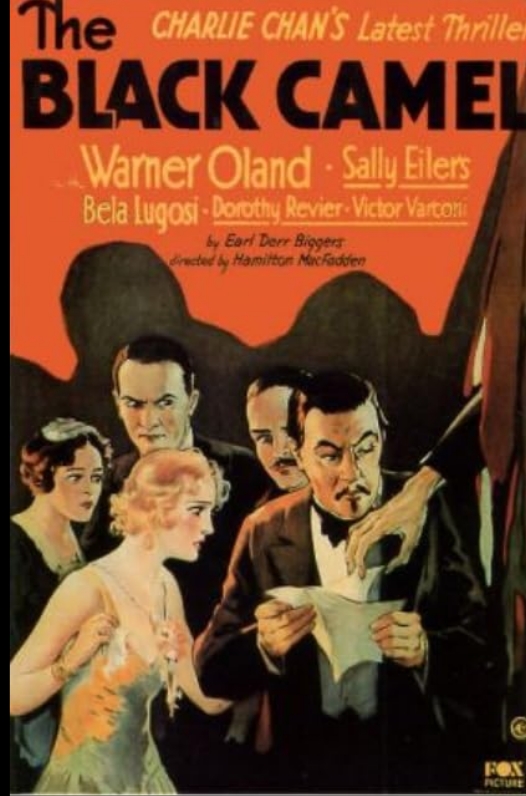
THE BLACK CAMEL (1931): Unlike other Charlie Chan movies, the real fun in The Black Camel is everything but the mystery. (If you're interested, actress Shelah Fane is murdered a few years after the murder of her lover, with a self-styled seer named Tarneverro being the likely suspect.)

OK, on to the good stuff. The Black Camel was one of the five original Chan movies thought lost in Fox Film's film storage fire in the mid-'30s, before a print unexpectedly turned up decades later. It was also the only one filmed on location in Hawaii (Chan being an Inspector on the Honolulu Police Department), allowing us to see the then-territory long before it became a relatively common tourist destination. The classy Royal Hawaiian Hotel allowed filming on its property as well; if it's still as beautiful as it was then, you just know the tourists aren't as well dressed.

But the cast! The cast! Bela Lugosi co-stars as Tarneverro, the same year as Dracula. Dwight Frye, legendary as Dracula's slave Renfield, is a suspicious butler. Robert Young, 40 years before Marcus Welby, MD, is Jimmy Bradshaw, dreaming of becoming a professional slogan writer (a typical '30s movie trope). Mary Gordon, the housekeeper in the Rathbone/Bruce Sherlock Holmes movies, who has information that helps Chan break the case wide open.  I almost needed a tranquilizer to handle The Black Camel's parade of iconic character actors. (A familiar character here is the starving artist with a British accent and pseudo-philosophical dialogue.) 

The movie also provides a rare scene with Chan's 12 slang-slinging children at the (long) breakfast table. None of the sons were old enough yet to be his incompetent sidekick, leaving that job to Otto Yamaoka as Kashimo, who spends most of the time running around Waikiki on wild nene chases. (If you know that the nene is Hawaii's state bird, it's a funny joke.) Yet for my money, the best moment is when Lugosi first meets Oland. Bela appears to genuinely enjoy their bantering, as if relieved to be rid of the Dracula cape in order to play a "normal" character part. While Charlie Chan at the Opera (co-starring Boris Karloff!) is often cited as the best Chan picture, The Black Camel is the most entertaining.

BONUS POINTS: In the strangest moment of any Chan movie, a bunch of real locals and tourists stand around gawking at the filming of The Black Camel on a beach. Good thing cellphones and TikTok hadn't been invented yet.


EL FANTASMA DE CONVENTO (THE PHANTOM OF THE MONASTERY) (1934): Well, that title
is one way to get audiences to think of an earlier horror movie. Still, this Mexican thriller stands on its own, and without a falling chandelier in sight -- even if, by the end, we see one has already fallen.

After getting lost on an evening hike, married couple Eduardo and Cristina, along with their friend Alfonso, are led to a centuries-old monastery by a strange monk. Hoping simply for a night's shelter and a little dinner, the trio encounter empty coffins, self-flagellation, the shadow of an invisible bat, and over a dozen of the weirdest old monks south of the border. As Cristina and Alfonso fall in lust, the padre tells them the story of a fellow monk who sought shelter there after desiring his best friend's wife... and summoning Satan in order to get the guy out of the way... only to have Satan kill the wife and eventually the monk, who now won't let himself stay buried. Cristina seems to believe this is a good risk for Alfonso to take, while he gradually comes around to her way of thinking. Ahh, young love!

As with other Mexican horror movies of the time, The Phantom of the Monastery is heavy on religious imagery atmosphere, eerie sounds, and an occasionally bombastic score which often distracts from the previous three things. But nothing can distract from the amorous looks Cristina gives Alfonso right in front of her husband, who is the only one who realizes that something very strange is happening all around them and wants to scram. (Sometimes what appears to be cowardice is actually intelligence.)

The scariest moments, other than the dead monk lying in his bed, are the most subtle. Two of them are courtesy of Marta Roel (Cristina), whose lust for Alfonso are signaled with just a brief change of facial expressions -- she's definitely under the control of something (or someone) otherworldly. The other is from Enrique del Campo (Alfonso), whose decision to hire Satan for Eduardo's murder is seen only in his eyes. I couldn't tell if it was a trick of the lighting, del Campo's acting skills, or both, but it's one of the movie's most memorable moments. While its predictable finale goes a little long, The Phantom of the Monastery proves that Mexico could, in its own way, match, and maybe surpass, the creep factor in Hollywood horror/thrillers, while throwing in a few surprises of its own.

BONUS POINTS: The mummified dead monk letting Alfonso know where to find Satan's instruction book. You have to see it to appreciate it.


HITLER: DEAD OR ALIVE (1943): Imagine Quentin Tarantino's Inglorious Basterds with a budget of a two-week car rental, and you've got Hitler: Dead or Alive. Three goofy gangsters -- Steve, Dutch, and Joe -- have been promised one million dollars by a patriotic American if they successfully kidnap Hitler and bring him back the US to face justice. Sound impossible? Not when the trio join the Canadian Army; hijacks a military plane to parachute into enemy territory, where every German speaks perfect English; and the country is filled with citizens willing to help them. Why didn't anybody think of this in real life?  

Contemporary audiences unfamiliar with movies like Hitler: Dead or Alive would likely be astounded how a silly, low budget piece of claptrap that made no sense entertained ticket-buyers in 1943. Easy! War-weary folks wanted to be distracted by silly, low budget pieces of claptrap that made no sense -- especially at a time when civilization was hanging in the balance. It was just one of many farces like Hal Roach's The Devil with Hitler and Nazty Nuisance turning Shicklgruber into a laughingstock. 

The biggest actor here, figuratively and literally, is Ward Bond as Steve, while familiar comedic wise guy Warren Hymer does his usual "Gee, boss" routine as Dutch. Bobby Watson, who portrayed Hitler in the two Roach comedies, repeats the role here, where he's billed as Bob Watson, perhaps reflecting his more serious portrayal. That is, as serious as can be when Ward Bond forcibly shaves off the moustache hiding a scar to make sure this Hitler isn't a body double. 

Things get dramatic at the climax when German soldiers, having captured the gangsters, mistakenly kill the clean-shaven Hitler before turning their rifles on four neighborhood children just because. Ward Bond gives an impassioned speech straight to the camera warning us that the Nazis must be stopped. When you consider Bond was one of Hollywood's most passionate right-wing antisemites, it's a brilliant performance. If nothing else, Hitler: Dead or Alive gives an idea of what movie audiences willingly sat through anything to get away from bad news. Which means you might enjoy it today.

BONUS POINTS: As cheap as any movie ever made, The Devil with Hitler was filmed at something called Fine Arts Studios.

                                                     *********************