Showing posts with label GEORGE BANCROFT. Show all posts

Wednesday, October 1, 2025

THE EARLY SHOW, PT. 57

Three movies made during the changeover from silent to sound, and one from a decade later featuring what was briefly Paramount's B-movie stock company.

THE DOCKS OF NEW YORK (1928): There's nothing about The Docks of New York promising greatness. A ship's stoker saves a hooker who tried to drown herself in the East River. They go to a dive bar, get married, spend the night the together before he ships off the following day. He has a change of heart and swims back to land, where he learns she's in night court for a crime he committed. He confesses, gets sentenced to 60 days. The hooker promises to wait for him.  

Would you watch such a movie? Well, maybe you should, just to see how important a great director can be. For Josef von Sternberg elevates a cliched tale into something both human and humane. The first reel or two feature situations and characters you've seen in countless old movies, particularly silents like this. Yet von Sternberg molds it all into something that you gradually come to understand and care about. Sure, George Bancroft (the stoker) is rough around the edges -- drinking beer straight out of a keg -- and Betty Compson (the hooker) has been beat around by life pretty badly. Yet each brings out something positive in the other. For Bancroft, it means a real love he's never felt for any woman. For Compson, it's a belief that it's possible to find a man who cares about her.

Von Sternberg transforms these battered people into a couple you root for even in their tawdry surroundings; it's a master class for anyone who wants to learn what an "actor's director" is. Watch the dozens of extras in the bar -- each one appears to have gotten personal instruction from von Sternberg; their action never looks forced or phony. (One funny moment comes when Bickford and Compson converse in a corner, completely ignoring a rowdy fight going on in a mirror's reflection above them.) 

There's more, much more, in The Docks of New York than is covered here, from the genuine filth covering the stokers, to how Betty Compson begins rock hard and slowly softens into the kind of woman her character probably dreamed of becoming when growing up. If von Sternberg's first movie, Salvation Hunters, was the work of a self-styled artiste trying too hard to say something important, The Docks of New York is a masterpiece of an unexpectedly mature drama from a bold, thoughtful director. Spoiler alert: the happy ending feels neither forced nor tacked on. 

BONUS POINTS: Gustav von Seyffertitz (born in 1862!) steals his five-minute scene as "Hymn-Book Harry", the priest who reluctantly marries the wayward couple in the dive bar. With a mere look in his eyes, von Seyffertitz reminds all the barflies (and us) of the solemnity of the moment. Brilliant stuff.

INTERFERENCE (1928): As you could guess from the advert on the right, Paramount's first talking feature Interference has nothing to do with football. It is, rather, a melodrama of the British upper-class involving hidden identity, divorce, blackmail, and murder. Kind of like the royal family if you dig hard enough. 

While Interference possesses many of the drawbacks prevalent during the early days of sound, its story is actually quite involving. Phillip Voaze has a chance meeting with first wife Deborah Kane a decade after his disappearance in World War I. In need of a few shillings, Deborah hatches a blackmailing scheme involving letters written to Voaze years earlier from his former sidepiece Faith. Without knowing what the others are doing, Voaze, Faith, and Faith's current husband Sir John Marlay each visit Deborah. One of them would like to kill her, another really does, while the third is arrested for it. All this hubbub for a few old "Oh baby, what you do to me" mash notes! People sure were touchy in 1928.

There are coincidences galore throughout Interference, like Voaze just happening to choose Marlay as a doctor, but that's to be expected in any movie of this type. Evelyn Brent and Doris Kenyon (as Deborah and Faith respectively) get the lion's share of histrionics. Clive Brook, the kind of distinguished Brit that talkies were created for, is agreeably lowkey as the stiff upper-lipped Sir John, the doctor whose prescription for blackmail is a dose of lethal threats. 

But it's William Powell, as the sickly Voaze, who steals Interference. His clipped, eloquent delivery, heard onscreen for the first time, must have convinced the boys at Paramount's front office that he was far more suited to leading roles than his often-villainous supporting parts in silents. No surprise that his next movie, a silent titled The Canary Murder Case, was immediately reshot with sound. Now that kind of studio interference makes sense.

BONUS POINTS: One credit reads "Dialogue Arranged by Ernest Pascal", as if the guy cut up the script, tossed the shreds up in the air, and glued them together at random like William Burroughs. Another credit, "Based on a Lothar Mendes Production", refers to Mendes' direction of the silent version of Interference, which Roy J. Pomeroy followed for his direction of the talkie version, which was shot simultaneously. As with The Canary Murder Case, those were the days when studios could pay actors once for making a movie twice.


THE SQUALL (1929): The funniest feature of 1929 must have been The Squall. And making it even more of a hoot is that it's a drama. Ergo, if you ever want to convince your friends that early talkies get a bad rap, this is not the movie to show them. 

In a small Hungarian village, middle-aged couple hire a young Gypsy woman named Nubi as their housekeeper. She shows her gratitude by seducing every male in the household and turning all the women against one another. Money goes missing, the maid and gardener quit, Paul breaks up with his fiancée Irma, fights break out -- and Nubi the housekeeper doesn't even sweep the floor! 

Absolutely nothing else happens in The Squall, other than the audience wondering why Nubi wasn't fired after her first day on the job. As for the acting -- hoo boy. Myrna Loy -- still stuck in "exotic" roles -- is Nubi. She's supposed to be sexy but appears to be a thousand kernels short of a cob. 
Too, Nubi (or, rather, Loy) is stuck with 90 minutes' worth of dialogue along the lines of "Nubi not happy!" or "Nubi like diamonds!" Loretta Young, as Irma, sounds exactly what she was in 1929: a 16 year-old girl badly reciting lines for the first time. Yet nobody beats Caroll Nye as Peter, emoting his already purple dialogue to the point where his mouth probably tasted like grapes. As for the direction, Alexander Korda makes sure to keep The Squall at a dead snail's pace. 

Somehow, Loy, Young, and Korda eventually proved to be far better than The Squall would have you believe. In later years they all probably shook their heads just hearing the word "squall" in weather forecasts. As for the rest of us... the forecast for watching The Squall is a 100% chance of disbelief mixed with unceasing laughter.

BONUS POINTS: The miniature horse & wagons standing in for the travelling Gypsy camp manage to be laughable and utterly charming all at once. In fact, they give a better performance than any human in the picture.


KING OF CHINATOWN (1939): 
Paramount must have been pretty pleased with the previous year's Dangerous to Know, because they rounded up much of the same cast for this well-made crime caper. Give the studio credit, too, for trying to revive Anna May Wong's sputtering career even in B-pictures like these. 

If there's a problem for fans of top-billed Wong, it's that her character, surgeon Dr. Mary Ling, is often overshadowed by Frank Baturin, the white leader of a Chinatown protection racket, who was shot by his underling Mike Gordon on orders of the gang's accountant (nicknamed The Professor). After performing life-saving surgery on Baturin, Dr. Ling becomes his temporary live-in caregiver. As Gordon and The Professor take over the racket, Baturin decides to break up his criminal band, furthering the accountant's desire to get him out of the way once and for all. Moral: always be good to your money manager.

King of Chinatown is unique in that the sex and race of Wong's character are never a subject for conversation or contention -- she is simply a brilliant surgeon, period. But unwilling to leave well enough alone, Paramount cast white actor Sidney Toler as her Chinese father because... well, he was currently playing Charlie Chan over at Fox! And why is Armenian-American Akim Tamiroff using an Italian accent when playing a character with the Ukrainian name of Maturin? Oh heck, let's continue with busy second-rate dialect actor J. Carroll Naish using an Irish accent as The Professor for no reason other than Chinese and Italian were already taken. Mexican-born Anthony Quinn, as the red-blooded American gunsel Gordon, already lost his accent, so he gets a pass.

All this confusion helps to make King of Chinatown an even more fun 56 minutes than it already it is. And despite the odd casting (and accent) choices throughout, Anna May Wong
was probably grateful for the chance to prove she could do something other than the usual Dragon Lady routine. But I still wonder how she felt about a white guy playing her Chinese father. 

BONUS POINTS: Super-annoying actor Roscoe Karns disappears from King of Chinatown before the end of the second reel, as if director Nick Grinde realized they didn't need an ambulance driver character ripped-off from MGM's Dr. Kildare movies.

                                                                        ******************

Wednesday, June 11, 2025

THE EARLY SHOW, PT. 52

 From the frozen North to the streets of Chicago and New York come two features, one TV news documentary, and an industrial short starring a comedian in a rare dramatic role. You've never seen any of these and, unless you're someone like me, probably never will. Your loss, my friend.


THE VIKING (1931): When the prologue to a movie uses the phrase "the greatest catastrophe in the history of the motion picture industry", it isn't referring to Michael Bay. Not to say the script for The Viking isn't hackneyed -- two feuding members of a seal hunt in love with same girl wind up having to save each other's lives. The acting, too, is strictly amateur hour (and nine minutes). No one is credited as director, but producer Varick Frissell is one of the two guilty parties responsible, with B-director George Melford wisely keeping his name somewhere else. 

But Frissell must be applauded for the extraordinary footage shot aboard the titular ship during a real seal hunt in the freezing waters of Labrador. Nothing is faked here -- not the icefloes the sailors walk on (or jump across to avoid falling in the ocean), the icebergs towering over them like skyscrapers, the blizzards, or the seal hunt itself (don't worry, folks, no clubbing here, only rifles are used). When The Viking sticks to its real-life footage, the result is riveting enough to make you almost forget the mediocrity surrounding it.

Frissell would have done better just making a straight-ahead documentary along the lines of With Byrd at the South Pole from a year earlier instead of padding it out with a trite love triangle. Instead, Frissell hired unknowns (only lead Charles Strarrett would go onto semi-big things in B-Westerns). Non-actor Bob Bartlett, real-life commander of the ship taken by Matthew Perry to the North Pole in 1908, gives the most authentic performance as, what else, the captain of The Viking. Luckily for them and the rest of the cast, they were on dry land when, during reshoots, the ship blew up, killing 25 crewmembers, along with Frissell himself. Now you understand the "greatest catastrophe" hype.

Critics didn't cut The Viking any slack for the deaths, while the movie did poor box-office. Not even the introductory appearance of Sir Wilfred Grenfell ("the greatest living authority of the Labrador Country") raised a pulse of sympathy. Let that be a lesson to moviemakers: nobody cares about your damn tragedies.

BONUS POINTS: The Viking was, as far as I know, the only talkie with the sound captured via wire recorder.


BLOOD MONEY (1933): Shady bail bondsman Bill Bailey springs bank robber Drury Darling, kid brother of Bill's on-and-off lover Ruby. Their relationship is coming to an end, though, as Bill flips for society sweetie Elaine Talbert. When Drury skips town, Elaine joins him, going so far as to double-cross Bill by making it look like he robbed the bank. Further gumming up his life is the jealous Ruby putting a hit out on him in a way that gives "behind the 8-ball" a whole new meaning.

It isn't often I stumble across a pre-Code I've never heard of, but thank God and Darryl F. Zanuck for Blood Money, which gives us not only the fine roughhouse character actor George Bancroft (Thunderbolt), but also Judith Anderson playing a dame long before she was a real Dame. It's rather refreshing to see a couple who aren't young and gorgeous, with Anderson, age 36, looking compatible with 51-year-old Bancroft. Their characters have seen plenty of action in their time, reflected in Ruby's cynical eyes and Bill's cigarette & liquor-aged face. 

 But it's Frances Dee who puts the "pre" in pre-Code as Elaine Talbart, possibly the most carnally obsessed woman in a studio picture up to then. Any time the subject of sex, violence, or sexual violence is brought up, her mouth opens in a twisted smile and her eyes pop out as if inflated behind their sockets. "What I need is someone to give me a good thrashing," she warns Bill on their first date. "I'd follow him around like a dog on a leash!" And if you stick around to the end of the movie, you'll see that's her least shocking moment. Over and done in 65 minutes, Blood Money is Type A entertainment with enough startling dialogue to drive your wife out of the room as it did mine.

BONUS POINTS: 22-year-old platinum blonde Lucille Ball has one line of dialogue in her role as a hooker at the dog track. Just the kind of girl you want to bring home to no one.


DREAM STREET (19??): Long before the concept of hidden cameras catching
criminals became a regular part of television, WCBS-TV in New York presented the 30-minute news special Dream Street hosted by reporter Bill Ledder. At least I think that's his name; the show's scratchy soundtrack makes it difficult to make out. But that only adds to the old-school, pre-Dolby Atmos you-are-there feel of the show.

Filmed in co-operation with the NYPD, the first half of Dream Street follows three undercover cops staking out the Prospect Place area of Brooklyn waiting for the pusher man to sell his supply to willing customers. Conversation between the cops, allegedly captured by hidden microphones, appears to be dubbed in; not only is it slightly out of synch with their mouths, much of it sounds scripted, along the lines of "Look, here come the three addicts" as if the guys were wearing jerseys identifying their team. The second half, shot inside a police station, consists of a police sergeant interviewing "apprentice dealer" Big Sam and addicts Vernon and Willie the Whip one at a time. While interesting, it's something of a slog compared to the footage preceding it.

Just when Dream Street originally aired is difficult to figure out; it's supposed to have been in the early 1960s, but it looks a few years older. Men sell furniture on the street while keeping warm with urban campfires. Produce stands outside bodegas take up much of the sidewalk. Salesmen use horse drawn carts to peddle their wares. And by God the addicts wear nice fedoras, overcoats and neckties I would love to wear in the 21st century. When did druggies become the slobs they are today?

BONUS POINTS: Is heroin still sold in capsule-form like it is here? Or am I just misunderstanding what the capsule really is?


THE ORDEAL OF THOMAS MOON (1956): From its stark black and white photography to its real-life ambient sound accompanying the on-location film shooting in the original Penn Station and Manhattan's west side, to the narrator who will sound familiar to TV-addicted baby boomers, The Ordeal of Harry Moon captures that brief time when cinema verite took hold in American entertainment, big pharm was still considered the answer to all our problems, and being overweight was the exception not the rule. 

The corpulent, perpetually perspiring Thomas Moon can barely walk up a flight of stairs at Penn Station, reach into his pants pocket for change, or fit inside a phonebooth. Nor can he open a newspaper or overhear a conversation without being reminded he's fat. Even his girlfriend chews him out -- telephonically, not literally -- sending him on a self-loathing stroll around Times Square. (How did he have the ability to walk 20 blocks from Penn Station?). 

You can't help but wonder what 24-year-old Dom DeLuise thought about playing a poor schlub surrounded by ads reading "ARE YOU SELF-CONCIOUS ABOUT YOUR WEIGHT?" or "FAT PEOPLE DIE FIRST." (His reflection in a storefront window is a near doppelganger of Oliver Hardy.)  When his character finally has a nervous breakdown in the middle of Broadway, DeLuise probably didn't need more than one take or even a rehearsal. 

The Ordeal of Thomas Moon lasts 14 minutes -- long enough for our heavy hero to decide he needs to do something about his condition. Or, as the understanding narrator reminds us, "He will face his problem the safe way, the only way, by seeing a doctor" -- who will likely put him on meds made by the film's sponsor, Smith, Kline & French Laboratories, the fine folks who manufactured and sold Benzedrine for weight loss. What, you thought proper diet and exercise would do the trick? 

BONUS POINTS: Dom DeLuise's breakdown happens directly across the street from the aptly-named Broadway Theater on the corner of 53rd Street, where, as we can see in the screenshot, Sammy Davis, Jr. was currently starring in Mr. Wonderful. 

                                                                  *************

Saturday, June 15, 2024

THE EARLY SHOW, PT. 36

 Today's thrilling chapter of The Early Show runs the gamut from early talkies to   '40s B-comedies to the end of the world to the end of the rein of a studio chief. 

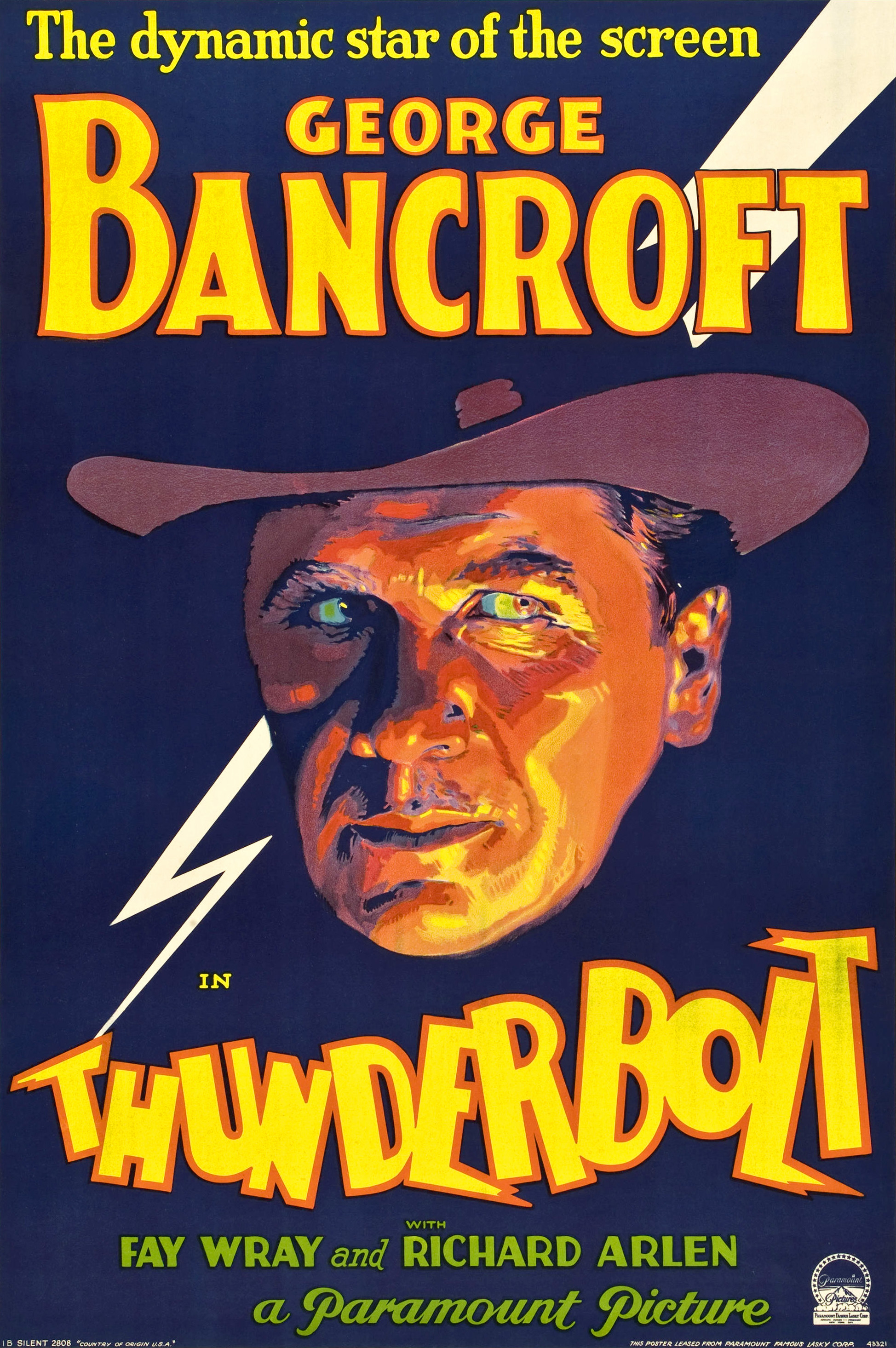
THUNDERBOLT (1929): A gangster named Thunderbolt (thanks to his infamously fatal punching skill) awaits execution on death row. Not wanting to be the only one in the hot squat, he frames nice guy Bob Moran for murder as punishment for winning the affections of his (Thunderbolt's) girlfriend Ritzie. But as he watches Bob's prison marriage to Ritzie, Thunderbolt has a change of heart. He admits to framing Bob... but is still flexing his fist for that final deadly sock in the skull.

One of the earliest gangster pictures with sound, Thunderbolt was also director Josef von Sternberg's first talkie, as well as his third production with tough guy George Bancroft. Thunderbolt's cinematography isn't as fluid as von Sternberg's silents -- a common drawback then -- yet he does wonders with the sound. While many of the early talkies focus on only two people in stiff conversation, the prison scenes offer moments with three people chatting at once as an offscreen prisoner sings hymns accompanying himself on piano. You wouldn't think about it twice in a contemporary movie, but for 1929 it's miles ahead of what other directors were doing.

It's too bad Thunderbolt's first half is so draggy and, at times, badly acted by the whiney Richard Arlen as Bob, who at times seems to be more in love with his mother than Ritzie (Fay Wray); you haven't lived ' til you've seen Arlen and Mom mock-wrestling on the bathroom floor. Thunderbolt doesn't really come to life until shifting to the prison 40 minutes in. George Bancroft's delivery is occasionally stilted -- he seems to be adjusting to the idea of speaking his dialogue -- while 65 year-old Tully Marshall steals the show as the hilariously hectoring prison warden who wants to keep a dying prisoner alive so he can be executed that evening. While Thunderbolt doesn't necessarily lay the groundwork for von Sternberg's later classics, it's worth it to see how a great director could overcome technical limitations of the day while giving a hint of what was to come.

BONUS POINTS: Thunderbolt's gaze at a black nightclub singer hints at more than just musical appreciation. 


LA FIN DU MONDE (1931):  Jean Novalic is an actor with a Jesus complex (aren't they all?). His brother Martial is a respected astronomer. As Jean foresees an impending apocalypse, Martial discovers a comet heading straight toward earth. Hoping this will deter mankind from an impending world war, Martial and his friend Werster do battle with a super-rich investor named Schomburg in winning the hearts and minds of the world's population. What's it going to be: brotherhood of man, or caviar for the rich? 

You'd never know La Fin Du Monde (that's The End of the World to you, mack) was written and directed by Abel Gance, the man responsible for two of the greatest French epics of the silent age, J'Accuse! and Napoleon. Having started production in 1929, the first half of La Fin Du Monde has all the technical drawbacks of early talkies, utterly lacking the astounding storytelling of Gance's earlier classics. Nor does it help that his studio chopped its original three-hour running time to 105 minutes, leaving scenes beginning and ending abruptly, while subplots (like Werster's apparently gay relationship with a young man) disappear without being explored or resolved. That the surviving prints run only 90 minutes is further cinematic butchery. 

This doesn't leave Gance off the hook, though, playing the Jesus-obsessed Jean himself as if out of a 1910 Biograph melodrama. If the studio had to chop La Fin Du Monde's running time, it should have concentrated entirely on the first half; indeed, once Jean is carted off to the asile de fous, he's never referred to again. 

But it's when Jean hits the road that La Fin Du Monde gets interesting, as the story shifts entirely to pacifism vs the stinking rich, with Martial and Schomburg vying for the control of the world's media in order to get their messages out. By the end, however, when the world's leaders convene for one final meeting before the world's destruction is expected, Gance's message seems (to me, anyway) lost. As Martial and the others promise a new world of peace and unity when the comet approaches, the bizarre special effects distorting their faces make them appear desperately out of touch rather than idealists. Or was that the idea? As it is, what remains of La Fin Du Monde gives only a rough idea of what Gance had in mind. Speaking cynically, it's nice to know that French movie studios could be as scissor-happy as Hollywood's. 

BONUS POINTS: Good location filming on the Eiffel Tower, with an all-too brief crane shot following the heroes running up the spiral staircase.

MISBEHAVING HUSBANDS (1940): There are way too many movies that exist only because the lead characters don't take 15 seconds to clear up a silly misunderstanding. In Misbehaving Husbands, a woman is divorcing her husband because he was seen shoving a dead woman into the back of his car. Why doesn't he tell her the corpse was actually a mannequin? Because people at PRC Studios needed a two-week job. 

Even for a low-budget 60-minute B-movie, Misbehaving Husbands stretches its premise to the breaking point, so you need a pro like Harry Langdon to make it work, even if professionally he had fallen several stories since his heyday almost 15 years earlier. If you're not familiar with his 1920s output, picture a middle-aged actor playing a character half his age who behaves like a seven-year-old. What was acclaimed as an "innocent" at the time now seems more like somebody on the spectrum, if not mentally ill. And somehow he usually won the love of a beautiful young woman.

But in Misbehaving Husbands, Harry's a smart, successful department store owner who can afford two servants. He puts his physical shtick to good use, but to make him amusingly eccentric rather than weird.  Too, Harry's character is married to what appears to be an age-appropriate woman, although the actress, Betty Blythe, at 47, was 13 years younger than Langdon. (You're guaranteed not to see so many older, normal-looking men and women in any movie today.) And where many actresses in this kind of movie would play the role strictly for yocks, Blythe's reactions to her husband's alleged misbehavior are dead serious, occasionally giving the movie an unexpected depth. Kudos to director William "One Take" Beaudine for handling both the comedy and drama equally well.

Call me nuts, but Misbehaving Husbands is funnier than many of Langdon's "classic" silents. The uproarious scene where a nosey woman mistakes Harry straightening out a mannequin on a bed for foreplay makes one regret he never became a member of Preston Sturges' stock company. For a comedy that will never be considered a classic, Misbehaving Husbands gave me more genuine laughs than many that are.

BONUS POINTS: In the lobby card above on the left, you can see the movie debut of a young actor named Byron Barr. Two years later, Warner Brothers changed his name to Gig Young.


SHADOW ON THE WALL (1950): David Starrling is understandably upset when
learning his second wife, Celia, is having an affair with his best friend Crane Weymouth. As David approaches Celia threateningly, she knocks him unconscious with a hand mirror. (This guy must have a soft head.)
Before you can say "sibling rivalry" Celia's sister Dell -- the fiancée of Crane Weymouth -- enters their apartment and shoots her to death before planting the gun in David's hand and running out the door. David is arrested, found guilty of murder, and put on death row. Dell is more or less relieved how things turned out, until learning that David's young daughter Susan (from his first marriage) is now in a hospital, suffering from amnesia after witnessing the shooting. As Dr. Caroline Canford gets closer to reviving the girl's memory, Dell will stop at nothing, and I mean nothing, to prevent her cure. No wonder why step-relatives have a bad reputation.

You can tell Louis B. Mayer was losing control of MGM to production head Dore Schary; there is no way the studio would have produced a movie like Shadow on the Wall even five years earlier. Shooting an evil step-sister was acceptable -- but slipping poison into a little girl's glass of chocolate milk, trying to drown her in a tub while she was sedated -- and, when those tricks don't work, adopting her so she can knock off the kid in private? Judy Garland and Mickey Rooney this was not. Not being a fan of child-in-danger stories, even I had put off watching this, despite having it on my DVR for months. 

I'm glad I ran out of excuses for avoiding it, if only for two of its stars. Having vague memories of Ann Sothern as a sitcom actress from my youth, it was a real change of pace to see her here as Dell, the perpetrator of femicide and attempted infanticide. You kind of feel sorry for her early on -- her sister Celia essentially stole everything Dell had when they were growing up, from clothes to boyfriends -- but letting David take the rap is taking things too far. Nancy Davis (before taking the name of husband-to-be Ronald Reagan) is actually credible as the kindly Dr. Cranford. Credible in that from what I've read about her, Nancy wasn't as kind to her own kids as she is to as Gigi Perreau (as Susan) here. 

Despite being second-billed, Zachary Scott probably filmed all his scenes as David in a week and a half. He's an interesting actor, not a legend like, say, Bogart or Cagney, but convincing, the accompanying still with his costars above notwithstanding. If you can deal with a story that many would consider distasteful, Shadow on the Wall won't drive you out of your job as it likely did Louis B. Mayer.

BONUS POINTS: When Dell is at the beauty parlor following the murder, she hallucinates the hairdryer being slipped over head for the electric chair. It wasn't meant to be funny but, damn, I can't be the only one these days who laughed out loud.

                                                                         *************