Showing posts with label HARRY LANGDON. Show all posts

Saturday, June 15, 2024

THE EARLY SHOW, PT. 36

 Today's thrilling chapter of The Early Show runs the gamut from early talkies to   '40s B-comedies to the end of the world to the end of the rein of a studio chief. 

THUNDERBOLT (1929): A gangster named Thunderbolt (thanks to his infamously fatal punching skill) awaits execution on death row. Not wanting to be the only one in the hot squat, he frames nice guy Bob Moran for murder as punishment for winning the affections of his (Thunderbolt's) girlfriend Ritzie. But as he watches Bob's prison marriage to Ritzie, Thunderbolt has a change of heart. He admits to framing Bob... but is still flexing his fist for that final deadly sock in the skull.

One of the earliest gangster pictures with sound, Thunderbolt was also director Josef von Sternberg's first talkie, as well as his third production with tough guy George Bancroft. Thunderbolt's cinematography isn't as fluid as von Sternberg's silents -- a common drawback then -- yet he does wonders with the sound. While many of the early talkies focus on only two people in stiff conversation, the prison scenes offer moments with three people chatting at once as an offscreen prisoner sings hymns accompanying himself on piano. You wouldn't think about it twice in a contemporary movie, but for 1929 it's miles ahead of what other directors were doing.

It's too bad Thunderbolt's first half is so draggy and, at times, badly acted by the whiney Richard Arlen as Bob, who at times seems to be more in love with his mother than Ritzie (Fay Wray); you haven't lived ' til you've seen Arlen and Mom mock-wrestling on the bathroom floor. Thunderbolt doesn't really come to life until shifting to the prison 40 minutes in. George Bancroft's delivery is occasionally stilted -- he seems to be adjusting to the idea of speaking his dialogue -- while 65 year-old Tully Marshall steals the show as the hilariously hectoring prison warden who wants to keep a dying prisoner alive so he can be executed that evening. While Thunderbolt doesn't necessarily lay the groundwork for von Sternberg's later classics, it's worth it to see how a great director could overcome technical limitations of the day while giving a hint of what was to come.

BONUS POINTS: Thunderbolt's gaze at a black nightclub singer hints at more than just musical appreciation. 


LA FIN DU MONDE (1931):  Jean Novalic is an actor with a Jesus complex (aren't they all?). His brother Martial is a respected astronomer. As Jean foresees an impending apocalypse, Martial discovers a comet heading straight toward earth. Hoping this will deter mankind from an impending world war, Martial and his friend Werster do battle with a super-rich investor named Schomburg in winning the hearts and minds of the world's population. What's it going to be: brotherhood of man, or caviar for the rich? 

You'd never know La Fin Du Monde (that's The End of the World to you, mack) was written and directed by Abel Gance, the man responsible for two of the greatest French epics of the silent age, J'Accuse! and Napoleon. Having started production in 1929, the first half of La Fin Du Monde has all the technical drawbacks of early talkies, utterly lacking the astounding storytelling of Gance's earlier classics. Nor does it help that his studio chopped its original three-hour running time to 105 minutes, leaving scenes beginning and ending abruptly, while subplots (like Werster's apparently gay relationship with a young man) disappear without being explored or resolved. That the surviving prints run only 90 minutes is further cinematic butchery. 

This doesn't leave Gance off the hook, though, playing the Jesus-obsessed Jean himself as if out of a 1910 Biograph melodrama. If the studio had to chop La Fin Du Monde's running time, it should have concentrated entirely on the first half; indeed, once Jean is carted off to the asile de fous, he's never referred to again. 

But it's when Jean hits the road that La Fin Du Monde gets interesting, as the story shifts entirely to pacifism vs the stinking rich, with Martial and Schomburg vying for the control of the world's media in order to get their messages out. By the end, however, when the world's leaders convene for one final meeting before the world's destruction is expected, Gance's message seems (to me, anyway) lost. As Martial and the others promise a new world of peace and unity when the comet approaches, the bizarre special effects distorting their faces make them appear desperately out of touch rather than idealists. Or was that the idea? As it is, what remains of La Fin Du Monde gives only a rough idea of what Gance had in mind. Speaking cynically, it's nice to know that French movie studios could be as scissor-happy as Hollywood's. 

BONUS POINTS: Good location filming on the Eiffel Tower, with an all-too brief crane shot following the heroes running up the spiral staircase.

MISBEHAVING HUSBANDS (1940): There are way too many movies that exist only because the lead characters don't take 15 seconds to clear up a silly misunderstanding. In Misbehaving Husbands, a woman is divorcing her husband because he was seen shoving a dead woman into the back of his car. Why doesn't he tell her the corpse was actually a mannequin? Because people at PRC Studios needed a two-week job. 

Even for a low-budget 60-minute B-movie, Misbehaving Husbands stretches its premise to the breaking point, so you need a pro like Harry Langdon to make it work, even if professionally he had fallen several stories since his heyday almost 15 years earlier. If you're not familiar with his 1920s output, picture a middle-aged actor playing a character half his age who behaves like a seven-year-old. What was acclaimed as an "innocent" at the time now seems more like somebody on the spectrum, if not mentally ill. And somehow he usually won the love of a beautiful young woman.
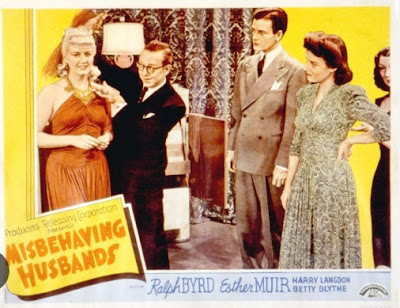
But in Misbehaving Husbands, Harry's a smart, successful department store owner who can afford two servants. He puts his physical shtick to good use, but to make him amusingly eccentric rather than weird.  Too, Harry's character is married to what appears to be an age-appropriate woman, although the actress, Betty Blythe, at 47, was 13 years younger than Langdon. (You're guaranteed not to see so many older, normal-looking men and women in any movie today.) And where many actresses in this kind of movie would play the role strictly for yocks, Blythe's reactions to her husband's alleged misbehavior are dead serious, occasionally giving the movie an unexpected depth. Kudos to director William "One Take" Beaudine for handling both the comedy and drama equally well.

Call me nuts, but Misbehaving Husbands is funnier than many of Langdon's "classic" silents. The uproarious scene where a nosey woman mistakes Harry straightening out a mannequin on a bed for foreplay makes one regret he never became a member of Preston Sturges' stock company. For a comedy that will never be considered a classic, Misbehaving Husbands gave me more genuine laughs than many that are.

BONUS POINTS: In the lobby card above on the left, you can see the movie debut of a young actor named Byron Barr. Two years later, Warner Brothers changed his name to Gig Young.


SHADOW ON THE WALL (1950): David Starrling is understandably upset when
learning his second wife, Celia, is having an affair with his best friend Crane Weymouth. As David approaches Celia threateningly, she knocks him unconscious with a hand mirror. (This guy must have a soft head.)
Before you can say "sibling rivalry" Celia's sister Dell -- the fiancĂ©e of Crane Weymouth -- enters their apartment and shoots her to death before planting the gun in David's hand and running out the door. David is arrested, found guilty of murder, and put on death row. Dell is more or less relieved how things turned out, until learning that David's young daughter Susan (from his first marriage) is now in a hospital, suffering from amnesia after witnessing the shooting. As Dr. Caroline Canford gets closer to reviving the girl's memory, Dell will stop at nothing, and I mean nothing, to prevent her cure. No wonder why step-relatives have a bad reputation.

You can tell Louis B. Mayer was losing control of MGM to production head Dore Schary; there is no way the studio would have produced a movie like Shadow on the Wall even five years earlier. Shooting an evil step-sister was acceptable -- but slipping poison into a little girl's glass of chocolate milk, trying to drown her in a tub while she was sedated -- and, when those tricks don't work, adopting her so she can knock off the kid in private? Judy Garland and Mickey Rooney this was not. Not being a fan of child-in-danger stories, even I had put off watching this, despite having it on my DVR for months. 

I'm glad I ran out of excuses for avoiding it, if only for two of its stars. Having vague memories of Ann Sothern as a sitcom actress from my youth, it was a real change of pace to see her here as Dell, the perpetrator of femicide and attempted infanticide. You kind of feel sorry for her early on -- her sister Celia essentially stole everything Dell had when they were growing up, from clothes to boyfriends -- but letting David take the rap is taking things too far. Nancy Davis (before taking the name of husband-to-be Ronald Reagan) is actually credible as the kindly Dr. Cranford. Credible in that from what I've read about her, Nancy wasn't as kind to her own kids as she is to as Gigi Perreau (as Susan) here. 

Despite being second-billed, Zachary Scott probably filmed all his scenes as David in a week and a half. He's an interesting actor, not a legend like, say, Bogart or Cagney, but convincing, the accompanying still with his costars above notwithstanding. If you can deal with a story that many would consider distasteful, Shadow on the Wall won't drive you out of your job as it likely did Louis B. Mayer.

BONUS POINTS: When Dell is at the beauty parlor following the murder, she hallucinates the hairdryer being slipped over head for the electric chair. It wasn't meant to be funny but, damn, I can't be the only one these days who laughed out loud.

                                                                         *************


Thursday, April 7, 2022

THE EARLY SHOW, PT. 3

I've come to accept that I'll likely never return to my usual, pre-pandemic sleeping schedule. Not that I was ever one of those lucky, eight-straight-hours-a-night people. But thanks to the internet and occasionally a revisit to a movie from my own collection, there's always a movie or forgotten TV program at my disposal worthy of a brief mention, even if it really isn't worthy. 

ALIBI (1929): Released from prison, gangster Chick Williams resumes his romance with Joan, the daughter of Police Sgt. Pete Manning. When a cop is murdered in a heist, Chick falls under suspicion, despite his seemingly airtight alibi.  With the unlikely help of Danny McGann, who's not the annoying rich lush he appears to be, the killer is found out and, during a police chase, falls off a rooftop because it's more dramatic than being shot.

For me, Alibi ticks all the boxes: gangster genre, early talkie, interesting direction (by Roland West) with touches of German expressionism, art deco sets, and Chester Morris in the lead. Not necessarily a great actor, Morris nevertheless is always interesting, especially when playing heels like Chick Williams. While the other actors are serviceable, Morris brings a simmering tension that breaks at the climax when his character betrays his true personality.

Alibi's only problem is Regis Toomey's portrayal of Danny McGann. Overplaying the stereotypical  drunk, Toomey pulls every clichĂ© in the Hollywood book -- stumbling, slurring, giggling -- that you see only in movies. He also gets the longest, most melodramatic death scene outside that of Sunny von Bulow. If he was looking for the first Oscar nomination for best actor, he must have been chagrined by Chester Morris receiving it instead. 

BONUS POINTS: The expressionistic prison shots at the beginning, making it look like The Hoosegow of Dr. Calagari. 


ALL-AMERICAN CO-ED (1941): Bobby Shepard (Johnny Downs) of Quinceton University pranks the all-girls Mar Byrnn by entering its free tuition contest in drag, only to fall in love with student Virginia Collinge (Frances Langford). And if you think that's a flimsy story for a full length movie, you're right. All-American Co-Ed is one of Hal Roach's 49-minute "Streamliner" releases. And the only reason it's that long is because of its four musical numbers. 

The fun of All-American Co-Ed  -- rightly promoted in newspaper ads as THE SEASON'S GAYEST MUSICAL! -- is how much of its sexualized humor crosses the line of what was otherwise permitted at the time ("Bobbi" Shepard is caught sitting on a guy in what somebody appears to think is the reverse cowgirl position), or how a song laments that the farmer's daughter "can't rhumba with an old cucumber." Wow.  

Most of the music is typical of a 1940s B-picture, with titles like "I'm a Chap with a Chip on My Shoulder", sung by Johnny Downs as his character's nom de drag The Flower Queen(!). On the other hand, Langford's showpiece, "Out of the Silence" is an Oscar-nominated forgotten gem sung, arranged and filmed in an almost hypnotic style far out of step from the movie's silliness. It's the best scene in the picture, and probably the only one from a Roach Streamliner that resembles an A-picture.

A weirdly enjoyable movie, All-American Co-Ed suffers from the appearance of Noah Berry, Jr. and Alan Hale, Jr. as a couple of nitwits who make you realize what Hal Roach lost when he parted ways with Laurel & Hardy. Yet, overall it's still an entertaining way to spend a late night or pre-dawn 49 minutes if you can't sleep or don't want anyone to know the kind of ridiculous movies you watch. 

BONUS POINTS: Harry Langdon shines as the Mar Brynn publicist, while the great African-American actress Lillian Randolph almost steals the movie as a laundress in a hilarious scene that, in lesser hands, would be offensive to modern audiences. In fact, it probably is anyway, but I'm not modern. And look fast for future noir queen Marie Windsor as one of the Mar Brynn cuties. 


THE CASE AGAINST BROOKLYN (1958): New York police detective Pete Harris goes undercover to bust an illegal gambling ring and the crooked cops protecting it. A little too dedicated to his job, Harris's bullheaded approach gets his partner Jess Johnson killed in the line of duty. He also puts his marriage in jeopardy by pretending to romance Lil Polombo, a lush whose husband Gus killed himself rather than being murdered by the mobsters to whom he's deep in debt. But that doesn't matter after Harris's wife is killed in a hit meant for him. Now it's personal! 

The Case Against Brooklyn, based on a true story, is kind of shocking, in that it seems every cop in this particular Brooklyn precinct was on the take. Too, Pete Harris, is fairly unlikeable, putting everybody around him in danger just for a promotion.

Too bad The Case Against Brooklyn -- one of the all- time great titles -- doesn't  live up to its premise. Shot mostly on L.A. soundstages,  it lacks authentic New York atmosphere. But McGavin is fine as the hotshot cop "dating" the alky widow just to get information on the criminals. I just wish this true-crime tale was more realistic. Especially the scene where pop star Bobby Helms sings his latest single in a bar while accompanied by a jukebox.

BONUS POINTS: The only movie I know of with someone murdered by an exploding telephone. 


I, JANE DOE (1948): A woman known only as Jane Doe is found guilty of murdering Stephen Curtis. When she's found to be pregnant with Curtis' child, his widow, Eve, defends her at a retrial. Curtis, we learn, was a two-timer who met and married the defendant -- whose real name name is Annette Dubois -- when he was shot down in action over Europe in the War. He soon disappeared, sending a lawyer to her to sign an annulment. Still in love with Curtis, Annette tracked him down to New York where we learn what really happened the day the two-timing louse was killed.

Like The Case Against Brooklyn, there's nothing really bad about I, Jane Doe. In fact the snappy first reel promises a good noir. But the retrial bogs down with more flashbacks than Brian Wilson's acid experiences, interrupted by the prosecutor shouting his objections and the reaction shots of the title character, played by Vera Ralston, the Greta Garbo of Republic Pictures.

As with her role in Angel in the Amazon, Ralston's emotions run the gamut from A to A-, with her glycerin-teared eyes forever on the verge of running down her face without actually doing so. No other actress had so many close-ups in one movie, likely at the behest of her lover, Republic president Herbert Yates. 

Director Joseph H. Auer does what he can with the material (and Ralston), focusing on the technical aspects, which are often quite good. The best of the primary actors is John Carroll, who makes Stephen Curtis a heel that you eventually believe deserved to get plugged. There's enough in I, Jane Doe to keep you fairly engaged and the bombastic score will keep you awake. Still, it would have been better as a straight-ahead B-picture with 10 of its 85 minutes shaved off. And someone other than Vera Ralston starring in it.

BONUS POINTS: The always-engaging character actor Leon Belasco makes the most of his brief appearance as Curtis's amusingly creepy, slithery, grimacing lawyer. His performance is a master class on making the most out of an otherwise throwaway role, and should be seen by aspiring actors everywhere to let them see a real pro in action. 

                                                              **************

Friday, January 24, 2014

MOVIES OF THE DAY: "WHAT! NO BEER?" (1933) AND "A SOLDIER'S PLAYTHING" (1930)

If anyone wants to see the outcome of genius denied, the notorious What! No Beer! provides the perfect tutorial. One of the top-drawer comedic actors in movies, Buster Keaton had forsaken independent production in 1928 to sign with MGM, believing that he would continue to make movies the way he always he had. Instead, he quickly found himself just another cog in a studio factory that had no understanding or appreciation of his style. Faster than you can say "Ars Gratia Artis," Keaton sank into morass of depression, divorce and drinking. And any Keaton fan watching his MGM features will ultimately do likewise. 

Having immersed myself in Keaton's silent movies in the early '70s, I was struck not only by his breathtaking physical comedy -- he once broke his neck without realizing it -- but his strangely-modern deadpan countenance. While optimistic contemporaries like Chaplin and Harold Lloyd were always ready with a smile, Keaton looked defeated even when triumphant. Watching his movies at a time when America was still reeling from Watergate and the Vietnam War, Keaton appeared to tap into a zeitgeist about 75 years before anyone knew what the hell that word meant.

Durante does MGM's bidding by finishing off
Keaton once and for all.
Once talkies arrived, MGM decided the best way to present Keaton was to put him into dialogue-heavy comedies. Make that "bad dialogue-heavy comedies." Because who would want to watch somebody just do stuff when they could hear him talk? Ultimately some studio genius got the bright idea of pairing him with MGM's other new hire, Jimmy Durante, for three movies, each worse than the one before it. Their final picture, What? No Beer?, was the bottle, as it were, that broke Keaton's back.


There's no point in recounting What! No Beer?'s story. Keaton and Durante play a couple of nitwits who become bootleggers during Prohibition's dying days -- that's all you need to know. What's sadly fascinating is how MGM deliberately placed Keaton in a situation that called for little of his comedic gifts, forcing him to simply feed lines to the bigmouthed Durante. Even worse, he plays straight to a trio of hobos-turned-brewers who play their scenes like a flashmob in a cemetery. (I wonder if their roles were originally intended for the Three Stooges, who were signed to MGM at the time.) It's like watching Edward Hopper having to paint generic billboards for Wonder Bread. It's nice he's getting a steady paycheck and all, but goddamn-mighty-damn it's a tragedy to watch.

While always a Durante fan, I nonetheless watched him more stonefaced than Keaton himself ever was. 
Run away, Buster, as fast as you can.
Playing against Keaton, he's the cinematic version of the schoolyard bully, completely overwhelming his helpless partner not with physical but verbal abuse. Only 37 but looking 50, the once-great Keaton is drunk -- I mean really drunk, not acting -- throughout What! No Beer?, slurring his words and and barely focusing his dark, haunted eyes. He gets a couple of chances at his physical comedy -- nobody can slide down a beer-slicked stairway like him -- but those moments only illuminate the sickening dismay that both we and Keaton find ourselves experiencing. It's the original version of Night of the Living Dead.


Gagman Keaton compares notes with the Marx
Brothers on how MGM destroyed their
careers.
To Keaton's horror, the worse his MGM movies got, the more money they made -- more, perhaps, than his good movies in the '20s. (Sometimes it isn't always a good thing to give the people what they want.) Shortly after What! No Beer?'s release, he was fired by MGM for insubordination, sending him spiraling into years of severe alcohol abuse. Ever wake up in Mexico with a woman you had no memory of marrying the previous day? Just another day in the life of Buster Keaton. In a typically vindictive move, MGM would later rehire him as an uncredited gagman at $100 a week. And while he lived another 33 years, What! No Beer? would be his final lead role in an American movie. Hooray for Hollywood, hunh?

A few years earlier, fellow movie comedian Harry Langdon found himself in a similar situation. Having come to movies from vaudeville far later than his contemporaries, he was soon compared favorably to Charles Chaplin. But after firing his writer/director Frank Capra -- a move which Capra never stopped bitching about until, and probably after, he died -- Langdon started to focus more on the dark, bizarre humor that fascinated him. (In Long Pants, Langdon, having fallen for a sexy temptress, spends the rest of the movie plotting to murder his fiance. It's a comedy.) By the end of 1928, he was for all intents and purposes washed-up. Langdon had been in movies for all of four years.

But in 1930, Warner Bros. cast him in a strong supporting role in the World War I comedy, A Soldier's Plaything. Nothing more than a loosely-connected series of comedic vignettes, the 59-minute feature is by no means a classic. A laid-back fan of early talkies might consider it "OK, nothing special" and leave it at that. However, compared to What! No Beer? (how sick are you of reading that title?), it's another Duck Soup. And it's due only to second-billed Harry Langdon.


Although their approach to comedy was different, Langdon and Keaton were similar in two key ways. Unlike the universally-beloved Chaplin and Harold Lloyd, Langdon and Keaton even at their best -- especially at their best -- were acquired tastes. Too, their onscreen characters never seemed quite of this world; while Keaton was an unemotional cynic, Langdon was more like a confused seven year-old boy trapped in a grown-man's body. It's no surprise that Langdon and Keaton play better to contemporary audiences than they did to those in the 1920s.

Ben Lyon warns Harry Langdon
to stop stealing the movie from
underneath him.
A Soldier's Plaything allows Langdon to display both the childlike and bizarre sides of his personality. Unfortunately, so dependent is Langdon on his subtle reactions that describing his best scenes really doesn't do him justice. You need to see him mindlessly following orders as he marches through a window, into the general's office and smack into a wall. It's not enough to tell you that he tries wooing a beautiful French woman, only to discover that she's deaf. It's his impossible-to-describe stunned, babbling reaction, climaxed by hitting himself on the head with a bottle, that makes it laugh out loud hilarious and proof that he could have easily reignited his career in A's if given the right material, a sympathetic director and the chance to contribute to his role. 


Alas, like Keaton, Langdon was at the mercy of an industry that just didn't get him. Apart from the occasional supporting role in A-movies, he was relegated to low-budget B's and shorts, a far cry from the days when he was mentioned in the same breath as Chaplin and carried thousand-dollar bills in his wallet for spending money. And again like Keaton, Langdon made it through the lean years as a gagman, working with Laurel & Hardy at the Hal Roach Studios. While Langdon died in 1944, Keaton lived long enough to experience a late-in-life career resurgence thanks to TV and movie producers who let him do what he wanted, which was all he ever asked for.


Louis B. Mayer would be baffled that Buster Keaton and Harry Langdon silents continue to run at museums and film festivals. But they're strange. And they aren't classy like Metro pictures! So the next time you see a preview for a comedy that makes you wonder Who the hell thought this was a good idea and why did they pay this guy $20-million to make it?, say a prayer for the two otherworldly talents cut off at the knees in their prime by studios run by men whose allegiance to the bottom line was equaled only by their fear of genius.  Ars Gratia Quaestus.

                                            *******************