Showing posts with label HUMPHREY BOGART. Show all posts

Wednesday, October 16, 2024

THE EARLY SHOW, PT. 42

By sheer coincidence, three of these titles are from 1951, which will never be confused with 1939 as a classic year for movies. 


SKYSCRAPER SOULS (1932): Warren William, the King of the Pre-Codes,
temporarily left his homebase at Warner Bros. for M-G-M as super-rich banker David Dwight, who isn't super-rich enough to outright own the skyscraper he's built. Nor is he moral enough to stop stringing along his loyal secretary Sarah while he woos her beautiful young niece, Lynn, who's currently dating Tom, a bank teller. Dwight solves the first problem by taking on a partner and issuing stock. As they start manipulating the market, everyone who bought shares in the stock -- including Tom -- lose their money, with unintended consequences all around.

While the story of Skyscraper Souls is pure Warners -- amoral boss, willing secretary, sex without guilt -- its gloss is M-G-M all the way. Warren William never starred in a better-looking movie, that's for sure. Louis B. Mayer must have gazed enviously at the box office take William's movies provided, and wanted a piece of the action, budget be damned. In fact, bigger budgets were the studio's whole reason for being. An overhead shot of the Dwight Building lobby is breathtaking in its size and scope -- this is a place where anybody would want to work, even if the boss is lecherous and, ultimately, near-sociopathic in his plan to bankrupt innocent  investors in order to gain entire ownership of his office tower, leading to one of the pre-codes' more genuinely shocking climaxes in what was, until then, something of a nasty joyride of a picture. 

Thanks to the seemingly different way people aged a century or so ago. 38 year-old Warren William and 29 year-old Verree Teasdale both look middle-aged, all the more commendable to be paired as lovers as well as boss and secretary, making his affair with 22 year-old Maureen O'Sullivan (who definitely looks her age) likely that much more risible to some audiences today but perfectly acceptable (and understandable) in 1932, even if she already has a boyfriend. There's a price to be paid for all those sexual and financial shenanigans, unusual in a pre-code like Skyscraper Souls, yet fitting nonetheless. 

BONUS POINTS: Boris Karloff can be seen in a two-second walk-on in a bank scene. Was his role meant to be larger, or was he between takes of The Mask of Fu Manchu at Metro when Skyscraper Souls director Edgar Selwyn put him through make-up and wardrobe just for fun?


YES SIR, MR. BONES (1951):
Over five decades ago, I stumbled upon Yes Sir, Mr. Bones while flipping through the TV dial, and what little I watched scared the hell out of me. Since then, the very idea of minstrel shows has become more bizarre even as "all in good fun" blackface has had a resurgence. Ergo, I'm asking for trouble by even watching this super-cheap release from poverty row studio Lippert Pictures, while saving you the guilt you'd feel from watching it yourself. 

Hanging on by the barest of plot threads -- a little boy visiting a rest home for former minstrel entertainers gets to imagine what one of the shows was like -- Yes Sir, Mr. Bones is historically important for two reasons, even if only one of which would be acceptable today. First, it features entertainers who actually appeared in minstrel shows of yore, including husband and wife team Chick & Cotton Watts, the remarkably offensive Slim Williams, and the legendary Emmett Miller, whose eerie "high yodeling" singing influenced Jimmy Rodgers and, eventually, Hank Williams. Unfortunately, Miller gets only a few seconds demonstrating his style, spending a large chunk of his time doing a typical mushmouth routine with Ches Davis.

A more acceptable -- and entirely unsurprising -- reason to watch Yes Sir, Mr. Bones is that the handful of black entertainers featured are so much better than the ofays in blackface. Monette Moore's vocalizing of "Stay Out of the Kitchen" (likely sung this one time only) makes up for her Aunt Jemima wardrobe, while Brother Bones's whistling and "bones"-playing of "Listen to the Mockingbird" amazes even today. But it's the hilarious team of F.E. Miller and Scatman Carothers (who would later drop the "a" from his last name) that steal the show with a sample of the so-called "never-ending" conversation that Miller shared years earlier on stage with Mantan Moreland. (They were teamed in the previously-discussed Mr. Washington Goes to Town.) These two pros are so brilliant that it makes you wonder what they and their brethren thought of being onstage with dopey guys in blackface.
 From start to finish, Yes Sir, Mr. Bones is only an hour long, which, along with its restoration, may or may not be enough to get you interested in watching it on YouTube. (I know, I know -- somebody spent good money on restoring Yes Sir, Mr. Bones? There must be a big audience for blackface in the 21st century.)

BONUS POINTS: Never heard of Brother Bones? If you've ever watched the Harlem Globetrotters, you've definitely heard his 1949 recording of "Sweet Georgia Brown". Scatman Crothers went on to make 134 movie and TV appearances, his best-known being Halloran, the hotel maintenance man in The Shining. 


THE HOODLUM (1951): Against the advice of the warden, 12-time loser Vincent Lubeck is let out of stir and into the arms of his dear old mother. His younger brother Johnny isn't so welcoming, but at the behest of mom gives Vince a job at his gas station. Vince returns the favor by driving away customers, knocking up Johnny's girlfriend Rosa, and plotting a bank heist with some of his chums from the old days. You can get dizzy counting the number of subsequent deaths, including mom (by heartbreak), Rosa (via swan dive off an apartment building) and Vincent himself. Well, at least Johnny still has the gas station.

Lawrence Tierney was still riding the fumes of his star-making role in Dillinger from 1945 when The Hoodlum was released. This low-budget programmer has every cliche in the screenwriters' book, including the gray-haired mother with an Easter European accent, and a robbery that doesn't go as planned. But none of that matters with Tierney in the lead. Not a great actor by any stretch -- he's only marginally better than George Raft, whom he also sounds like -- Tierney nevertheless is one of the scarier bad guys of his time. Maybe he was drawing from his real-life exploits of bar fights and beating up cops (which derailed his career), but there's something undeniably unnerving about his performance in The Hoodlum, or any of his bad-guy roles. 

You can't say he has no depth as an actor; you can see Vince's shame when, on the run from the cops, his dying mom admits to being wrong about urging the parole board to free him from prison. But until that point, Tierney is at his best treating Rosa like dirt after she asks him to run away with her, splashing a car with gasoline because he doesn't like the driver, or shooting as many bank guards as possible at the robbery. 

Edward Tierney, Lawrence's real-life younger brother, is strictly one-note as Johnny, perhaps due as much to the script as his talent, although it's pretty interesting to see the two siblings going at it the way they do. By the climax, when Johnny pulls a gun on Vince with the promise to kill him at the town dump, you wonder if any of what you're watching was cathartic for Edward, whose career didn't go much of anywhere. As for Lawrence, he was already on the fast-track to smaller roles and only the occasional TV appearance before his great comeback in Quentin Tarantino's Reservoir Dogs in 1992, where he had become unrecognizable from the almost handsome but still scary actor he was in The Hoodlum. 

BONUS POINTS: Shaky rear-projection in the apartment rooftop scene makes L.A. look like it's experiencing a 2.0 earthquake.

SIROCCO (1951): Outside of In a Lonely Place, Humphrey Bogart's self-produced movies for Columbia aren't highly regarded. But give one of them, Sirocco, credit for being intriguing if nothing else, as Bogie portrays a genuine antihero that you're not sure you want to root for, seeing that his character, Harry Smith, is smuggling weapons to Syrian terrorists -- or are they freedom fighters? -- battling the French occupational force in 1923. (The sounds of violent street fighting run almost nonstop until the very end.) Smith finds himself attracted to Violette, the sidepiece of Col. Feroud of the French army, who makes the smuggler his number one target more for personal than professional reasons. After being informed on by a colleague, Smith suddenly finds himself shunned by almost everybody he knows -- except, ironically, Feroud, who does him a favor, ultimately at the cost of one of their lives. 

As with another of Bogart's Columbia releases, Tokyo Joe from two years earlier, Sirocco gives off a Casablanca vibe; hell, nine years after that classic's release, the tagline on the one-sheet above doesn't even try to hide it. Mideast intrigue, guys in fezzes, a foreign dame, and the lead character who has no cause to believe in, no loyalty to any side -- he can even get you out of the country for a price. The difference is that you know from the get-go that it's all a front for Casablanca's Rick Blaine. Sirocco's Harry Smith is a cynic bordering on nihilist, seeing that he doesn't care who or how many die as long as he gets paid. And he walked out on his wife back in the States!  In a way, it's kind of a refreshing change to see him not as a conventional hero or bad guy but something in between -- or, perhaps, out of bounds.

Also going for Sirocco is the fine cast of supporting characters actors. Bogart, comfortable in his own skin on and offscreen, seems to have no problem being upstaged every time he turns around. He must have enjoyed working with Everett Sloane and Zero Mostel on his previous movie The Enforcer, seeing they appear here respectively as the French commanding officer Gen. LaSalle and smuggler Balukjiaan, the man who drops a dime on Smith to save his own neck. The familiar Peter Brocco and Jeff Corey underplay to good effect as a sarcastic barber and witty jewel thief, while the lively Nick Dennis (Harry's sidekick Nasir) unashamedly steals every scene from Bogart with the ease of Jerry Colonna, whom he resembles. As with The Enforcer, Sirocco provides proof that a new generation of actors had come along who undoubtedly admired Bogart but had their own way of doing things. 

So it's kind of strange that the biggest name outside of Bogart, 40-year-old Lee J. Cobb, doesn't register well as Col. Feroud. Hulking, jealous, prone to anger yet desirous of brokering a truce between the French and Syrians, Cobb is nevertheless wrong for the part. (He and Everett Sloane might have swapped roles to better effect.) As for Marta Toren as Violette, whatever sex appeal she exudes -- which isn't much -- is overpowered by her character's greed. You just don't buy Smith's attraction to her, unless it's because she's a woman who matches him in misanthropy. These little problems aside, Sirocco overall is a well-made, fascinating drama, and probably the second best of Bogart's Columbia pictures.

BONUS POINTS: Cobb's dialogue with LaSalle and the emotionally cold leader of the Syrian underground proves nothing has ever changed in the Middle East and never will. Maybe Harry Smith was onto something after all.

                                                                ************

Tuesday, June 25, 2024

THE EARLY SHOW, PT. 37

 
Two weeks of the bachelor life while the wife was away in Vancouver and a retreat (from me?) offered lots of opportunities to catch up on Blu-Rays ordered but not yet seen and movies on YouTube I'd either never watched or heard of. Just the thing to distract from a New York heatwave.


THE TELLTALE HEART (1928): 
OK, you know the story, right? A whacked-out guy who's killed and buried an old man under the floorboards of the house? Manages to fool a couple of investigators only to give the game away by "hearing" the heartbeat of the dead man beneath his feet? And, like everything Poe wrote, is almost impossible to believe was published in the 1840s?

There have been over a dozen film adaptations of The Telltale Heart, ranging from eight minutes to feature-length. And while the 1941 short directed by Jules Dassin is still startling -- especially for an MGM picture -- this silent two-reeler was the earliest and most unusual for its time. Directors Charles Klein and Leon Shamroy must have viewed every available German Expressionist film before embarking on this project. Tilted walls and doors, oddly-shaped furniture, the word KILL projected in squiggly lines over the lead character, the investigators speaking moving their mouths identically and simultaneously, this Telltale Heart was likely meant for the art-houses and film clubs attended strictly by the aficionados de film who wouldn't have known a Laurel from a Hardy.

The acting from Otto Matieson (as the killer) and William Heford and Hans Feurberg is, to be expected, highly-stylized, further creating a sense of dread and madness. Other than being a really interesting production, The Telltale Heart is one of the rare examples of silent American movies that, instead of pandering to audiences, actually brought them to a different level. It wouldn't have hurt to run it at the local Bijou before the latest Tom Mix western. Might have even been a good thing for the popcorn-munching kiddies.

BONUS POINTS: Otto Matieson played Dr. Joel Cairo in the original 1931 version of The Maltese Falcon. Co-director Leon Shamroy would go on to be the cinematographer (and later, director of cinematography) for over 100 movies, including Cleopatra, The Agony and the Ecstasy, South Pacific, and Snow White and The Three Stooges.


THE BIG TRAIL (1930): For "The Most Important Picture Ever Produced", The Big
Trail
 doesn't offer much difference from other major Westerns of the day as far as story is concerned -- it's your typical go-west drama featuring deserts, snowstorms, and murder. What definitely separates it from any movie of its day was being shot in the new 70mm Grandeur film process with hundreds of actors, extras, horses, cows, covered wagons... and, oh yes, 23 year-old John Wayne in his first starring role.

Even for a movie nut like me, a two-hour movie from 1930 almost promises to be something of a slog -- it takes a very full half-hour for the wagons to get moving, as characters are introduced, re-introduced, and re-re-introduced. The dialog tends get barked more often than spoken, with pauses adding to the film's length. But boy, does it look beautiful; aside from the occasional thin vertical scratches, the restoration job done on The Big Trail is pretty much perfect, giving a great idea of how it looked in the two theaters able to run it in 70mm at the time. (Each scene was also shot in 35mm, as were -- get this -- the four foreign language versions with different lead actors, all over the course of only four months. The budget was $1.25-million, or roughly $21-million in 2024 -- and still cheap at that.)

Watching a genuine, nearly century-old widescreen production, filmed entirely on location in six states, is remarkable and damn near uncanny. What's also uncanny is how annoying Fox Film's resident Swedish dialect comedian El Brendle can be as "comedy relief". The Big Trail could have been 20 minutes shorter without his endless "yackass" and "yumpin' yimminy" routines. 

But what of the barely out of his teens John Wayne? If you like him already, you'll like him here. If you never liked him, you'll at least be stunned by his movie-star handsome looks, decades before trucks of Chesterfields and barrels of Old Crow ravaged him. His delivery is exactly what you expect, only younger. What you don't expect is how is character, trapper Breck Coleman, is a friend to "the Injuns", preferring their company to that of whites. No matter what you think of John Wayne or Westerns in general, The Big Trail is one of those groundbreaking movies that you should see once, if only because, well, there was a time when a movie looked kind of like what you see now, and John Wayne hung out with Injuns.

BONUS POINTS: The Big Trail's original exit music remains on Blu-Ray and its occasional TCM broadcast.


HOUSE BY THE RIVER (1950): A-list director Fritz Lang decamped to low-brow Republic Studios for a drama that mixes the worst sides of writers and family. After turn-of-the-20th-century author Stephen Byrne accidentally(?) kills his maid, he guilt-trips his gimpy older brother John into dumping the body into a river. As news of the maid's "disappearance" makes the news, Stephen is delighted to see the sales of his latest book rise, inspiring him to write a new novel about the real crime. Even better, once the body turns up, the locals believe big brother John is the murderer, giving Stephen the idea of arranging the guy's "suicide" to "prove" his guilt. And as long as he's at it, Stephen might as well strangle his own wife to death, too, because it would make a terrific climax to his book. But not even the cleverest writer can always make that kind of thing work.

From House by the River's opening moments, you know Louis Hayward's characterization of Stephen Byrne is going to be a quietly nasty one, gradually growing during its 90 minutes until all you want is for him to disappear from this earth, the more painful the better. I'm not quite familiar with Hayward's oeuvre, but this one performance alone is impressive enough to keep in one's memory. Just how much of it is strictly his own talent or brought out by Fritz Lang is not for me to say. All I know is, well, this is a Fritz Lang movie to the core. And with not necessarily well-remembered co-stars Lee Bowman (John Byrne) and Jane Wyatt (Stephen's wife Marjorie) doing first-rate work -- hell, even Dorothy Gaunt as the short-lived maid Emily has real presence -- makes me believe Lang knew exactly how to get the best out of actors. 

Lang was also smart enough to cast plenty of interesting, often familiar character actors in supporting roles, including Peter Brocco as the one-eyed coroner; Jody Gilbert as John's love-starved, frog-faced housekeeper; and Katheen Freeman as a giddy family friend. House by the River is not the easiest place to visit but is nevertheless worth dropping by just to see how easily a sociopath can manipulate neighbors and so-called loved ones alike. The only distraction is how the South African-born Louis Hayward resembles Desi Arnaz at certain angles. Babaloo!

BONUS POINTS: Paul Brocco's eyeglasses have one dark lens, evoking Fritz Lang, who wore a patch over one eye and a monocle over the other. 

THE ENFORCER (1951): The boys in the Warner Bros. publicity department must have been
aware that their studio's number one star was aging fast. Although Humphrey Bogart had entered the bowtie stage of his career, the posters for The Enforcer didn't just picture him with his '40s neckwear, his face was airbrushed to within an inch of Casablanca. 

And while Bogie is his usual tough guy persona, as D.A. Martin Ferguson he's definitely on the side of the righteous as he tries to bring down a ring of hitmen-for-hire.  If you didn't see the original trailer, you wouldn't even know who the enforcer is supposed to be -- the D.A. or the killers' ringleader.

The hitmen surrounding Bogart in The Enforcer are some of the most striking-looking character actors of the day, including the least-expected hitman ever, Zero Mostel, looking well over a decade than his 36 years. If you're used to Mostel as a comedian-par-excellence, his performance as Big Babe Lazick is a real stunner. More of a wannabe murderer than the real thing, Lazick is just a petty criminal trying to earn an extra buck for his wife and son. Others in this real rat pack are guys you've seen somewhere even if you're not sure where, like Ted de Corsia and Michael Tolan, the only one who doesn't look like he would kill your baby for crying. 

But the real scene-stealer is the most low-key, the great Everett Sloane as the ringleader who dreamt up the brilliant idea of hiring killers who have absolutely no connection to the victims in order to throw the police off their trail. The Enforcer has so many memorable actors that at times Bogart seems to be a supporting player in his own movie. Yet his final decade of movies gave Bogart a different, often deeper side; too, if you watch them in order there's a genuine poignancy as he seems to be gradually dying before your eyes -- which, frankly, he is -- but always putting up a fight. Even if he doesn't exactly run the board in The Enforcer, Bogart is, as always, a real screen presence.

BONUS POINTS: The only movie where a potential victim is warned off the streets by Humphrey Bogart speaking over a record store loudspeaker. I don't care how serious it's supposed to be, it's mirth-provoking as heck.

                                                                  **********

Saturday, March 16, 2024

THE EARLY SHOW, PT. 31

What are you up for? Whether it's British musical hall comedy, World War II intrigue, post-World War II intrigue, or a hoary TV remake of a hoary 1927 movie, we've got you covered!

O-KAY FOR SOUND (1937): A TV Guide description of the British comedy O-Kay for Sound would probably read, "Six out-of-work zanies mistaken for wealthy investors run riot at a movie studio." Any further description is superfluous. But let's try.

O-Kay for Sound marks the screen debut of The Crazy Gang, a proto-Monty Python for the working class, made up of a trio of comedy teams (or double acts, as the Brits call them). The movie's throughline -- movie studio head Hyman Goldberger has 24 hours to keep his studio from going bankrupt -- allows the Gang take over the musical currently in production, which, of course, becomes a rousing success. In between their routines are some song & dance numbers (one in blackface), an extraordinarily violent Apache Dance, and lone American Fred Duprez using a comedic Yiddish accent as Goldberger. Just how funny it is depends on your acceptance and understanding of semi-prehistoric humor. 

One thing you likely won't understand is the Crazy Gang itself, as their accents, slangs and references made their movies impossible to release in the US. All you can do is figure out the individual team's styles and hang tight. Naughton & Gold are low-class Scots who ridicule the upper class. Nervo & Knox are rough house. Flanagan & Allen (the best of the three teams) share rapid-fire, pun-filled conversations and sing wistful tunes. The Crazy Gang's funniest routine in O-Kay for Sound, a lampoon of British military melodramas, was likely straight from its original stage version at the London Palladium, and is the movie's highlight. Just as Animal Crackers is the closest we'll ever come to seeing the Marx Brothers on Broadway, so O-Kay For Sound gives us an idea of what an evening in the company of the Crazy Gang was like. Just don't expect to understand more than one out of four of their jokes. (If you're up for a drinking game, take a shot each time Knox runs his forefinger under his nose before wiping it on the jacket of whoever's standing closest to him.)

BONUS POINTS: During a row, Knox says, "You know what you can do!", to which Nervo replies, "Yes, but it's impossible." Or was it Nervo to Knox? Or Naughton to Gold? Or some other combination?


THE HOUSE ON 92ND ST. (1945): In the days leading up to World War II, German-
American Bill Dietrich works undercover for the FBI in New York in order to infiltrate a suspected German spy ring. Under the tutelage of his American handler Inspector George Briggs, Dietrich is assigned to prevent the enemy from getting the top-secret Process 97 formula (a/k/a the atomic bomb) and to find out the identity of the ring's leader, known only as Mr. Christopher. Over time, his Nazi contact Elsa Gebhardt discovers that he's no more Nazi than Mickey Mouse, and deserves a rodent's fate. He's saved in the nick of time by Briggs and half of the NYPD, who also discover the not-so-mysterious Mr. Christopher at the scene.

Based on a true story, The House on 92nd Street is perhaps the earliest documentary-style police procedural, and probably influenced The Naked City. Its use of genuine undercover footage of Nazi spies in New York and abundant location filming give it a you-are-there feeling. If that wasn't enough reality, J. Edgar Hoover, always ready to endorse a project that put a good light on the FBI, allowed cameras into the agency headquarters and let employees play themselves. You can tell who they are: they look ordinary and move stiffly, even when sitting down.

Lloyd Nolan, an actor I've come to enjoy in his 1940s roles, does the NYPD proud as Insp. Briggs -- smart, no-nonsense, always ready with a good idea. I wasn't familiar with top-billed William Eythe (Bill Dietrich); if I've seen him elsewhere, he sure didn't make any impression on me. It's the spies who command the screen here. All homely except for Signe Hasso as the ringleader, these folks were born to play Nazis whether they wanted to or not. It was the best way to stay employed in the USA during wartime if you were of German extraction, that's for sure. Entertaining and well-made, The House on 92nd Street is a good place to visit some dark night.

BONUS POINTS: Speaking of Naked City, Harry Bellaver, one of the stars of the TV series of the same name, is a Nazi undercover spy here, while Man from UNCLE fans will recognize Leo G. Caroll as the traitorous Col. Hammersohn. 

TOKYO JOE (1949): Former Army pilot Joe Barrett returns to Tokyo in order to buy back his old bar and reunite with his ex- wife, Trina. In need of some fast money, he's forced to partner up with vice lord Baron Kimura in a literally fly-by-night transport company, which is to smuggle in Kimura's old partners in crime, now in Korea. To sweeten the deal, Kimura threatens to release proof that during War, Trina went all Tokyo Rose on shortwave radio. Which is true -- otherwise, the government would have taken away her daughter... whose father is Joe... and who will be killed if he doesn't do the job.

The only thing more cynical than Humphrey Bogart's character Joe Barett is the way Tokyo Joe tries to shoehorn elements of Casablanca into its story.  A cynical American who owns a bar in a foreign country, and whose ex is now married to another man, is reluctantly turned into a hero at the climax. There's even an old love song ("These Foolish Things") to haunt him ad nauseum. Now replace exotic Northern Africa with post-war Japan, a sexy Swede with a Russian who's about as sensual as an empty bottle of rice vinegar, and her Nazi-hunting husband with a lawyer. Oh yeah, real romantic.

Created by Bogart's Santana Productions, Tokyo Joe was hyped as the first American feature shot in post-war Japan. But the leads stayed behind on the comfy Columbia Pictures lot, so it's Bogart's quite obvious stand-in walking the streets of Tokyo and riding rickshaws. (His judo stunt double is even less believable). As Trina, Florence Marly, more wooden than a cigar-store Russian bottle blonde, should have been replaced by her stand-in. And while Alexander Knox isn't the dishiest actor in the world, he seems to be the type of guy who would marry Trina (Bogart sure doesn't). The best of the supporting players is Sessue Hayakawa as Kimura. Quiet and mildly threatening at all times, his occasional "Ah so" to Joe is amusingly sarcastic. Had the script focused on their relationship, Tokyo Joe would have made for a darker, more interesting movie. As it is, it would have worked better as a B-picture with a smaller budget, low-rent cast, and a quarter-hour shaved off its 90 minutes. 

BONUS POINTS: In a brief turn, Hugh Beaumont goes toe-to-toe with Bogart as a military official -- and wins! He should have gotten more roles like this. Come to think of it, Beaumont would have been perfect in the lead in my fantasy B-version of Tokyo Joe.


LINCOLN MERCURY STARTIME: THE JAZZ SINGER (1959): The one-hour, videotaped color remake of The Jazz Singer was Jerry Lewis' attempt to turn back the cultural hands of the clock to a time when the idea of a fifth-generation cantor disowning his show biz son was considered the stuff of high drama. The title itself doesn't even make sense here, seeing that the character of Joey Robin (nee Rabinowitz) is a stand-up comic who occasionally sings standards big-band style. This Jazz Singer exists solely to give Jerry a chance to stretch his dramatic acting muscles (which atrophy immediately), while creating a fictional version of his real life, unsuccessful attempt to win the respect of his father Danny Lewis, a one-time, third-rate vaudeville comic and Jolson imitator. Jerry, save it for the shrink!

No cliche is left unturned in Jerry's Jazz Singer,. The "Oy yoy yoy" mother. The wisecracking uncle. And of course, the stern, old-fashioned father who actually says, "I have no son". The story and the characters were borderline hackneyed in the 1927 movie; 32 years later, they were the Jewish version of Amos & Andy, only here the comedy is strictly accidental. Just when you think you've seen it all, the climax redefines the word "tasteless", when Joey Robin, still in his sad clown make-up, rushes from his dressing room to visit his dying father. (To strengthen the Jolson connection, Lewis is one step away from blackface.) As his father dies, Joey takes his place at the temple and sings "Kol Nidre" while still made up as a clown. Such was Jerry's clout in 1959, when he was the highest-paid actor in Hollywood, that nobody said no to any of this.

The cast is a mishmash of Yiddish theater (Molly Picon as Joey's Mama), movies (Eduard Franz as Cantor Rabinowitz, the same role he essayed in Danny Thomas' 1952 Jazz Singer), burlesque (Joey Faye as Joey's manager), light opera (23 year-old Anna Maria Alberghetti as the singer who gives Joey his big break), and Jerry's regular co-stars (Del Moore as a hot-headed agent). While this production of The Jazz Singer was quickly forgotten, it continued to have its effect elsewhere. In 1965, Gary Lewis wore make-up very similar to his father's on the cover of the album Everybody Loves a Clown, while Jerry himself would don it once more in his unfinished Holocaust drama The Day the Clown Cried. Good Lord, didn't his people suffer enough?

BONUS POINTS: Once you realize that Alan Reed (Joey's uncle) was the voice of Fred Flintstone, you keep expecting him to yell "Yabba dabba doo!" in Yiddish.
 
                                                               ***********

Thursday, January 5, 2023

THE EARLY SHOW, PT. 9

 My wife's been at a retreat this week, giving me the chance to catch up on some entertainment that she might not go for, but gives me pleasure. And really, there's nothing like watching forgotten movies at 6:00 a.m. while chowing down on pancakes and swilling strong coffee to get your day going.

THE RETURN OF DR. X (1939): Dr. Michael Rhodes and idiot reporter Walter Garrett investigate a series of murders involving victims whose blood has been drained -- one of whom mysteriously returns to life only to die a second time. The deeper Rhodes and Garrett dig, the more it looks like --

Oh hell, it doesn't matter. The Return of Dr. X is the movie where Humphrey Bogart plays a vampire. His character, Marshall Quense, was once Maurice Xavier, a doctor executed for experiments involving starving children to death. (I guess that's to keep the audience from feeling sorry for his current living dead state.) Xavier/Quense had been brought back to life by Dr. Francis Flegg, who tips his hand early on by his interest in developing synthetic blood, not to mention wearing a monocle and devilish goatee. 

Wearing heavy white make-up, continually sweating as if in a sauna, and softly petting a lab rabbit, Bogart seems to realize he's hit the bottom of the Warner Bros. B-unit. It's only at the climax, sporting his trademark fedora and engaging in a shootout with cops, that Bogie even approaches his more familiar persona. But he's still a vampire.

The Return of Dr. X is your typical Warners B-picture, unashamedly espousing bogus medical procedures and half-baked scientific theories, accompanied by useless shadows, suspicious glances, and a studio orchestra working overtime to create tension to distract you from the silliness onscreen. Only Bogart's unintendedly(?) laugh-inducing performance makes it worth watching. I guess Jack Warner tried to make it up to Bogie by giving him top billing in the closing credits. It didn't work.

BONUS POINTS: Huntz Hall appears as a newspaper copy boy. Oh, and in case you missed it, Humphrey Bogart plays a vampire.


THE CHASE (1946): Unemployed war vet Charles Scott lucks into a job as a chauffeur 
for the very rich (and very violent) businessman Eddie Roman. Eddie's wife Lorna, rightfully frightened of her hubby, convinces Charles to escape with her to Havana so they can start a new life together. (People fell in love really quickly back then). When Eddie finds out he's the cuck of the day, he arranges for Lorna to be murdered and make it look like Charles is the killer. But, hey, it was all a dream! Or was it? And why can't Charles figure it out? No matter -- Eddie Roman is still on his trail.

For its first two-thirds, The Chase promises to be a great, forgotten noir. While Robert Cummings (as Charles) and Michele Morgan (Lorna) get top-billing, the real stars are Steve Cochran, who portrays Eddie as a dead-eyed psycho not above feeding a business rival to his vicious dog, and the great Peter Lorre as his malevolent sidekick Gino. 

Unfortunately, once Charles wakes up, The Chase becomes an easy gait. However, it remains a good enough picture to keep watching until its (SPOILER) disappointingly happy ending. Credit director Arthur Ripley (whose friends thought him unbalanced) for the same sense of unease he also brought to the extraordinary Voice in the Wind two years earlier. Hey, he was nominated for work here at the Cannes Film Festival in 1947. All directors should be so unbalanced.

BONUS POINTS: The Chase offers your only chance to see Jack Benny's radio and television announcer Don Wilson in a film noir. 


SOMEWHERE IN THE NIGHT (1946): Yet another WW II-vet-in-trouble noir. George Taylor returns to L.A. from military duty with amnesia, the only clue to his identity being a letter from a friend named Larry Cravat promising him $5,000. With the help of nightclub thrush Christy Smith, her boss Mel Phillips, and flatfoot Donald Kendall, Taylor eventually discovers Cravat is not only wanted for murder, he's also in possession of $2,000,000 in smuggled Nazi money -- and there are plenty of people who will stop at nothing, including killing Taylor, to get their hands on it. 

Somewhere in the Night displays the same gloss as other 20th Century-Fox A-list noirs. Even star John Hodiak's mustache has been professionally trimmed to an inch of its life. Femmes Nancy Guild and Margo Woode (the latter a real knockout) obviously spent plenty of time in hair and wardrobe before stepping in front of the camera, too. 

Even though -- or, more accurately, because -- its storyline virtually defines the word "boilerplate", Somewhere in the Night  Night hits the right notes, even as it gets a little to complex for its own good. In order to find out his identity, Taylor visits half of L.A., including a steam bath, nightclub, hotel, docks, a mental hospital, and a psychic. (Why didn't he just stay at the military hospital and get free treatment?) But at least it gives an opportunity to enjoy a passel of great character actors -- Richard Conte, Lloyd Nolan, Harry Morgan, Sheldon Leonard, and scene-stealing Fritz Kortner -- to remind you that, truly, there's nobody like these guys around anymore.

BONUS POINTS: Close your eyes when Richard Conte speaks, and you'd swear you were listening to to Regis Philbin.

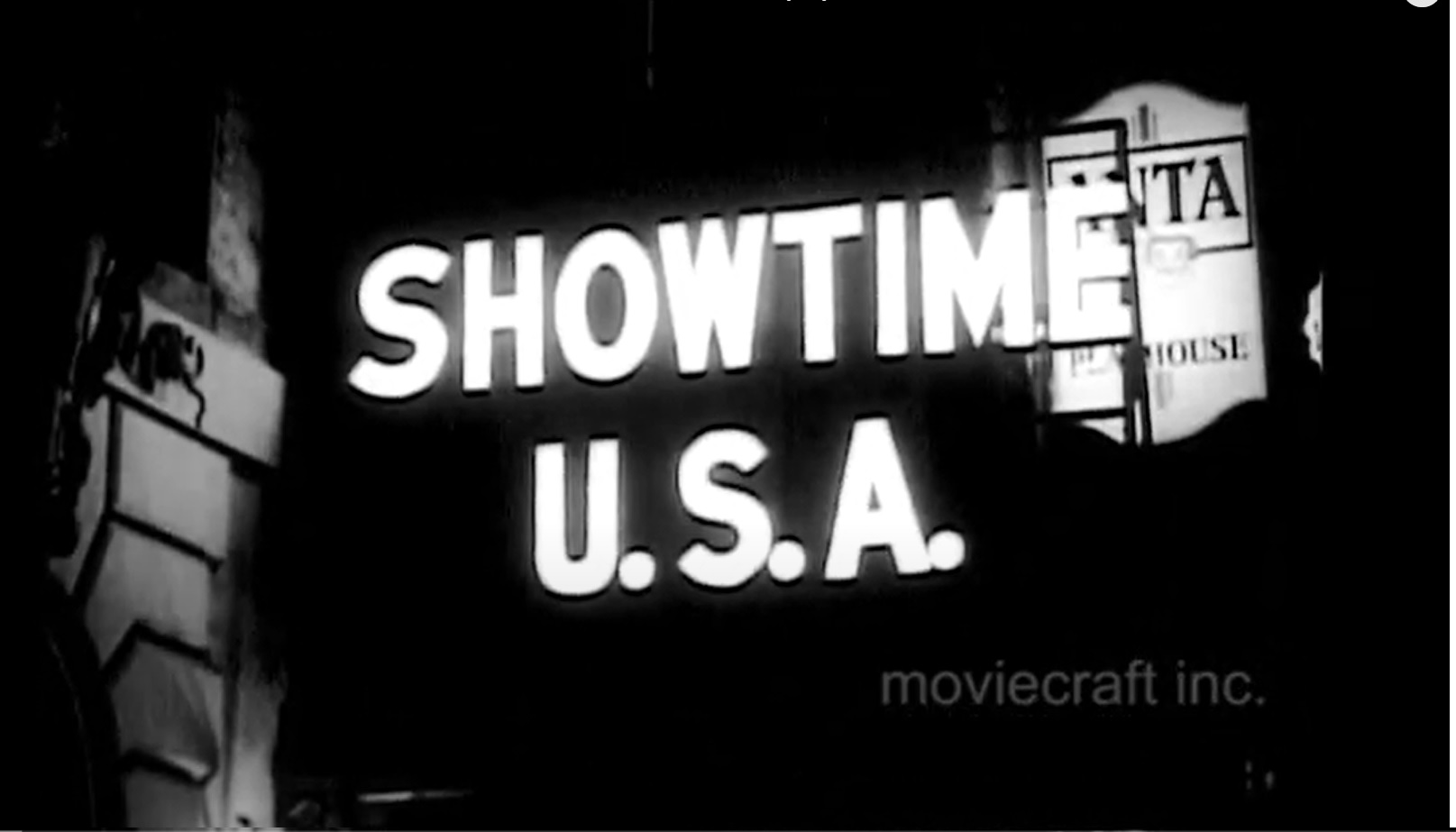
SHOWTIME U.S.A. (2/4/51): Ostensibly a showcase for the best of the New York stage, the short-lived TV series Showtime U.S.A. comes off as a self-aggrandizing project for its host, Vinton Freedley, the president of the American National Theater Company. From the moment the top-hatted Freedley smugly steps from his Sutton Place apartment building and into his chauffeur-driven 1951 Dodge, it's clear that he wants the lowly viewer to hold him in the same awe as he does himself. (What do you expect from a guy named Vinton Freedley?)

Perhaps realizing that nobody outside Broadway knew who he was, Freedley turns the rest of the hosting duties to Eva Gabor, who can't make enough jokes about her Hungarian accent. One dismal act after another follows: forgotten singer Johnny Johnston; forgotten actors Georgina Cookson and Michael Evans; and forgotten comic Florence Desmond impersonating the forgotten entertainer Hildegarde. This is the best of Broadway?

No, this is: the finale with John Garfield in a scene from Peer Gynt, in which he was then starring at the ANTA Theater on 52nd Street. For fans of Garfield's movies, his appearance here gives a brief, tantalizing taste of his stage work; this, folks, is the original Brando, the first Method actor to achieve mass appeal stardom. In just five minutes, the 38 year-old actor holds your interest in a way the previous "entertainers" on the show could only dream of. Typical of live TV at the time, Showtime U.S.A. runs long, abruptly cutting to the ABC-TV logo at the end of the scene. It never occurred to Vinton Freedley to forego one of the earlier acts to give Garfield an extra five minutes? Some producer he was.

BONUS POINTS: The then-current theater marquees featured in Showtime U.S.A.'s opening credits are a reminder of how far Broadway has fallen since John Garfield's time. Wait, that isn't a bonus after all.

                                                               ************

Saturday, April 30, 2022

MOVIE OF THE DAY: "MIDNIGHT" (1934)

One of the most interesting movies Humphrey Bogart ever appeared in was made before he was a star; underwent a title change several years later; and is virtually unknown today. And Bogart himself is onscreen for roughly 10 minutes. That's the trade-off the greats have to make for getting a mention on this blog.

In the strangest meet-cute ever, Stella Weldon flirts with Gar Boni at the murder trial where her father, Edward, is the foreman. And just to get this out of the way, I have no idea what the hell kind of name Gar Boni is, but he's eventually described as a "foreigner". With a name like that, I'm thinking he's from Jupiter.

Who cares that my father is sending a woman to
the death house? This guy is cute!

Gar never explains his profession to Stella, but judging by the rod he's packing, it doesn't seem like he's a shoe salesman. To Stella's sorrow, after several months of dating, her bf is going to Chicago for a while to acquire some "hard money", which sounds like a sack of silver dollars. 

Stella's father Edward, having asked the woman on trial a question that eventually led to a guilty verdict, has been justifying his actions right up to the evening she's going to the hot squat.  Man, I'm glad juries in New York can't ask questions of the defendants; I'd probably be found in contempt of court. Maybe of humanity, too. 

Nolan promises to doxx Joe if he doesn't let
him snoop on the family.
Distracted by the budding romance between Stella and Gar, Edward doesn't
realize that the friend his layabout son-in-law Joe has brought over the house is Nolan, a reporter who's eavesdropping on what is laughingly considered private conversations.
This is why people hate reporters.

Midnight stars O.P. Heggie and
Sidney Fox -- with those 
names, can you tell which is
which?
Meanwhile, relatives have dropped by to play bridge, which is the thing to do when your host is on the verge of a stroke from -- all together now -- sending a woman to her death.  As the midnight execution approaches, Stella sneaks out of the house to meet with Gar in a desperate attempt to run away with him. But he's got other things on his mind, like women not named Stella. Life happens, right? 

Just as the switch is pulled at the prison, Stella returns home to claim that she's killed Gar. Her father, cold and hard as a bag of frozen steak when it came to ordering a woman's life taken in return for her actions, now has to decide if his daughter should face the same consequences.

Thanks to its stage origination, Midnight presents philosophical dilemmas not often seen on the screen. As Edward doubles down on his belief that the death penalty was warranted, he gradually feels the pressure of what he's done -- even as he appears to believe that his daughter should feel the full weight of the law, too. What a dad! But at least he's consistent.

Just one of many moments where Midnight's 
actors are looking right at YOU.
Where Midnight really excels is its look. Clearly adapted from a one-set stage play, director Chester Erskine, only 29, uses every trick at his disposal to jazz things up visually. With rapid edits, tense close-ups, and, especially, cutting back and forth from the Weldon living room to the prison with characters' actions mirroring each other, Midnight doesn't look like the average studio picture of its time. (It was an indie production released by Universal). If it resembles anything at all, it's the remarkable The Sin of Nora Moran, the low-budget drama only recently receiving long-overdue acclaim.

While all the actors are fine, Henry Hull (Nolan) and Lynne Overman (Joe) are standouts, being natural in their delivery and even physical movement. Bogart, of course, creates an impact because he's Bogart, period.

Nothing in this poster
reflects the movie.
In Midnight's 1934 original release, Bogart's name was second to last in the posters. In 1947, fly-by-night outfit Guaranteed Pictures rereleased it as Call it Murder, promoting it as a new movie "starring" Humphrey Bogart with contemporary images on promotional materials. This sham likely confused younger audiences while stirring thoughts of Didn't I see this years ago? in everybody else. 
The Universal print still exists, though, available on YouTube, and it looks great. Maybe Guaranteed Pictures called it murder, but I think it's fascinating.

Horror movie connection: O.P. Heggie (Edward) played the blind hermit in Bride of Frankenstein, while Henry Hull (Nolan) was the star of Werewolf of London. They don't call them character actors for nothing.

                                                                   ***********
To read about The Sin of Nora Moran, go here.

Tuesday, February 18, 2020

STARS IN OUR EYES

Fully aware of what he brings
to the table.
The recent death of Kirk Douglas was a signal that the participants of "Hollywood's golden age" are fast disappearing. In fact, Kirk might have been the last of the greats.

It also served as a reminder that some people are born to be not just actors, but movie stars. One look at Kirk in his prime, and you know this isn't a plumber, bursar, or milkman. He isn't even a leading presidential candidate in the JFK mode. This is a S*T*A*R!

Even the name Kirk Douglas tells you everything you need to know -- everything except he was born in upstate New York as Issur Danielovitch, the son of Russian immigrants. So when you think of Jewish movie stars, forget Woody Allen for once and go with Spartacus.

Nobody in movies today looks remotely like Kirk Douglas (except Michael Douglas, and that's only because he can't help it). Actors like Tom Cruise and Leonardo DiCaprio strive to look forever young, as if they even sleep with sunblock with a 95 SPF.


On the other hand, when you consider that Humphrey Bogart and
Tom Cruise are both age 56 in these photos, maybe taking care of
yourself isn't such a bad idea.


Kirk Douglas' movie debut in 1946 must have been a shock to audiences. Consider three of the most popular movie stars from a little over a decade earlier.


Gaze upon those faces carefully. Now picture them on a movie screen. Today's audiences would turn away in revulsion, these actors suitable only for the latest chapter of the Saw franchise. In no way, shape or form does this trio look like movie stars by our standards. Yet for theatre owners in 1932, booking a movie starring any of them was like printing money.

Talent and personality be damned -- neither George Arliss, Marie Dressler nor Wallace Beery would get past the studio security guards today. But back in the early 1930s, they were just what the doctor (i.e., studio accountants) ordered. Arliss reeked of class in a time of Depression, while Dressler and Beery were simply relatable.

For whatever reason, people just looked different back then. Or did they? Study these two compelling photos taken roughly a century ago.


The melancholy young woman and disheveled fellow could be featured in a Wes Anderson movie. Who they don't look like, at least at first glance, are ZaSu Pitts and Charlie Chaplin. It makes you consider the magic of make-up, costumes, and making funny faces for the camera.

Is it possible that movie actors of different times could switch places without anyone being confused? Only two came to mind -- and I'm talking physical, not stylistic, similarities. As I studied their photos, the resemblance came primarily from their younger days.


Could be half-brothers, right? Although it might be more obvious they are, in actuality, Paul Muni and John Malkovich, as you can see when they're older:


Well, whaddaya know -- there's still a resemblance, kinda sorta. Would Malkovich have made it as an actor in Muni's time? On stage, very likely. On screen... perhaps in supporting roles made popular by Dwight Frye, aka Renfield in Dracula.

So perhaps some actors really are essentially interchangeable with those of the past. Let's sign off by comparing a 1950s soiree with Vogue's 2019 Young Hollywood Party:


Well, there goes my thesis all shot to hell.

                                                       ***************