By 1942, Hal Roach was no longer the powerhouse comedy producer he once was. Having lost or sold off his most popular stars -- Laurel & Hardy and Our Gang -- he tried to turn his little studio into one of the majors. Initially, it seemed to work, releasing classy A-list features like Topper (starring Cay Grant) and Of Mice and Men (with an original score by Aaron Copland).
But with our involvement in the War, the US Army commandeered the studio to make training films, leaving him only a fraction of the space he needed to continue his cinematic output.
For the remainder of the decade, Roach released what he called "Streamliners" -- 45-minute B-movies that were too long to be short subjects but too short to be considered features.
 |
Satan learns there's no severance
package in Hell. |
Hands down, the best of these Streamliners has to be the bizarre comedy/fantasy The Devil with Hitler. Hell's Board of Directors has decided that Adolf Hitler would make a swell CEO, being far more evil than the current office-holder, Satan. The Jeff Zucker of his day, Satan begs for another chance, making a deal with the Board: he will visit Hitler and prove that the Feurher is capable of one nice gesture, and thus lacking what it takes to run things down below.
 |
| A menage-a-trois I'd rather not think about. |
Satan arrives in Berlin and immediately weasels his way into Hitler's inner circle. (Wal-Mart seems to have better a security team than Hitler.) Satan plays on Hitler's feelings(!), getting to admit that, yes, sometimes he feels bad about wiping out villages or sending prisoners to concentration camps. But Hitler snaps out of it in time to welcome his visitors, Benito Mussolini and his Japanese counterpart Suki Yaki. (Apparently the writers hadn't heard of Hirohito.) A visit from a fast-talking insurance salesman, however, convinces the three leaders to secretly take out policies on one another. This leads to a lengthy scene where they discover time-bombs in their beds, forcing them to sleep together, bombs in hand, while trying to sneak out of the room one at a time. (It makes even less sense than it sounds.)
 |
| Two Hitlers + one explosive = endless hilarity. | |
They all survive, only to have Satan disguise himself as Hitler and tell the guards that the real Hitler is an impostor. Further mix-ups ensue when they all wind up in an exploding munitions building. Scared out of his wits, Hitler bows to Satan's command to perform one good deed: freeing a couple (the insurance guy and an ex-Nazi agent) rather than sending them to a concentration camp as planned. Hitler is killed in the explosion and sent to Hell. Having watched Hitler's good deed on their proto-HDTV, the Board of Directors realize he's not fit to rule Hell. "That's only the beginning, folks," Satan assures us as the Board takes Hitler out for a beating, "only the beginning!"
 |
| A laffing, panicky crowd outside the Globe Theater in Times Square. |
 |
If this doesn't make you want to see
The Devil with Hitler, there's something
wrong with you. |
Many would posit that The Devil with Hitler is no competition for Charlie Chaplin's The Great Dictator. I'm not so sure. Granted, the latter is more sophisticated in every way possible. (The sets in The Devil with Hitler look like they could fall over if you sneezed near them.) Yet it also takes an extra 80 minutes to make the same point, and without the pathos-laden subplot, either. Heck, you could even say that, at 18 minutes, the Three Stooges' You Natzy Spy outdoes them both.
In his book Forgotten Horrors 2, Richard H. Price describes The Devil with Hitler as a laugh a minute. While I wouldn't go that far, I have to admit I laughed more than I do at most contemporary comedies, and often for the right reasons.
 |
| Even a dictator needs a luffa now and then. |
Bobby Watson's bravura performance as Hitler is worth the price of admission. (Early on, he tells his hapless servant, "You are fired! Report yourself to the Gestapo and tell them to shoot you -- and get me a new valet!") Hitler comes off as simultaneously egotistical, malevolent and effeminate, giving a vitriolic radio speech while lounging in a bubble bath as an aide plays recorded applause after each sentence.
Later, he relaxes by painting a wall while skipping back and forth like a little girl. This stereotypical "pansy" portrayal goes further by having him rammed directly in the rear end three times -- first by a large remote-control toy airplane, then by an artillery shell and finally by the devils' pitchforks.
 |
| Hitler fondles the airplane with anticipation. |
Other laughs come from the simple ridiculousness of the production. British character actor Alan
Mowbray, the poor man's Sir Cedric Hardwicke, plays Satan with what looks like a badly-designed bathing cap with two tampons atop his head. Joe Devlin's buffonish Mussolini sports a burlesque Italian accent ("Hey, whatsamatter for you?!"). George E. Stone, taking a sabbatical from playing Boston Blackie's sidekick at Columbia, is Suki Yaki, the typical buck-toothed, goggle-glasses-wearing, photo-taking "Jap" so prevalent during World War II. (Did the Axis produce equally over-the-top parodies of the Allies?)
 |
| A suggestion for your next Halloween party. |
The slapstick often provides I-can't-believe-what-I'm-watching entertainment for its very crudeness. I dare you not to laugh when the three despots try to avoid the runaway toy airplane, or when Hitler falls backwards off a painting scaffold. Yet one very brief yet effective dramatic moment of a prisoner being tortured for information drives home that this Nazi business was, in the end, no laughing matter. The rest of The Devil with Hitler reminds us that there was a time when it was OK to make fun of the enemy without even the allies getting offended. Imagine that.
Hal Roach admitted to Richard H. Price that both The
Devil with Hitler and the Army's occupation of his studio were
something of a penance. In 1937, you see, while on vacation in Italy, Roach was contacted by representatives of Benito Mussolini, a serious Laurel & Hardy fan. As Roach explained it to another film historian, Randy
Skretvedt: "The first thing I said was, 'The motion picture business is a Jewish business. If you have sanctions against the Jews, forget this talk, because I want no part of it.' Mussolini was not anti-Semitic at that time." Just so we have that straight.
 |
Hal Roach: "I never met a
Fascist I didn't like." |
Out of that pleasant afternoon came a deal: Roach would supply American technicians to shoot movies in Italy starring Italian actors. A studio was born: RAM -- short for Roach And Mussolini. As a goodwill gesture, Roach brought Il Duce's son, Vittorio, back to Hollywood to introduce him to the industry movers-and-shakers. (Is this starting to sound like a Coen Brothers comedy or what?)
Strangely, nobody had any interest in knocking back a beer with a Fascist dictator's son. I guess they didn't get the word -- Benito's OK with you guys for the time being! With RAM now just another broken Hollywood promise, Vittorio returned home empty-handed.
Four years later, Mussolini declared war on the US. Causation or correlation? I leave it to you.
This wasn't Roach's first brush with politics. He was one of the many members of the right-wing American Liberty League, a group of wealthy businessmen who were against the New Deal. I mean, really against. How against? In 1934, Roach and his fellow patriots allegedly tried to engineer a military coup against President Roosevelt. Cue the Laurel & Hardy "Cuckoo" theme.
Hollywood had forgotten these moral detours by the time Hal Roach received a special Academy Award in 1984 (or maybe he just outlived everyone who remembered). He died in 1992, just two months shy of turning 101. To the end, he swore that his Streamliners were the right length for any comedy. And when you consider Adam Sandler movies have been known to run up to two-and-a-half hours, 45 minutes of The Devil with Hitler looks pretty good.
******************
Memo to the Coens: Oscar Issac as Hal Roach
John Goodman as Benito Mussolini
Seth Rogen as Vittorio Mussolini
Damien Lewis as Stan Laurel
Jack Black as Oliver Hardy
Steve Buscemi as Josef Goebbels
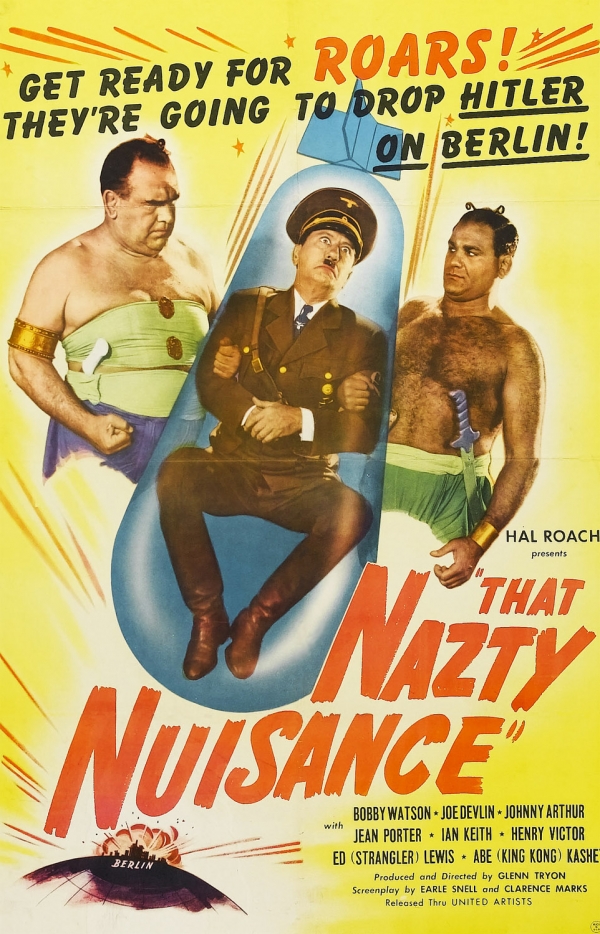
 Clearly, anyone expecting another The Devil with Hitler won't be getting their money's worth here. As movie follow-ups go, Nazty Nuisance isn't even The Godfather 3, and that featured Sofia Coppola in a major role. The problem, as usual in these kinds of situations, is the idea itself. Nazty Nuisance lacks not only the bizarre story of its predecessor, but an exact title as well. The posters say That Nazty Nuisance. The movie credits read simply Nazty Nuisance. Maybe somewhere there's a preview where it's called Nuisance.


