Showing posts with label FREDRIC MARCH. Show all posts

Wednesday, March 2, 2022

THE EARLY SHOW, PT. 2

My 4:30 a.m. wake-ups seem to be a thing of the past. Now I'm rising in the usual 5:30-6:00 range. This still gives me time to occasionally catch a quality (by my standards) movie or TV show that have been lost to time but deserve a quick mention -- the same way I'll be treated after I'm gone. Alphabetically:


BRAVE EAGLE (1956): A short-lived TV series told from the perspective of the Native Americans. In the episode titled "Moonfire", white settler Penny Pattifore is rescued by Chief Brave Eagle from the clutches of an opposing tribe. Initially frightened, Penny, given the honorary tribal name Moonfire,  decides she'd like to go native with Brave Eagle and company. She's rebuffed by Smokey, the tribe's token halfbreed, which sounds a little hypocritical if you ask me. Penny decides her fate by sitting atop a "vision rock" (no mention of psilocybin being involved). Her uncle, Col. Matthews, is ready to kill her new friends in order to bring her back to "civilization". Luckily for them, Penny decides cultural appropriation isn't cool after all. She wouldn't have looked good in a headdress anyway.

One of the dozens of 1950s TV Westerns, Brave Eagle deserves to be commended for making the usual bad guys into the heroes. And by "heroes", I mean knowing their place. Brave Eagle goes so far as to provide safe passage for white people who, of course, are stealing his people's land. That's the kind of redskin we like!
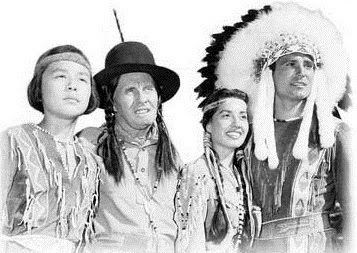
Where it doesn't differ is that almost all of the lead characters are played by whites.
 Keith Larsen, as Brave Eagle, looks as Native American as Errol Flynn. I mean, he doesn't even wear that stupid red make-up you see in these things. 

But what puts Brave Eagle into whacko territory is that his sidekick Smokey is played by Bert Wheeler of Wheeler & Woosley fame. And despite being the only actor wearing "Injun" make-up, Wheeler delivers his lines in his usual wisecracking style, as if Smokey's white father had been a pre-vaudeville comedian. Again, the halfbreed hypocrisy is stunning.

Brave Eagle's contradictions put today's woke viewers in a bind. Respecting Native American culture, heritage, and knowledge: good! Not respecting it enough to cast a real Native American in the lead: ugh!

BONUS POINTS: When informed that his niece Patti has gone to the vision rock, Col. Matthews simply accepts the explanation rather than saying, as any 19th-century American soldier would, "What the fuck is a vision rock?!"


CHLOE, LOVE IS CALLING YOU (1934): Mandy, a/k/a Mammy, returns to her home in the Florida Everglades seeking revenge on Col. Gordon, the white man she believes lynched her husband 17 years earlier. Accompanying Mandy is her daughter Chloe, and her assistant Jim, both of whom had white fathers. Chole resists Jim's amorous moves while finding herself attracted to the white Reed Howe, who manages Col. Reed's turpentine factory (what a man!). Chloe soon discovers that she's actually Col. Gordon's daughter and was kidnapped by Mandy as a baby. She's now free to marry the white guy -- yay for the honky girl! -- if she isn't sacrificed in a voodoo ceremony first.

Wowwee! Chloe, Love is Calling You has it all -- racial politics, interracial love, black stereotypes, voodoo, and authentic animal abuse. A mainstream studio release this is not.

Yet for all its, shall we say, debatable social viewpoints, the movie, at least in the beginning, makes Mandy sympathetic. Can you blame her for wanting revenge on the guy who allegedly lynched her husband on "the death tree"? That alone sets it apart from other movies of its time.

But once we learn that Col. Gordon is innocent of the charge, and that Chloe is actually 100% pure-as-Ivory Snow white, it regains its footing as a weird, racist, low budget indie exploitation melodrama that will never be run in any film studies class today.

Chloe, Love is Calling You was the last stop for lead actress Olive Borden, whose bad attitude, drinking habits, and difficulty transitioning to sound saw her fall from $1,500-per-week, 1920s stardom to alcoholic scrubwoman at a skid row homeless shelter in downtown L.A. That's Hollywood!

BONUS POINTS: The climactic voodoo ceremony, featuring Chloe being lowered over a flaming pit, is pretty creepy. As are the real scenes of a snake being smashed in half, and a man wrestling an alligator underwater before stabbing it to death. You don't see that kind of thing in movies anymore. 


MEET THE MAYOR (1932): Imagine Forrest Gump, only with a slightly higher IQ and never getting laid. That's elevator operator Spencer Brown. But he's smart enough to help best pal Harry Bayliss invent a home recording device which eventually gets the goods on the honest mayor's crooked rival. Just not smart enough to realize the girl he crushes on loves Harry. What a dolt.

Likely realizing his suave stage persona didn't play outside of the New York stage, Frank Fay's characterization of the smalltown Spencer Brown -- a cross between Harold Lloyd and Harry Langdon -- was a desperate attempt to achieve the movie stardom that had eluded him. His low-key performance is occasionally affecting, particularly when he forces the mayor's rival to drop out of the race. Yet none of the major studios would release the Fay-financed Meet the Mayor, despite it being no worse than many movies of its time. 


Perhaps it was because Frank Fay -- the first stand-up comic -- wasn't boffo box office. On the other hand, being a raging anti-Semitic racist who counted Franco supporters, the Ku Klux Klan, and the American Nazi Party as his best only friends couldn't have helped. 

The two-bit outfit that finally released Meet the Mayor in 1938 -- six years after its production! -- must have had second thoughts as well, seeing that Fay's name on the opening credits is about the size of the copyright notice. That's what happens when your star would have been comfortable in a movie called Meet the Fuehrer. 

BONUS POINTS: Meet the Mayor is the earliest movie I know of that uses the phrase "Looking out for number one" and the slang "coffin nails" for cigarettes. Do I win a prize?


PAROLE, INC. (1948): Special agent Richard Hendricks goes undercover to find out why the locale parole board keeps freeing dangerous prisoners. He infiltrates a posse of low-rent gangsters, who seem to do nothing but play cards at a diner all day. (Maybe if they committed a few more crimes, they'd get somewhere.) Hendricks soon discovers their puppet master -- a lawyer -- is paying off the board members. That's one way of having a constant stream of clients returning to you, even if it does cost a few bucks off the top.

Low budget B's like Parole, Inc. did a better job of showing the seedy criminal underworld than the A's. Actors like Bogart, Robinson, and Cagney always seem like they're living the good life. You can tell just by looking at the crew in Parole, Inc. that they reek of cheap cologne, Lucky Strikes, and stale Ballantine Ale. There's nothing romantic or exciting about these yeggs and their lifestyle. 

Everybody is reminiscent of actors that the producers couldn't afford. Michael O'Shea, as Hendricks, is a cut-rate Dan Duryea. Turhan Bey, the lawyer, sounds like George Sanders despite being of Austrian/Turkish/Czech heritage. His sweetie, Evelyn Ankers, is vaguely reminiscent of Joan Crawford, though less glitter and more gutter.

Between the cast, cheap sets, and not-so-great dialogue (crooked parole board member facing cops with tear gas: "They've got gas and I've got sinus trouble!"), Parole, Inc. is a more accurate look at low-rent criminals than anything Warner Brothers made. Just not as good.

BONUS POINTS: Michael O'Shea speaking the phrase "punchboard racket" with a straight face. Also, one of only four movies credited as "An Orbit Production." 


THE STUDIO MURDER MYSTERY
(1929): Who killed leading man Richard Hardell? Was it his wife Blanche, who was sick of his 
tomcatting? Hardell's sidepiece Helen MacDonald, who learns he will never leave Blanche? Helen's brother Ted or her father, both of whom hated Hardell? Hardell's director Rupert Borka, who suspected Hardell of fooling around with his wife? 

Brother, if you can't figure it out by the end of the first reel, you have no right to watch any mystery. No matter. Movies like The Studio Murder Mystery are strictly for pleasure. Not only do we see the Paramount Pictures soundstages when they're not in use, we also glimpse a recreation of how silent movies were still being shot. Too, many scenes take place outside the Paramount gate, where the actors' breaths are visible in the nighttime scene. L.A. must have been mighty chilly in early '29. 

Unlike other early talkies, The Studio Murder Mystery showcases actors delivering their lines in normal tones rather... than... very... slowly. Fredric March (Hardell), Warner Oland (Borka), Eugene Pallette (Detective Dirk), and Neil Hamilton (wiseacre gagman Tony White) enunciate while still sounding like real people -- if real people had a script at the ready. Although it's still impossible not to hear Oland without thinking of his soon-to-be career-changing move as Charlie Chan. (Why does a Swedish-born actor playing an Eastern European sound Asian?)

At 62 minutes, the fast-paced The Studio Murder Mystery never has a chance to be dull. What it lacks in genuine mystery it more than makes up for with entertainment. But it kind of makes you wonder what Fredric March thought being killed off ten minutes after the opening credits.

BONUS POINTS: Studying the reactions of Florence Eldridge as Hardell's two-timed wife, since in real life, she had to put up with the same sexual shenanigans from her husband -- none other than Fredric March! Talk about method acting.

                                                         ****************

Wednesday, April 25, 2018

KLAN MARCH

The two sides of Fredric March.
When it comes to the great actors of the past, few compare with Fredric March. Star of stage, movies, radio, and television.  A long list of great screen performances -- Dr. Jekyll & Mr. Hyde, The Best Years of Our Lives, Death of a Salesman, Inherit the Wind, to name a few. The only person to have won two Oscars and two Tonys. Member of the Ku Klux Klan... Wait, what?

According to a University of Wisconsin "task force" assigned to "investigate" the school's past transgressions, Fredric March -- UW graduate, class of 1921 -- was indeed a member of a campus fraternal organization called Ku Klux Klan. Well, give them credit for being easy to understand. None of that Phi Gamma Gooma stuff for them.

Naturally, the faculty is going into overdrive putting things "in context" -- not so much to defend March but the school itself for allowing a Klan offshoot on campus.  UW archivist Joshua Ranger reminds us that Fredric March and his fellow fratbotys "weren't the same as the ones you hear about in the South that would terrorize people." I believe the phrase used in relation to such parsing is "cold comfort."


March and his wife Florence review their plans
to overthrow the government.

It should be noted that there's no evidence whatsoever that March continued to hold Klan beliefs after graduation. He was, in fact, a pro-Civil Rights political progressive who campaigned for Socialist writer Upton Sinclair in his 1934 run for governor of California. A decade later, March was one of many show business personalities who signed a petition condemning the House Un-American Activities Committee. By 1949, he and his wife really hit the political big time when the FBI officially declared them Communists. (Take a number.)


Walter Brennan shares some good
assassination news with John Wayne.
Compare March's CV to a 14-karat showbiz right-winger like three-time Oscar winner Walter Brennan, who often made anti-Semitic remarks on the set of The Real McCoys, and was delighted by the assassination of Martin Luther King, Jr. Or John Wayne, who said in a Playboy interview, "I believe in white supremacy, until the blacks are educated to a point of responsibility." That was in 1971, three years after King's death.

But forget those guys. You want to know what a real racist anti-Semite is? Only months after the end of World War II, Broadway star Frank Fay was celebrated at Madison Square Garden by the Klan and the American Nazi Party, an honor Mel Gibson yearns for today.


The University of Wisconsin says
aloha to Fredric March.
So what gives with Fredric March's frat years? Well, what everybody seems to forget is that college isn't just where you go to get some smarts. It's also where you can get away with stupid things for four years, or try out some outrĂ© opinions for size before waking up on graduation day. I wish I had a buck for every white college kid today who says something like, Black conservatives -- they shouldn't be allowed on campus, ever. 

Or, perhaps in Fredric March's case, I believe in white supremacy, until the blacks are educated to a point of responsibility. Because in 1921, the Klan was more popular than Facebook is right now. And within a few years of graduating, March was more "woke" than a millennial jacked-up on Red Bull.  

But due to a stupid thing he did almost a century ago, students want to rename UW's Fredric March Theater. Considering that nobody attending the school in the last 40 years ever heard of him, they wouldn't consider it a loss. Who cares about a racist who was in black & white movies? Let's watch Braveheart again. Mel Gibson's such a badass!    

UPDATE (2024): It seems that the Klan frat had nothing to do with the real Klan. The only they had in common was sharing the same name. Once the frat members learned about the other KKK, they changed the name. So now March's "cancellation" makes even less sense -- like college itself. 

                                                *****************************

Friday, August 29, 2014

MOVIE OF THE DAY: "AN ACT OF MURDER" (1948)

Anyone who tells you that present-day Hollywood movies are more mature than ever should seek out An Act of Murder. Really, I'd like to see a writer pitch an idea involving a middle-aged couple and euthanasia. "Are you crazy?" would come the reply. "A middle-aged couple?!"

Calvin Cooke is a hanging judge, following the letter of the law like a senator follows a Gallup poll, sentencing criminals to 20 years when 20 days would be more appropriate. His straight-arrow attitude is put to the test when his wife, Catherine Cook, is diagnosed with a fatal disease found exclusively in studio sound stages. Her doctor informs Calvin of her illness, while keeping Catherine in the dark. The Hippocratic Oath, as we know, states, "First, tell no truth."

Unwilling to let his wife suffer as she deteriorates, Calvin makes a split-second decision to kill her and himself in a car crash while returning from vacation. He survives, however, and, rather than taking it on the lam with a cutie-pie half his age like anyone else would, turns himself in for murder. (Remember, this is a movie.) His future son-in-law, David Douglas, whom he loves like a lice-infected cavity, volunteers to take on the case.

In 1948, this was normal. Today, audiences
would throw up.
Other than all those alliterative character names, An Act of Murder is an adult movie that would put most of today's releases to shame. What strikes you almost immediately is that there was a time when mature (i.e., older-looking) actors took the leads in A-pictures. Fredric March and Florence Eldridge look every bit their ages -- 51 and 47 respectively -- and then some. Way then some. (To put it in perspective, Brad Pitt is 51 and Sandra Bullock is 50. And don't tell me about good genes, unless you're talking about those belonging to their plastic surgeons.)

Can you think of any actor, other than George Clooney, who doesn't appear to be in arrested development?  Or an older-looking actress who isn't relegated to character roles? This couple is in love, and you get the feeling they still get it on once in a while. Perhaps that's because March and Eldridge were married in real life, which must have given their on-screen situation a little more charge. Hey honey, I've got a script for us where I kill you. No, really, you'll like it. Let's rehearse.


Judge Cook not only learns that his wife is dying,
the long-distance phone call isn't
considered a deductible, either.
As usual in old movies, the medical stuff is a little sketchy. Catherine's disease is never quite spelled out -- her doctor alludes to a "neuroplastic situation," admitting that any disease with several names is something medical professionals don't know anything about. You can trust this guy, right? Especially when his first bit of advice to Calvin when breaking the news is, "Have a cigarette." His colleagues' bedside manners leave a little to be desired -- like, oh, compassion -- telling Calvin during a conference call, "Surgery is useless" and "Death is indicated at any time." Don't forget to pay the receptionist on the way out! 

Following doctor's orders -- other than smoking cigarettes -- Calvin keeps the diagnosis from Catherine, in order to make her final days that much more peaceful. Like dropping coffee cups, falling into mirrors, and going blind are peaceful. Calvin gets a prescription of Demorine to give Catherine when necessary, with the warning that
"Let me get you a flower for your funeral --
I mean, corsage!"
more than two every 12 hours could be fatal. I Googled "Demorine," and the only thing I found was someone on Facebook, so that must be another of those only-in-Hollywood medical things.


But Calvin can't stand to see his wife suffer. An idea is planted when a medical advertisement reading, none too subtly, KILL THE PAIN catches his eye in a drugstore. A moment later, that idea blooms when a dog who's been hit by a car is put out of his misery by a friendly cop. Muttering, "Well, we can't let him suffer," he pulls out his gun and blows its head off. Paws up, don't shoot!

The Judge is up for murder, but he's just pissed-off
his daughter is sleeping with his lawyer.
Watch enough old movies, and you get to appreciate actors you took for granted on TV in later years. In An Act of Murder, that would be Edmond O'Brien as David Douglas, the lawyer who believes there's more to justice than law. Or the other way around. Only 33 but looking 50, he doesn't quite appear the ideal suitor for Cook's law-studying daughter, Ellie, played by 23 year-old Geraldine Brooks. (Everybody looked older then.) And talk about different times -- Calvin doesn't blink an eye when Ellie casually smokes in front of him, like it was normal.  Which it probably was back then.

It's Ellie who gives David an idea that leads to An Act of Murder's twisty climax, which I won't reveal. However, Fredric March's closing lines still resonate today, if only accidentally. Realizing that intentions can be as important as legalities, he admits that a person must be "judged not just by the law but the heart" -- words similar to those used by Barack Obama when nominating Sonia Sotomayor to the Supreme Court. That guy really does have a thing for Hollywood.

Can you imagine a studio today
backing a major movie with this
couple in the lead roles?
Even during a time of grown-up movies, An Act of Murder probably stood out. It was, in fact, nominated for the Cannes Film Festival's Grand Prize. It holds up quite well, still packing several punches, with Fredric March giving his usual classy performance (something else sadly missing from most actors today). Like its leads, An Act of Murder is a mature piece of work -- one that continues to make profound statements on human nature and what really counts when judging a person's actions. Unlike, say, Transformers Part 3.

Pay no attention to the image of
a car driving off a cliff, folks!
But as with Freud 14 years later, Universal-International Pictures got a little skittish about the title, eventually re-releasing it as Live Today for Tomorrow -- what the hell does that even mean? -- which sounds like a homily you'd see hanging in somebody's laundry room. Adding insult to artistic injury, the one-sheet's design makes it look like a love story instead of, uh, an act of murder. For that alone, the head of the marketing department should have been force-fed a bottle of Demorine.

                             ***************