Showing posts with label CHARLES LAUGHTON. Show all posts

Monday, July 15, 2024

THE EARLY SHOW, PT. 38

 The only thing these four movies have in common is murder. I must get out in the fresh air some more.

PICCADILLY (1929): Likely one of the last great silent movies out of the UK, Piccadilly is probably one of the handsomest as well, a big-budget drama that could pass for a major US studio release (no offense to the British film industry), and a terrific vehicle for German director E.A. DuPont as much as its star Asian-American legend Anna May Wong. From its clever opening credits (resembling bus advertisements) to its ironic closing images, Piccadilly is often startingly entertaining. 

For some sensitive souls, its story might border on -- oh heck, let's say proudly resides in -- Asian-fetishization. Which is the whole point, children. Nightclub owner Valentine Wilmot falls hard for scullery-worker-turned dancer Shosho. This puts him in dutch with Mabel Greenfield, his club's former star and longtime paramour. Shosho, having lived forever in a Limehouse flophouse, is more than willing to take advantage of Wilmot's attentions, even if it means risking the relationship with her Chinese boyfriend Jim. Both Jim and Mabel notice what's going on; sooner or later one of these saps is going to snap.

One of Piccadilly's more interesting takes is how the principal Chinese characters positively drip with contempt for their white "betters". (King Hou Chang, as Jim, puts a whole new spin on the fine art of sneering.) Say what you want about Wong's Shosho, she is 100% in charge of her relationship with Wilmot, even when such a thing was, if not verboten, at least frowned upon. (It's easy to think that top-billed Gilda Gray felt like her character Mabel while watching Wong steal the movie from under her dancing feet.)

Aside from Jameson Thomas as Wilmot, a couple of other actors are worth a mention. If you were one of those kids in the 60s who watched Mary Martin's Peter Pan, you'll likely not recognize its Captain Hook, Cyril Ritchard, in his brief role as a dancer. But you absolutely cannot miss 30-year-old Charles Laughton in his even briefer part as the grotesque, demanding guest eating dinner at the club, in what looks like the prototype for the character of Mr. Creosote in Monty Python and the Meaning of Life. Almost a century after its release, the British Film Institute's restored print of Piccadilly (and its classy new score) can easily hold the attention of a willing, receptive audience.

BONUS POINTS:  Piccadilly has a five-minute sound prologue featuring Jameson Thomas and an unidentified actor setting up the story, filmed as a sop for audiences who were already turning their back on silents. Technically crude and creaky, it's a harbinger for what movies would become for the next year or two before coming up to speed.


THE KISS BEFORE THE MIRROR (1933): Vienna: Land of sausages! Snow globes! Murdering your wife for cheating on you! Well, at least that what Walter Bernsdorf thinks. As his lawyer, Paul Held, tries to put together a defense, he discovers that his wife, Maria, is behaving identically to how Walter's wife Lucy did before her demise. If a plea of momentary insanity works in Walter's case, then it should in Paul's, yes? 

Although a Universal picture, The Kiss Before the Mirror gives off Paramount vibes with its glossy sophistication. All credit goes to its unlikely director James Whale, between his classics Frankenstein and Bride of Frankenstein. Perhaps interested in discombobulating his audience, Whale sets up the movie as a typical romantic comedy of the time, allowing viewers to live vicariously through the adulterous lovers, before Walter unexpectedly shows up to blow his wife's brains out. It's a director's way of saying, Not so cute, is it?

Paul Lukas, as Walter, is a little pathetic -- why do these "mature" guys marry younger women who are way too sexy for them? Yet he offers to plead guilty to murder rather than see Paul kill Maria. And what a pleasure that Paul is played by Frank Morgan, who, as with his appearance in Any Number Can Play, easily makes you forget his dithering comedic parts. This guy had far more range than given credit for.
The Kiss Before the Mirror's nominal star, Nancy Carroll, is Maria (another wife too young for her husband!), whose sweet-on-the-surface behavior flips when Paul rightly suspects her of adultery. But the more interesting casting choice is Walter Pidgeon in his five-minute role of Walter's wife's paramour. Pidgeon's leading man career had momentarily derailed; perhaps Whale took pity on a fellow gay man by giving him what looks like a one-day job. (Pidgeon's primping and pirouetting before his date with Lucy appears to be a deliberate directorial signal to hipper audiences of the day). A forgotten gem, The Kiss Before the Mirror is marred only by what seems to be a studio-imposed happy ending -- which is nicely undercut by a shattered mirror symbolizing Paul and Maria's very imperfect future together. At least that's how I see it.

BONUS POINTS: Michael Mark, best known as the father of the drowned little girl in Frankenstein, is a courtroom spectator. James Whale sure was good to his friends and actors. 

 WHEN STRANGERS MARRY (1944): At the time of When Strangers Marry's release, Orson Welles declared the modest B-picture better directed (by William Castle) and acted than two recently acclaimed big budget releases, Double Indemnity and Laura. And while Welles's opinion is up for debate, When Strangers Marry is nevertheless several cuts above the average B of the time.

In presenting the story of a woman's marriage to a man she's known only three days -- and soon suspects of murder -- Castle manages to evoke more unease than the story has already. Sudden noises, harsh neon lights, confusion as to whether she's seen her husband or has hallucinated him -- no scene ends without a moment of foreboding. No supporting character actor looks ordinary when weird will do. In portraying the couple, Kim Hunter and Dean Jagger manage to squeeze every drop of angst the story offers, while soaking up some more and wringing it out again. Her husband, after all, is a killer... isn't he?

Kim's ally in this nightmare is Fred Graham, played by a fellow named Bob Mitchum. It would be interesting to know what audiences at the time thought of the tall, sleepy-eyed, drawling actor, seeing that even for a B movie he was way different from others of the day. It's a good bet that co-star Neil Hamilton, a veteran of silents, probably looked upon him as other older actors did Marlon Brando some years later: Who is this guy, where is he from, and why does he talk like that?

Within a year, when everyone definitely knew who he was, Monogram re-released When Strangers Marry as Betrayed, changing Bob to Robert to reflect his "new" billing in his star-making role in The Story of GI Joe, and bumping him from third to first place in the credits. As with Humphrey Bogart "starring" in a 16 year-old movie Call it Murder originally titled Midnight, Mitchum probably had a good laugh and toasted the ticket-buyers who were fooled into watching the same movie twice. But you know what? It was worth it. When Strangers Meet may not be Double Indemnity, but it's singularly fascinating, almost entirely thanks to William Castle's unique vision. 

BONUS POINTS: The nearly dialogue-free sequence of Mildred and Paul avoiding the police by wandering through Harlem before winding up at a gin joint is brilliant, and possible only in a B movie.

GREEN FOR DANGER (1946): At a small-town hospital in wartime England, Police Inspector Cockrill investigates the mysterious death of patient Joseph Higgins and flat-out murder of Nurse Bates. Sizing up two doctors and three nurses, Cockrill notes that they're the only ones who were connected to the victims. When one of them, Nurse Freddie Linley, almost becomes the third victim, Cockrill decides he can break the case with a scheme that could leave her on death's door a second time.

The British production Green for Danger is as good an example as any of David Mamet's dictum that any movie can be improved by getting rid of the first 10 minutes. Over half an hour is needed setting up the suspects' personal, psychological and sexual conflicts that would make Fleetwood Mac envious. But when Inspector Cockrill finally takes charge, the story finally works up to a good trot.

As with all good vintage mysteries, Green for Danger's suspects appear to have a motive, or at least act that way, so that our suspicions of the guilty party shift from moment to moment. A love triangle involving Nurse Freddie and the two doctors? The anesthesiologist's previous accidental patient death becoming known? And why did the mailman insist he heard a nurse's voice somewhere recently -- like maybe on a Nazi shortwave propaganda broadcast -- just before his death? 
Yet none of this would matter without Alastair Sim's wonderful, hilarious portrayal of the inscrutable Cockrill. The inspector takes delight in needling the suspects with his keen mind, dry wit, and quiet sarcasm. With a slouched manner and cool fedora, Sims makes Cockrill the British Sam Spade, only funny. Had Green for Danger starred almost any other British actor of the '40s, it would be a pleasant if unremarkable 90 minutes. With the brilliant Alastair Sim running the show, it proves how a truly great actor can, depending on your point of view, elevate a project or fool you into thinking you're watching a movie better than it really is. 

BONUS POINTS: Despite the credits reading "Presenting Alastair Sim as Inspector Cockrill", this was his 35th movie appearance in 11 years. Either Green for Danger was intended as the first in a series with the Cockrill character, or someone at the studio was really unfamiliar with his C.V.

                                                              ***************

Wednesday, November 8, 2023

MOVIE OF THE DAY: "WHITE WOMAN" (1932)

 Was there ever an actor who enjoyed acting with such sordid gusto more than Charles
Laughton? If Warren William was the King of Pre-Codes, then Laughton was its manipulative Crown Prince, humble and by-your-liege one moment before pulling out the dagger the next, sweating, slobbering, and spitting his way to the throne. 

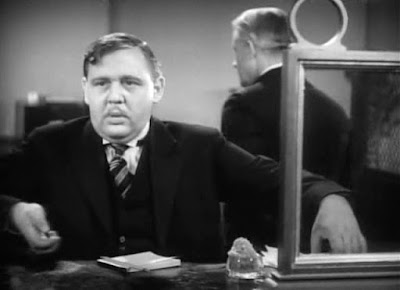
Laughton isn't just aware of his homeliness -- he positively relishes putting it on display, exaggerating his already outsized features to the point of repulsiveness. Even when dressed to the nines as a navy captain in The Devil and the Deep, he's a hideous excuse of a man. But give him tacky clothes, sloppy hair, and a ridiculously archaic walrus moustache as in White Woman, while coated in humid jungle sweat and speaking with a proud cockney accent, he's a nightmare come to life for the likes of a knockout like Carole Lombard.

The look of love is in your eyes...
While the movie's title is White Woman, it might as well be White Slob. Laughton is top-billed and gets the lion's share -- make that wild boar's share -- of screentime as Horace Pin, the autocratic owner of a rubber plantation. Lombard is Judith Denning, a singer who is ordered to leave the Malaysian city where she lives for the crime of -- gasp! --working at an integrated nightclub. Yup, we're in pre-code territory, alright.

Judith, a woman "with a past" (her husband blew his brains out under mysterious circumstances) has nowhere to go. Pin, possessing the amorous style of an overfed hyena eyeing a baby gazelle, offers his pudgy hand in marriage so she doesn't have to wander the world like women with a past have to do. Before you can say "There goes the bride," Judith is living in connubial hell in the middle of a jungle, where all the plantation workers are on the run from the authorities for crimes ranging from drug dealing to murder. At least they didn't sing at integrated nightclubs!

David marvels at how Judith's make-up never
runs in this blasted heat.
One of the workers, David von Elst, isn't so bad -- he just went AWOL from his outfit after one of his fellow soldier's severed head was tossed through his window by angry natives. (I guess they'd have to be angry to do that.) When he and Judith ("the first white woman I've seen in ten years") start doing the hubba-hubba, Pin transfers him to his other plantation downriver. Hey, it's the Depression, and it's better than being fired.


Ballister and Judith decide who has better
cleavage.
David's replacement, a roughhouse named Ballister, doesn't care that Judith is married to the boss, either. But unlike David, he enjoys rubbing it in Pin's face. Too bad for Ballister that Judith isn't interested in rubbing anything in his face. It doesn't matter, anyway; once Pin insults a tribal chief, the natives are out for revenge. David, having risked his life making his way through the jungle, returns to take Judith away, leaving Pin and Ballister to face their fate alone. Some honeymoon!

The menage-a-trois of your nightmares.
Laughton hovers over White Woman -- one of the more outrageously sleazy studio pre-Codes -- like a putrid Geppetto. As in The Devil and the Deep, he manipulates everybody around him for his own amusement. Having grown up poor and looked down upon, he now relishes the reversal that money has brought him. Some bosses feel like killing their employees when they quit -- this guy outsources it to the locals with poison spears. 

To Pin, Judith is just another of his employees, her job merely to be brought low as with the others. Continually addressing her as "your ladyship", you can't be sure if he's serious or sarcastically reminding her how far she's sunk. When he brings her home after the wedding, the first thing he does is show her the bedroom -- articulating the word in a way that sleep is the last thing on his mind. As Judith enters and tries closing the door, he immediately steps in behind her, slamming it shut so that we know what's about to happen is going to ugly indeed. 

Laughton tells Bickford to stop trying to steal
his scenes.
Of the other men in White Woman, only Charles Bickford, as Ballister, can stand up to Laughton both physically and professionally. Whereas Pin mumbles his words, Ballister barks them like a ferocious pitbull. He regards Pin not as his boss so much as his damaged equal, and doesn't care what fate brings him. Despite being only slightly less uncouth than Pin, he's got more personality than Judith's lover David, who, as played by Kent Taylor, doesn't seem like the kind of man a hot number like her would go for. But perhaps that's the whole idea -- she's one of those "bad girls" who comes to realize that a "nice guy" is exactly what she needs. Only in the movies, kids.

Ladies, how would you like this guy
gazing at you every morning?
And then there's Carole Lombard (thought I forgot about her, eh?). Her portrayal of the
unfortunate Judith is sincere and sympathetic. She's lovely to look at, of course, and she can actually sing. You definitely feel bad for Judith being stuck on a tropical hellhole where she gets more enjoyment from the camp's pet monkey than her husband. And even that doesn't last. (I'll let you find out for yourself -- it's too good to spoil.)

But nobody can outdo Charles Laughton, who conveys more with a leer than a dozen leading men can do with an entire script. More than anyone in the pre-Code days, he delights in disgusting the audience to the point where they probably regretted buying a ticket to the movie. That's a real actor.

                                                   ********************

For more Charles Laughton pre-Codes, go to Payment Deferred and The Devil and the Deep.

Monday, January 17, 2022

MOVIE OF THE DAY: "PAYMENT DEFERRED" (1932)

For a teller at a foreign exchange bank, William Marble is pretty inept with money. Not only is he in debt to every store in the neighborhood, his boss has given him 72 hours to repay the dough he lifted from an important client. 

But fortune comes smiling to the Marble home when William's adult nephew James pops by for a visit, flashing a mighty tempting bankroll. When James refuses his host's offer to invest it for him in exchange for a 10% commission, William does the next best thing: he slips some cyanide into James's drink, takes his money, and buries him in the back yard. What's family for anyway? 

Biggest issue I have: Maureen O'Sullivan
is supposed to be Charles Laughton's daughter?

Some contemporary viewers might have an issue with what seems like a major plot problem. Payment Deferred' hinges entirely on Marble's wife and daughter not putting a very obvious two and two together. 

Like, wondering why Wiliam's clothes are covered with mud the morning after James leaves. Or why there's a new grave-sized mound of dirt in the yard. Or where he got the money to invest. Or -- and this should really set off alarms -- why he takes a sudden interest in books about murder by poison.

Haven't you known guys like this?
It's because the great Chares Laughton plays William Marble so convincingly as a mousy bank clerk that there's no way anybody would believe him capable of jaywalking, let alone murder. Even when he's barking at his wife and daughter over household finances, it doesn't seem like anything other than a cover for his self-contempt. 


Mme. Collins makes un idiote out of Marble.

And yet that same self-awareness fails him at a pivotal moment. Knowing that the now-rich Marble has sent Annie and Winnie on a three-week holiday, French neighbor Mme. Collins drops by. The middle-aged temptress quickly seduces him into giving her money to keep her business afloat. Making herself at home, Collins continues their affair  -- and money demands -- until Annie and Winnie return.


If my daughter ever looks at me this way, it'll
be time to pack it in...

Marble's triple-life of investor/murderer/ adulterer starts falling apart. Winnie, now hanging out with a more sophisticated group of friends, looks upon her crude father with condescension. And in an interesting bit of bad news/good news, Annie finally figures out what he's done with his nephew... but appears to accept it! She sure takes that "for better or for worse" stuff seriously.


On the other hand, if my wife is OK with murder
when it means more money, she's definitely
a keeper!

You can't go wrong with any Charles Laughton performance, and Payment Deferred is as good as any. Just 33 years old -- only 11 years older than Maureen O'Sullivan, who plays his daughter -- he plays the dumpy, middle-aged William Marble with a complexity that makes you feel sorry for the schmo. OK, murderer. 

In two words: uh oh.
Twenty-five year-old Ray Milland has the brief yet pivotal role as the doomed nephew
who falls victim to his uncle's nefarious ways. (Laughton has an extraordinary moment where you see him get the murderous idea just by the look in his eyes.) If you're wondering why Marble has a bottle of cyanide hanging around the house, it's one of the chemicals he uses to develop pictures. Just one more reason digital photography isn't as good as film.

Since he's the star of a pre-code movie, Laughton gets away with murder. Well, technically. The title is Payment Deferred, after all. And as the bill unexpectedly comes due, you'll marvel at the brilliance of an actor who, nearly a century later, can still make you feel a dozen different emotions over 80 minutes. 

For my wife, though, here and in another pre-code drama The Devil and the Deep, all she could feel from Laughton was an unbearable creepiness. He would likely have taken that as a compliment.

                      **************

To read about Devil and the Deep, go here.


Thursday, January 16, 2020

MOVIE OF THE DAY: "DEVIL AND THE DEEP" (1932)

When Charles Laughton toured the US in the 1950s reading passages from Shakespeare and the Bible, did small town audiences remember there was a time he gleefully played some of the sleaziest characters in movie history? Sir William Porterhouse, William Marble, Dr. Moreau, Sir Humphrey Pengallan... and, in his first American movie, submarine commander Charles Sturm in Devil and the Deep. Laughton might have third billing, but his character's redolence hangs over the rest of the cast like London's Great Fog of 1952 -- almost as fatally.

Sturm and his wife Diana have been dismally married many years because of some kind of monetary favor he did for her father. (No way I could ever be accused of that.) And so she is condemned to a lifetime of paying off a debt that she was never really part of. That's what you get for being born, sweetie!


Sturm takes great pleasure in ruining Jaeckel's
career before the end of the second reel.
While stationed in North Africa, Sturm is happily aware that the man under his command, Lt. Jaeckel, has struck up a friendship with Diana. Happily, because it allows him the chance to punish Jaeckel by hauling him up on charges of "inefficiency". And since the lieutenant is played by 31 year-old Cary Grant, this is certainly a Jaeckel & Hyde situation. 


What Sturm is too thick (figuratively and
Sempter makes sure that they don't knock over
the phony palm tree on the Paramount soundstage.
otherwise) to realize is that Diana really has been faithful to him all along, which makes her in need of the "brain specialist" that he's been seeing. Faithful, that is, until running into a fellow named Sempter one evening... and doing the dirty with him under the desert moon faster than you can say, "What was your name again?"


But this isn't just a one-night lay for Sempter, because in the morning he asks Diana, "Do you love me?" -- which is probably what Pete Davidson does the first time with every woman, too. But if Pete looked like Gary Cooper, who plays Sempter, it's understandable why Diana answers in the affirmative. But since Diana is played by Tallulah Bankhead, Sempter should take her reply with a rock of salt.


"Dahling, didn't I see you inside of me last night?"
Despite her feelings for him, Diana doesn't want to see Sempter again. So just imagine her surprise when he arrives at her house the next day as Jaeckel's replacement on Sturm's sub. That's some funny stuff there, lady, eh? 

This time, Sturm knows there was more than tea and crumpets between his wife and subordinate. When Diana sneaks aboard the sub while it's still in port, Sturm decides everybody needs to pay the price for her affair. Setting sail without letting Diana out first, Sturm deliberately puts the sub on a collision course with a ship and blames Sempter for the "accident". 


"Sorry, men, that you have to pay the price for my
psychopathy. But thank you for your service."
Wait, that's not enough madness? Well, how's this: Sturm demands that Sempter be thrown in the stockade, tells the crew about Diana's tryst, and then calmly waits for all of them to die. And the crew of the Caine thought Capt. Queeg was crazy!

Even by pre-Code standards, the first-rate Devil and the Deep takes things one step further by showing the sexual frustration running not-so-deeply in the marriage situation. Diana all but shouts I gotta get laid before my head flies off! every time she meets a new guy.


Look at them. If that's not love, I don't know what is.
Which tells you all you need to know about me.

Sturm, on the other hand, is either impotent or, perhaps more likely, finds sex repulsive. What else can explain his compulsion to set up younger, handsome men in sexually-unfulfilled relationships with his wife, then secretly watch them as they share their feelings for each other? That way, he can get off by punishing his wife emotionally and the men professionally. That's definitely a two-fer in the sadism department.

Charles Laughton, however, must have been a glutton for masochism, because not a moment goes by when he isn't making himself look even homelier than he already is. Running his hands down his face, asking Cooper pathetically, "Have you ever felt sick to death? Sick of being alive?... Must be a happy thing to look like you do. Women must love that. I've never had that", you get a terribly uncomfortable feeling that Laughton isn't acting. It's a brave, brilliant, even moving moment: Sturm's ugliness has driven him to the brink of insanity. Of course, that doesn't mean his habit of loudly telling the same bad jokes day after day isn't doing the same thing to everyone else.


Another fun evening with the Sturms.
In his brief time onscreen, Cary Grant still gets to shine in what was only his fifth movie appearance. As in his debut, This is the Night, his charisma is on display, far more so than the then-bigger star, Gary Cooper, who, as usual, sounds like he's reading his lines for the first time straight from the script. 

Cooper, however, figures in Devil and the Deep's most mesmerizing scene. When Diana leaves her house the evening Jaeckel is stripped of his duties, she stumbles into a parade of revelers celebrating a holiday. Director Marion Gering cuts quickly from Arab faces to hands banging drums to Diana and back again, over and over, creating a forbidden sexual tension broken only when Sempter rescues her from out of nowhere by blocking her against a wall with his long, stiff arm. Yup, we get the picture.


That's "Night Over Tunis"
to you, pal.
I almost forgot about Tallulah Bankhead, one of those actresses -- make that personalities -- who never quite became a movie star. Only 30, she already has the jaded personality, smoky voice, and tired eyes of a woman twice her age. She's good-looking and, I suppose, sexy, but in an uncomfortable way, as if she's seen too much of everything, including you. Especially you.

Bankhead's personality might have been too chilly even for Norway, where, on at least one poster, Gary Cooper's name came first, and his warm all-American face was the main draw. Must be a happy thing to look like him. 


                                                            *********************

To read about Cary Grant's movie debut, This is the Night, go here.
To read about the ridiculous Gary Cooper movie The Fountainhead, go here.