Showing posts with label WARNER OLAND. Show all posts

Tuesday, March 31, 2026

THE EARLY SHOW, PT. 66

 Pre-codes dominate today's quadruple feature, with one semi-noir rounding out the show.


CHINATOWN NIGHTS (1929): This must be the only movie where its source material -- in this case, Samuel Ornitz's Tong War -- is given almost equal billing on the one-sheets and opening credits, making me think either the guy had a lot of pull at Paramount or the phrase was on everybody's tong -- er, tongue.

Two tong leaders -- nightclub owner Chuck Riley (Wallace Beery) and Chinese businessman Boston Charley (Warner Oland) -- are on the Zhan tu (that's warpath to you white devils).  Chuck falls hard for uptown dame Joan Fry; before you can say "dim sum", the two are shacking up, Chinatown-style. But the couple are from two different worlds -- you might call them a dim sum -- and it seems inventible they're going to break like a bamboo chopstick. 

The William Wellman-directed Chinatown Nights has potential but is an utter mess. Filmed as a silent, the Paramount bosses ordered it reshot as a talkie. Dialogue was simply dubbed in over some silent footage, with real talking scenes added only when necessary. By my estimate, it's 50/50 split, and a bad one at that. Much of the dubbed dialogue is out of synch with the actors' lips; the back and forth between the two styles is jarring, often happening in the middle of a scene. Chinatown Nights would have worked better one way or the other rather than an awkward hybrid that likely fooled nobody.

As with the truculent Louise Brooks in The Canary Murder Case, Chinatown Night's leading lady Florence Vidor left the dubbing to someone else. Wallace Beery had no problem yakking his lines as the gangster whose hard heart softens with love. And you can never go wrong with Warner Oland in one of his stereotypical Asian roles. Unless you're Asian. Then you can join the non-movie nerds of today who will find nothing of interest in Chinatown Nights except wondering why people in 1929 paid 10 cents a ticket to watch it.

BONUS POINTS: In an effort to get Chuck out of the crime business, Joan tells the authorities that the tong members are illegal immigrants and suggests mass deportations. Say, that sounds familiar....


SAFE IN HELL (1931): New Orleans chippie Gilda Carlson, accused of murdering a john, is dropped off in Tortuga by her seaman sweetie Carl Bergen, who promises to return to her when the coast is clear. It's hard enough for Gilda to keep away from the horny criminal hotel guests without the local hangman Bruno figuring out how to get his paws on her as well. The unexpected arrival of a certain man from Gilda's past offers the chance of her escape from this island. But just try telling Bruno the hangman that.

Let's get this out of the way: Safe in Hell is one of the grimiest, sweatiest, squirm-inducing studio releases of its time; you've never seen so much spitting or sexually-depraved behavior on celluloid. Every glimmer of hope is killed with all the joy of a New Yorker stomping on a spotted lantern fly. And talk about racy! When Gilda checks into the hotel, one of the male guests warns his pals to avoid using "words ending in 'it', 'itch', and 'er'." While modern day viewers may think Gilda is being punished for her sins, Safe in Hell's original trailer describes her "The Little Girl Who Tried So Hard To Be Good -- And The World Wouldn't Let Her"; pre-code movies usually cut slack to Depression-hit janes who did what they had to in order to survive.

The long-forgotten Dorothy Mackaill gives the doomed Gilda the right balance of cynicism and faith; it's the kind of pre-code character that anticipates Jane Fonda's turn in Klute decades later. The ever-boyish Donald Cook, as Carl, really looks like the kind of guy who'd forgive his girlfriend's trespasses. Yet for all the greasy goons who populate Safe in Hell, it's the two black actors -- Nina Mae McKinney as the barmaid and Clarence Muse as the porter -- who stand out. Not only are they terrific actors whose careers were unfairly confined to roles like these due to their race, their characters seem to be the only decent people on the island. Maybe they need their own ICE troops to throw out the white illegals.

BONUS POINTS: Safe in Hell is the earliest studio movie I know of that begins only with the title card, saving the other credits for the end. Director William Wellman seemed to want to get the movie going pronto.


NARCOTIC (1933): Dwain Esper, the Emperor of Exploitation, never met a social problem he couldn't cash in on. But unlike his delirious 1934 screed Maniac, Narcotic takes a fairly serious if seriously cut-rate look at drug addiction, while providing enough just enough tawdriness to entice audiences who patronized the more declassee grindhouses. 

This "true biography" follows the downward spiral of Dr. William G. Davis from brilliant surgeon to hopeless addict, starting at the local opium den before moving on to the harder stuff, and eventually hawking his own heroin-laced snake-oil remedy. Soon, he's surrounded by junkies ("If I don't get a pop right away, I'm gonna go nuts!"), hopheads, coke fiends, and -- gasp! -- prostitutes. And thanks to the graphic close-ups that would never be featured in studio releases, Narcotic makes it easy to learn how to puff, snort, and shoot up. Thanks for the instructions, Dwain!

Narcotic
 contains everything expected from Esper's
 grimy productions -- flimsy sets, women's gams, rickety silent movie footage of car chases and freak shows, and the requisite stilted line-readings from actors ranging from amateur to washed-up. Special commendation to J. Blackton Stuart, Jr., whose absurd portrayal of a "Chinaman" couldn't be less convincing if he played him as Australian. 

Oddly for the already-odd Esper movies, I recognized character actor Harry Cording (in a rare lead role as Dr. Davis) from his later appearances in the Rathbone/Bruce Sherlock Holmes movies. Having appeared in well over 200 movies, he's the probably the only actor in Narcotic capable of a decent performance, but only when not instructed by the director to chew scenery, mainline heroin, or smoke opium.

BONUS POINTS: In a brief sequence you'll never see on The PittNarcotic also includes documentary footage of a real cesarian birth. When I later described the scene to my wife (a retired nurse), she said, "Oh, that was the old-fashioned way!" 


CRISS CROSS (1949): Burt Lancaster, Yvonne DeCarlo, and Dan Duryea make for
the most dangerous triangle outside Bermuda in this grade-A noir. 
Steve Thompson (Lancaster) returns to L.A. after odd-jobbing around the country, getting back his old job as armored truck driver, while doing likewise with his ex-wife Anna (DeCarlo), despite her being involved with gangster Slim Dundee (Duryea). Thompson gets the bright idea of arranging for Slim's gang to hijack his truck, split the dough with them, and run off with Anna. Sure, no way that plan won't go off the rails.

All noir elements -- doomed lovers, flashbacks, lust confused with love, greed mistaken for genius -- feature in the fast-moving Criss Cross. Director Robert Siodmak handles every aspect, from actors to lighting to framing, with the same skill that made his previous picture Cry of the City such a great watch. And just when you think you've reached the climax, the story continues into another, unexpected direction followed by another and another -- all within the final two reels. 

As for the cast, the incredibly young, curly-haired Lancaster likely never looked better. He and the borderline trashy DeCarlo have a real connection; they look like a couple who know they're doomed yet unable to resist their unhappy fate. And it's always a treat when Dan Duryea turns up in slimy roles like this, giving off sinister vibes with just his eyes. I don't know how Criss Cross never made it on my radar until now, but it was worth the wait.

BONUS POINTS:  Unbilled bit player Tony Curtis (still answering to the name of Bernie Schwartz) makes his very brief movie debut as DeCarlo's dance partner. And Alan Napier (all together now: Alfred the butler on the Batman TV series), has a small but key role as the classy dipso who organizes the truck hijacking. 

                                                                        *********

Wednesday, March 2, 2022

THE EARLY SHOW, PT. 2

My 4:30 a.m. wake-ups seem to be a thing of the past. Now I'm rising in the usual 5:30-6:00 range. This still gives me time to occasionally catch a quality (by my standards) movie or TV show that have been lost to time but deserve a quick mention -- the same way I'll be treated after I'm gone. Alphabetically:


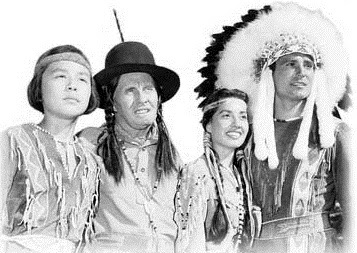
BRAVE EAGLE (1956): A short-lived TV series told from the perspective of the Native Americans. In the episode titled "Moonfire", white settler Penny Pattifore is rescued by Chief Brave Eagle from the clutches of an opposing tribe. Initially frightened, Penny, given the honorary tribal name Moonfire,  decides she'd like to go native with Brave Eagle and company. She's rebuffed by Smokey, the tribe's token halfbreed, which sounds a little hypocritical if you ask me. Penny decides her fate by sitting atop a "vision rock" (no mention of psilocybin being involved). Her uncle, Col. Matthews, is ready to kill her new friends in order to bring her back to "civilization". Luckily for them, Penny decides cultural appropriation isn't cool after all. She wouldn't have looked good in a headdress anyway.

One of the dozens of 1950s TV Westerns, Brave Eagle deserves to be commended for making the usual bad guys into the heroes. And by "heroes", I mean knowing their place. Brave Eagle goes so far as to provide safe passage for white people who, of course, are stealing his people's land. That's the kind of redskin we like!

Where it doesn't differ is that almost all of the lead characters are played by whites.
 Keith Larsen, as Brave Eagle, looks as Native American as Errol Flynn. I mean, he doesn't even wear that stupid red make-up you see in these things. 

But what puts Brave Eagle into whacko territory is that his sidekick Smokey is played by Bert Wheeler of Wheeler & Woosley fame. And despite being the only actor wearing "Injun" make-up, Wheeler delivers his lines in his usual wisecracking style, as if Smokey's white father had been a pre-vaudeville comedian. Again, the halfbreed hypocrisy is stunning.

Brave Eagle's contradictions put today's woke viewers in a bind. Respecting Native American culture, heritage, and knowledge: good! Not respecting it enough to cast a real Native American in the lead: ugh!

BONUS POINTS: When informed that his niece Patti has gone to the vision rock, Col. Matthews simply accepts the explanation rather than saying, as any 19th-century American soldier would, "What the fuck is a vision rock?!"


CHLOE, LOVE IS CALLING YOU (1934): Mandy, a/k/a Mammy, returns to her home in the Florida Everglades seeking revenge on Col. Gordon, the white man she believes lynched her husband 17 years earlier. Accompanying Mandy is her daughter Chloe, and her assistant Jim, both of whom had white fathers. Chole resists Jim's amorous moves while finding herself attracted to the white Reed Howe, who manages Col. Reed's turpentine factory (what a man!). Chloe soon discovers that she's actually Col. Gordon's daughter and was kidnapped by Mandy as a baby. She's now free to marry the white guy -- yay for the honky girl! -- if she isn't sacrificed in a voodoo ceremony first.

Wowwee! Chloe, Love is Calling You has it all -- racial politics, interracial love, black stereotypes, voodoo, and authentic animal abuse. A mainstream studio release this is not.

Yet for all its, shall we say, debatable social viewpoints, the movie, at least in the beginning, makes Mandy sympathetic. Can you blame her for wanting revenge on the guy who allegedly lynched her husband on "the death tree"? That alone sets it apart from other movies of its time.

But once we learn that Col. Gordon is innocent of the charge, and that Chloe is actually 100% pure-as-Ivory Snow white, it regains its footing as a weird, racist, low budget indie exploitation melodrama that will never be run in any film studies class today.

Chloe, Love is Calling You was the last stop for lead actress Olive Borden, whose bad attitude, drinking habits, and difficulty transitioning to sound saw her fall from $1,500-per-week, 1920s stardom to alcoholic scrubwoman at a skid row homeless shelter in downtown L.A. That's Hollywood!

BONUS POINTS: The climactic voodoo ceremony, featuring Chloe being lowered over a flaming pit, is pretty creepy. As are the real scenes of a snake being smashed in half, and a man wrestling an alligator underwater before stabbing it to death. You don't see that kind of thing in movies anymore. 


MEET THE MAYOR (1932): Imagine Forrest Gump, only with a slightly higher IQ and never getting laid. That's elevator operator Spencer Brown. But he's smart enough to help best pal Harry Bayliss invent a home recording device which eventually gets the goods on the honest mayor's crooked rival. Just not smart enough to realize the girl he crushes on loves Harry. What a dolt.

Likely realizing his suave stage persona didn't play outside of the New York stage, Frank Fay's characterization of the smalltown Spencer Brown -- a cross between Harold Lloyd and Harry Langdon -- was a desperate attempt to achieve the movie stardom that had eluded him. His low-key performance is occasionally affecting, particularly when he forces the mayor's rival to drop out of the race. Yet none of the major studios would release the Fay-financed Meet the Mayor, despite it being no worse than many movies of its time. 


Perhaps it was because Frank Fay -- the first stand-up comic -- wasn't boffo box office. On the other hand, being a raging anti-Semitic racist who counted Franco supporters, the Ku Klux Klan, and the American Nazi Party as his best only friends couldn't have helped. 

The two-bit outfit that finally released Meet the Mayor in 1938 -- six years after its production! -- must have had second thoughts as well, seeing that Fay's name on the opening credits is about the size of the copyright notice. That's what happens when your star would have been comfortable in a movie called Meet the Fuehrer. 

BONUS POINTS: Meet the Mayor is the earliest movie I know of that uses the phrase "Looking out for number one" and the slang "coffin nails" for cigarettes. Do I win a prize?


PAROLE, INC. (1948): Special agent Richard Hendricks goes undercover to find out why the locale parole board keeps freeing dangerous prisoners. He infiltrates a posse of low-rent gangsters, who seem to do nothing but play cards at a diner all day. (Maybe if they committed a few more crimes, they'd get somewhere.) Hendricks soon discovers their puppet master -- a lawyer -- is paying off the board members. That's one way of having a constant stream of clients returning to you, even if it does cost a few bucks off the top.

Low budget B's like Parole, Inc. did a better job of showing the seedy criminal underworld than the A's. Actors like Bogart, Robinson, and Cagney always seem like they're living the good life. You can tell just by looking at the crew in Parole, Inc. that they reek of cheap cologne, Lucky Strikes, and stale Ballantine Ale. There's nothing romantic or exciting about these yeggs and their lifestyle. 

Everybody is reminiscent of actors that the producers couldn't afford. Michael O'Shea, as Hendricks, is a cut-rate Dan Duryea. Turhan Bey, the lawyer, sounds like George Sanders despite being of Austrian/Turkish/Czech heritage. His sweetie, Evelyn Ankers, is vaguely reminiscent of Joan Crawford, though less glitter and more gutter.

Between the cast, cheap sets, and not-so-great dialogue (crooked parole board member facing cops with tear gas: "They've got gas and I've got sinus trouble!"), Parole, Inc. is a more accurate look at low-rent criminals than anything Warner Brothers made. Just not as good.

BONUS POINTS: Michael O'Shea speaking the phrase "punchboard racket" with a straight face. Also, one of only four movies credited as "An Orbit Production." 


THE STUDIO MURDER MYSTERY
(1929): Who killed leading man Richard Hardell? Was it his wife Blanche, who was sick of his 
tomcatting? Hardell's sidepiece Helen MacDonald, who learns he will never leave Blanche? Helen's brother Ted or her father, both of whom hated Hardell? Hardell's director Rupert Borka, who suspected Hardell of fooling around with his wife? 

Brother, if you can't figure it out by the end of the first reel, you have no right to watch any mystery. No matter. Movies like The Studio Murder Mystery are strictly for pleasure. Not only do we see the Paramount Pictures soundstages when they're not in use, we also glimpse a recreation of how silent movies were still being shot. Too, many scenes take place outside the Paramount gate, where the actors' breaths are visible in the nighttime scene. L.A. must have been mighty chilly in early '29. 

Unlike other early talkies, The Studio Murder Mystery showcases actors delivering their lines in normal tones rather... than... very... slowly. Fredric March (Hardell), Warner Oland (Borka), Eugene Pallette (Detective Dirk), and Neil Hamilton (wiseacre gagman Tony White) enunciate while still sounding like real people -- if real people had a script at the ready. Although it's still impossible not to hear Oland without thinking of his soon-to-be career-changing move as Charlie Chan. (Why does a Swedish-born actor playing an Eastern European sound Asian?)

At 62 minutes, the fast-paced The Studio Murder Mystery never has a chance to be dull. What it lacks in genuine mystery it more than makes up for with entertainment. But it kind of makes you wonder what Fredric March thought being killed off ten minutes after the opening credits.

BONUS POINTS: Studying the reactions of Florence Eldridge as Hardell's two-timed wife, since in real life, she had to put up with the same sexual shenanigans from her husband -- none other than Fredric March! Talk about method acting.

                                                         ****************

Saturday, May 2, 2020

MOVIE OF THE DAY: "OLD SAN FRANCISCO" (1927)

What with COVID arousing anti-Chinese sentiment in some quarters, it's interesting to look back to remind ourselves this is nothing new. The 1927 silent movie Old San Francisco -- Warner Brothers' fifth release with a synchronized score and sound effects -- takes it one step further, essentially comparing them to vampires. See, things could be worse!

The year is 1906. Don Hernandez de Vasquez lives on his family estate in San Francisco with his granddaughter Dolores. Long past its glory days, the homestead has come under the scrutiny of land developer Chris Buckwell. 


Buckwell, highly-regarded by the business community, is hiding a secret: he's Chinese! Or, as the subtitles insist on referring to him, a Mongol (because it sounds more sinister). Buckwell is able to pass for white because he's played by Warner Oland, the Swedish-born actor who, some years later, would gain his greatest fame as Charlie Chan. 


Don Vasquez wonders why his granddaughter
looks so darned white.
Buckwell's reps, Michael Brandon and Terrence O'Shaughnessy, get nowhere with Vasquez sales-wise. But Terrence falls hard and fast for the comely Dolores, played by the homonynic Dolores Costello.

The usual mix-ups and misunderstandings occur during their courtship, allowing Blackwell to (forcefully) make his move on Dolores -- not for his own pleasure, but to sell her to a Chinatown pimp who intends on shipping her back to the old country. But you don't really think things will turn out that way, do you? 


One of Old San Francisco's more subtle moments.
There wouldn't be much reason to watch Old San Francisco if not for the character of Chris Buckwell, because it provides fascinating insight to Hollywood's (and America's) view of Chinese immigrants. 

And that regard is low. Real low. Like Grand Canyon low. While the average Chinatown resident here is regarded with, at best, a vague, confused fascination (like a wild animal who's been trained to ride a tricycle), Buckwell is, from the get-go, portrayed as the personification of evil. 


File under "Typical silent movie villain." 
While evil landowners were nothing new in movies by 1927 -- hell, every other Western had them -- they were just your regular bad guys (i.e., white). In Old San Francisco, Buckwell being Chinese elevates him to a first class villain. Passing himself off as white? Now we're talking pure blackguard.

But Chinese and manhandling the Spanish-but-white-looking virgin Dolores? Get the noose ready, boys!

Almost as bad as his wanton desires is Buckwell's religion. Ducking into his basement after a business meeting, he dons a robe and skullcap, and kneels before a giant statue of a Chinese deity. Lighting several tall sticks of incense, Buckwell prays for forgiveness for selling out his people to the Chinatown criminal underworld. At least he's sorry.


"And another thing, you could stand to lose 20 pounds!"
You'll never guess what else Buckwell keeps down there. A dwarf named Chang Lu -- and he's locked in a cage! Buckwell must enjoy being reminded what a scumbag he is, because the only function Chang Lu serves is to endlessly taunt him. "What fresh deed of evil is on your vile soul?" Chang inquires not unreasonably. "Not all the incense of the Indies will blot your sins from the eyes of heaven." I would have said, "You stink on ice!" but there's very little drama in that.


In Sweden, they cut to the chase and
called it Mongolians.
Before going further, it would be thoughtless not to add that Lu Chang is played by Angelo Rossitto, one of the stars of another Fisheye movie, Scared to Death, although he's most famous for his role in Freaks. Unless you're a fan of contemporary cinema. Then you'd definitely recognize him as The Master in Mad Max Beyond Thunderdome -- in 1985! That's a long career for a little guy.


But is there anything worse than attempting to defile the virginal Dolores Vasquez? Yes: blasphemy. Buckwell drops by the Vasquez ranch allegedly to pray at their shrine of Jesus. But while Dolores and granddad watch from behind in admiration, we see Buckwell himself fumbling with the sign of the cross, a look of confusion and disgust on his face. 

The Vasquezes aren't fooled for long. When Don goes into town on business, Blackwell returns to have his way with Dolores. Interrupted by the unexpected return of her grandfather and Terrence O'Shaughnessy (you remember him, right?), Blackwell threatens revenge. 


And don't wave garlic in front of him, either.
As Dolores faces him down, Buckwell steps near the shrine -- and recoils in horror, covering his face in Dracula fashion with his cape. Lowering it a moment later, Buckwell, to Dolores' horror, now appears 100% Chinese for the first time, his sneering mouth ready to take a bite of her. Or, as the subtitle puts it, "In the awful light of an outraged, wrathful Christian God, the heathen soul of the Mongol stood revealed."  

It's a staggeringly racist, shocking, bizarre moment. Yet I don't care how woke you are, when Buckwell drops his cape, the effect is so startling that your breath gets caught in your throat. Audiences watching it on a big movie screen nearly a century ago were probably ready to burn down their local Chinatown


Chinese woman; Swedish man playing Chinese passing himself off as
white; white woman of Irish descent playing Spanish. The magic of
the movies!
To add insult to ridiculous injury is that the only real Chinese actor who has something approaching a major role in Old San Francisco, Anna May Wong, plays Buckwell's stooge. 

Wong's most important job here is to help her boss kidnap Dolores in order to sell her into prostitution. Judging by her sullen expression, she appears to be aware of being forced into a similar situation.


The race baiting/blasphemy angle is even more wacky when you remember that Warner Brothers, like the other major studios, was run by Jews who played up Christianity as if at gunpoint. A decade earlier, the villain would likely have been a Spaniard, instead of a heroic figure like he is here


Dolores looks totally into this guy.
And a decade before that, an Irishman like O'Shaughnessy would have been played strictly for boneheaded laughs. Even here, the Vitaphone Orchestra plays a rip-off of "Believe Me If All Those Endearing Young Charms" whenever he enters a scene, just to remind you of his nationality. 

Come to think of it, there's absolutely no reason to make his character Irish other than to justify his courtship of a Spanish woman. After all, he isn't American white. He's a foreigner, like her. 


There goes the neighborhood.
Old San Francisco, then, is not headed for the Brotherhood Hall of Fame. Its casual -- make that defiant -- racism, along with its head-clobbering Christian agitprop, would likely cause demands for it to be disappeared like Disney's Song of the South if it were better known. It is, then, a textbook example of relative obscurity besting negative fame. 

Plus, Old San Francisco's climax provides the most hilariously preposterous cause of the 1906 San Francisco earthquake ever suggested. Without going into detail, it has nothing to do with fault lines. Except those, perhaps, around Warner Oland's evil eyes.

                                                        ***************

Wednesday, March 7, 2018

MOVIE OF THE DAY: "DAUGHTER OF THE DRAGON" (1931)

Fu Man Chu is in a bit of a Chinese pickle. Convinced that a certain army officer named Petrie murdered Mrs. Fu Man Chu and their child decades earlier, he's made it his mission to enact revenge. After killing the offending Petrie and his son, Fu has returned 20 years later to kill the two remaining Petrie males. C'mon, Fu, take the song's advice and let it go!

But Fu only gets to the third generation Petrie before being shot himself by a police detective. With his remaining strength, Fu bequeaths the honor of killing Petrie #4 to his only child, Ling Moy, despite that she's -- eeww! -- his daughter! Sons, you see, are generally the only ones considered talented enough to do anything more complicated than pouring a cup of Jasmine tea. So not only is this nepotism, it's bad nepotism. In other words, Ming Loy is the Jared Kushner of the Fu house.


Half an hour later, and he's
hungry for her again.
Conveniently enough, Ling Moy lives next door to Petrie, and quickly turns on her charm. Petrie is soon following Ling Moy like a food delivery guy looking for a tip. Petrie's girlfriend Joan -- not accidentally Occidental -- sees the logogram on the wall, but can do nothing to stop his philandering ways. Maybe if she dyed her hair black and wore tight dresses.

Petrie's not the only one gaga-gai pan for Ling Moy. Chinese detective Ah Key also falls under her spell, to the point where he leaves his post guarding Ronald Petrie at her request -- not to engage in a little Eastern fun like he hoped, but so that Petrie can be kidnapped by her cronies. Like I always say -- dames, you can't trust them. Even Chinese ones.


It was fun while it lasted, eh, Petrie?
Before you can say "Peking duck", Ah Key is trussed up like a badly-wrapped mummy in an attic while Petrie and Joan are tied to chairs side by side awaiting their fate. Like her old man, Ling Moy turns up her nose at guns, preferring to kill her enemies in the most painful, ugly ways possible -- in Joan's case, getting fed an IV drip of carbolic acid. Why didn't Jack Kevorkian think of that?

But just to show she's got a heart, Ling Moy offers to turn off the drip... and force Petrie to stab Joan through the heart instead. As Jack Benny once said, I'm thinking it over!

Ah Key manages to throw himself out of the attic in order to get the attention of some cops, who raid the house. Ling Moy and her sidekick Lu Chung escape through a secret passage that leads to Petrie's house, where Ah Key is waiting. Two gunshots later, Ling and Lu are dead, while Ah Key dies at her side, promising to meet on the other side, where, presumably, they won't try to kill each other again.

Lu Chung, Fu Man Chu, and Ling Moy
surrender to Hollywood's racist demands.

Daughter of the Dragon pulls out almost all the old Hollywood tropes regarding Chinese people -- mysterious, exotic, heathen -- and, in the case of Ling Moy, slinky. The only thing missing are the opium dens. And if you happen to find one, let me know.

Other Hollywood clichés abound. The Chinese woman enticing the white sap. The Chinese cop happy to give his life for the white guy. Secret passageways built between houses without anyone noticing. A contractor like that would have his own series on HGTV.


Anna May Wong and Sessue Hayakwa
look for a way to cut their scenes from
Daughter of the Dragon.
And then, of course, there's the cast. Of the four major Chinese characters, only Anna May Wong was really Chinese. The rest were Swedish (Warner Oland as Fu Man Chu), Japanese (Sessue Hayakawa as Ah Key) and American (E. Alyn Warren as Lu Chung). In old Hollywood, an inclusion rider was the guy who rode shotgun on stagecoaches in Westerns.

In fact, Oland went on to play Charlie Chan, while Warren made a specialty of Chinese flunkies who were humble on the outside, nasty on the inside. You can call it racist all you want, but movies like Daughter of the Dragon are all the more entertaining for it. It's a combination of the absurdity with the fantastical that make some of these things even watchable.

It's probably why Miramax cancelled its much ballyhooed "reimagining" of soft-spoken Charlie Chan as action hero Charles Chan circa 1993. If only that had been the only idea of Harvey Weinstein's that didn't pan out.

                                                   ********************************