Showing posts with label HUGH BEAUMONT. Show all posts

Saturday, March 16, 2024

THE EARLY SHOW, PT. 31

What are you up for? Whether it's British musical hall comedy, World War II intrigue, post-World War II intrigue, or a hoary TV remake of a hoary 1927 movie, we've got you covered!

O-KAY FOR SOUND (1937): A TV Guide description of the British comedy O-Kay for Sound would probably read, "Six out-of-work zanies mistaken for wealthy investors run riot at a movie studio." Any further description is superfluous. But let's try.

O-Kay for Sound marks the screen debut of The Crazy Gang, a proto-Monty Python for the working class, made up of a trio of comedy teams (or double acts, as the Brits call them). The movie's throughline -- movie studio head Hyman Goldberger has 24 hours to keep his studio from going bankrupt -- allows the Gang take over the musical currently in production, which, of course, becomes a rousing success. In between their routines are some song & dance numbers (one in blackface), an extraordinarily violent Apache Dance, and lone American Fred Duprez using a comedic Yiddish accent as Goldberger. Just how funny it is depends on your acceptance and understanding of semi-prehistoric humor. 

One thing you likely won't understand is the Crazy Gang itself, as their accents, slangs and references made their movies impossible to release in the US. All you can do is figure out the individual team's styles and hang tight. Naughton & Gold are low-class Scots who ridicule the upper class. Nervo & Knox are rough house. Flanagan & Allen (the best of the three teams) share rapid-fire, pun-filled conversations and sing wistful tunes. The Crazy Gang's funniest routine in O-Kay for Sound, a lampoon of British military melodramas, was likely straight from its original stage version at the London Palladium, and is the movie's highlight. Just as Animal Crackers is the closest we'll ever come to seeing the Marx Brothers on Broadway, so O-Kay For Sound gives us an idea of what an evening in the company of the Crazy Gang was like. Just don't expect to understand more than one out of four of their jokes. (If you're up for a drinking game, take a shot each time Knox runs his forefinger under his nose before wiping it on the jacket of whoever's standing closest to him.)

BONUS POINTS: During a row, Knox says, "You know what you can do!", to which Nervo replies, "Yes, but it's impossible." Or was it Nervo to Knox? Or Naughton to Gold? Or some other combination?


THE HOUSE ON 92ND ST. (1945): In the days leading up to World War II, German-
American Bill Dietrich works undercover for the FBI in New York in order to infiltrate a suspected German spy ring. Under the tutelage of his American handler Inspector George Briggs, Dietrich is assigned to prevent the enemy from getting the top-secret Process 97 formula (a/k/a the atomic bomb) and to find out the identity of the ring's leader, known only as Mr. Christopher. Over time, his Nazi contact Elsa Gebhardt discovers that he's no more Nazi than Mickey Mouse, and deserves a rodent's fate. He's saved in the nick of time by Briggs and half of the NYPD, who also discover the not-so-mysterious Mr. Christopher at the scene.

Based on a true story, The House on 92nd Street is perhaps the earliest documentary-style police procedural, and probably influenced The Naked City. Its use of genuine undercover footage of Nazi spies in New York and abundant location filming give it a you-are-there feeling. If that wasn't enough reality, J. Edgar Hoover, always ready to endorse a project that put a good light on the FBI, allowed cameras into the agency headquarters and let employees play themselves. You can tell who they are: they look ordinary and move stiffly, even when sitting down.

Lloyd Nolan, an actor I've come to enjoy in his 1940s roles, does the NYPD proud as Insp. Briggs -- smart, no-nonsense, always ready with a good idea. I wasn't familiar with top-billed William Eythe (Bill Dietrich); if I've seen him elsewhere, he sure didn't make any impression on me. It's the spies who command the screen here. All homely except for Signe Hasso as the ringleader, these folks were born to play Nazis whether they wanted to or not. It was the best way to stay employed in the USA during wartime if you were of German extraction, that's for sure. Entertaining and well-made, The House on 92nd Street is a good place to visit some dark night.

BONUS POINTS: Speaking of Naked City, Harry Bellaver, one of the stars of the TV series of the same name, is a Nazi undercover spy here, while Man from UNCLE fans will recognize Leo G. Caroll as the traitorous Col. Hammersohn. 

TOKYO JOE (1949): Former Army pilot Joe Barrett returns to Tokyo in order to buy back his old bar and reunite with his ex- wife, Trina. In need of some fast money, he's forced to partner up with vice lord Baron Kimura in a literally fly-by-night transport company, which is to smuggle in Kimura's old partners in crime, now in Korea. To sweeten the deal, Kimura threatens to release proof that during War, Trina went all Tokyo Rose on shortwave radio. Which is true -- otherwise, the government would have taken away her daughter... whose father is Joe... and who will be killed if he doesn't do the job.

The only thing more cynical than Humphrey Bogart's character Joe Barett is the way Tokyo Joe tries to shoehorn elements of Casablanca into its story.  A cynical American who owns a bar in a foreign country, and whose ex is now married to another man, is reluctantly turned into a hero at the climax. There's even an old love song ("These Foolish Things") to haunt him ad nauseum. Now replace exotic Northern Africa with post-war Japan, a sexy Swede with a Russian who's about as sensual as an empty bottle of rice vinegar, and her Nazi-hunting husband with a lawyer. Oh yeah, real romantic.

Created by Bogart's Santana Productions, Tokyo Joe was hyped as the first American feature shot in post-war Japan. But the leads stayed behind on the comfy Columbia Pictures lot, so it's Bogart's quite obvious stand-in walking the streets of Tokyo and riding rickshaws. (His judo stunt double is even less believable). As Trina, Florence Marly, more wooden than a cigar-store Russian bottle blonde, should have been replaced by her stand-in. And while Alexander Knox isn't the dishiest actor in the world, he seems to be the type of guy who would marry Trina (Bogart sure doesn't). The best of the supporting players is Sessue Hayakawa as Kimura. Quiet and mildly threatening at all times, his occasional "Ah so" to Joe is amusingly sarcastic. Had the script focused on their relationship, Tokyo Joe would have made for a darker, more interesting movie. As it is, it would have worked better as a B-picture with a smaller budget, low-rent cast, and a quarter-hour shaved off its 90 minutes. 

BONUS POINTS: In a brief turn, Hugh Beaumont goes toe-to-toe with Bogart as a military official -- and wins! He should have gotten more roles like this. Come to think of it, Beaumont would have been perfect in the lead in my fantasy B-version of Tokyo Joe.


LINCOLN MERCURY STARTIME: THE JAZZ SINGER (1959): The one-hour, videotaped color remake of The Jazz Singer was Jerry Lewis' attempt to turn back the cultural hands of the clock to a time when the idea of a fifth-generation cantor disowning his show biz son was considered the stuff of high drama. The title itself doesn't even make sense here, seeing that the character of Joey Robin (nee Rabinowitz) is a stand-up comic who occasionally sings standards big-band style. This Jazz Singer exists solely to give Jerry a chance to stretch his dramatic acting muscles (which atrophy immediately), while creating a fictional version of his real life, unsuccessful attempt to win the respect of his father Danny Lewis, a one-time, third-rate vaudeville comic and Jolson imitator. Jerry, save it for the shrink!

No cliche is left unturned in Jerry's Jazz Singer,. The "Oy yoy yoy" mother. The wisecracking uncle. And of course, the stern, old-fashioned father who actually says, "I have no son". The story and the characters were borderline hackneyed in the 1927 movie; 32 years later, they were the Jewish version of Amos & Andy, only here the comedy is strictly accidental. Just when you think you've seen it all, the climax redefines the word "tasteless", when Joey Robin, still in his sad clown make-up, rushes from his dressing room to visit his dying father. (To strengthen the Jolson connection, Lewis is one step away from blackface.) As his father dies, Joey takes his place at the temple and sings "Kol Nidre" while still made up as a clown. Such was Jerry's clout in 1959, when he was the highest-paid actor in Hollywood, that nobody said no to any of this.

The cast is a mishmash of Yiddish theater (Molly Picon as Joey's Mama), movies (Eduard Franz as Cantor Rabinowitz, the same role he essayed in Danny Thomas' 1952 Jazz Singer), burlesque (Joey Faye as Joey's manager), light opera (23 year-old Anna Maria Alberghetti as the singer who gives Joey his big break), and Jerry's regular co-stars (Del Moore as a hot-headed agent). While this production of The Jazz Singer was quickly forgotten, it continued to have its effect elsewhere. In 1965, Gary Lewis wore make-up very similar to his father's on the cover of the album Everybody Loves a Clown, while Jerry himself would don it once more in his unfinished Holocaust drama The Day the Clown Cried. Good Lord, didn't his people suffer enough?

BONUS POINTS: Once you realize that Alan Reed (Joey's uncle) was the voice of Fred Flintstone, you keep expecting him to yell "Yabba dabba doo!" in Yiddish.
 
                                                               ***********

Thursday, November 16, 2023

THE EARLY SHOW, PT. 25

 My sleep routine has taken a new turn. After lights out, I fall asleep for what seems like eight hours, to discover just 45 minutes have passed. From that point on, I toss and turn for a while before sleeping for an hour, then repeat the whole business before waking up for good between 4:30 and 6:00. What else is there to do from that point other than fire up the DVR, YouTube, or streaming app to discover what most people just pass by, often for good reason?

CROSS EXAMINATION (1932): I'm always on the lookout for 1930s B-pictures that A) are
courtroom dramas, B) have generic titles, or C) were made by studios with names that didn't match their ambitions. Artclass Pictures' Cross Examination ticks all those boxes. David Wells is on trial for the murder of his wealthy father Emory. Plenty of people have a motive: David (for being written out of the will); Emory's servants (ditto); Emory's wife (for having an affair with his lawyer); and David's girlfriend Grace, who just doesn't like the old coot. But the appearance of a surprise witness upends the trial, leading to the confession of the real killer. Why hasn't this happened to any jury I've been on?

Unlike many other movies of its genre, Cross Examination opens with the trial, not the murder; you see the crime's build-up and aftermath -- but never the killing itself -- via flashbacks provided by the witnesses' statements. The jurors (and the audience) must paste together everything to decide whether Wells is guilty or not. It's an interesting twist to the usual courtroom dramas of its day, and one that a poverty row studio needed to do to stand out from the crowd. And per usual with indie B's of its time, Cross Examination's cast is a mixture of former stars on their way down (H.B. Warner as lawyer Gerald Waring), mid-level actors on loan from one of the majors (Sally Blane as Grace), and those nobody ever heard of (Don Dillaway as David). 

Being low-budget, Cross Examination is also a fine example of speedy filmmaking. Almost all the witnesses are filmed from the same angle, suggesting they were done in succession (probably on the same day), as are the close-ups of the judge, and Grace's tearful reactions. Being low budget also meant a minimum of second takes, so we get to see actors going up on their lines once in a while. But do you speak perfectly every time you open your mouth?

BONUS POINTS: At least four cast members were born in the 1870s, with two as early as 1871 -- the year cable cars were invented, and Ulysses S. Grant was president. Spooky stuff.


THE VAMPIRE BAT (1933): In a little Bavarian town, villagers are being murdered, all with
the same two little punctures in their throat. While the locals are convinced a vampire is the culprit, neither detective Karl Brettschneider nor Dr. Otto von Neimann are so superstitious. Their doubts are confirmed when the deaths continue after the main suspect, the bat-loving Herman Gleib, is hounded to death by the townsfolk. Von Neimann's assistant, Ruth Bertin, discovers the real mastermind behind the killings is her boss, even though he never leaves his laboratory -- proving that doctors won't make housecalls even to commit murder.

I'm not giving away the ending. When you're watching a movie featuring Lionel Atwill as a scientist, you tend to know how the thing will end. A production of low-rent indie studio Majestic Pictures, The Vampire Bat shares the look of the horror pictures coming out of Universal, thanks to using the latter's soundstages, as well as the casting of a who's-who of horror: the aforementioned Atwill, Fay Wray, and Dwight Frye. Leading man Melvyn Douglas (fresh from Universal's spooky The Old Dark House), lends the proceedings a dash of class and a boyfriend for Wray, the typical "pretty assistant" that labs always have on hand.

Oh, and you know what every Bavarian town seems to have? A village idiot, and nobody plays one like Dwight Frye. Channeling his role of Renfield in Dracula while using the childish syntax of Sesame Street's Elmo, Frye steals every scene as the creepy Herman, demonstrating why he was forever typecast as this kind of character; it's a shame he's killed mid-way through the movie. If only the same could be said of the dreadful "comic relief" (a misnomer if there ever was one) provided by Maude Eburne as Ruth's Aunt Gussie, who should have been the first victim of Dr. von Niemann's gruesome blood-draining contraption.

The Vampire Bat, long available only in murky 16mm prints, has been given a sparkling restoration, including the original tinting of the lynch mob's fiery torches. It's quite effective, even if it doesn't make sense, seeing that everything else is in black and white. 

BONUS POINTS: Majetic Pictures and Vampire Bat producer Phil Gladstone were also the brains behind the brilliant, bizarre The Sin of Nora Moran. (You still haven't bought the Blu-ray? What are you waiting for?)


YOU, THE PEOPLE (1940): From 1935 to 1947, M-G-M released occasional two-reelers under the umbrella title Crime Doesn't Pay, with a formula that never varied. At the beginning of each short, a different unknown contract player identifies himself as "Your M-G-M crime reporter" and, predating Dragnet by several years, assures us that the story we are about to see is true, with only the names being changed. He then throws it over to yet another studio actor -- often identifiable by face if not name -- who, as a police chief or mayor of an unidentified city, introduces the criminal case we're about to see. 

Underworld kingpin "Boss" Bailey is doing whatever it takes to get his puppet, Mayor James Wheelock, re-elected. Bailey's posse pressure city workers and small business owners to cough up donations under threat of job loss or physical violence, and begin cynical whispering campaigns that suggest voters stay home on election day using the old both-sides-are-crooks gag (which may or may not be true in real life). Having been beat up for not donating to Wheelock's campaign, civil servant William Wright is deputized to investigate Bailey and his crew, who are rounded up by the police on election night. 

You, the People is unexpectedly shocking in portraying how dirty the criminal element will play in order to get their way; in this case, it involves, among other things, murdering a City Hall worker and almost burning down a warehouse filled with authentic ballots on the evening of the election. And the yellowbelly mayor is in full compliance! 

As with all the Crime Doesn't Pay entries, the short abounds with young actors the studio had hopes for (which usually never panned out); older actors on their last legs; and journeymen who appeared to have worked incessantly until they dropped dead. The latter includes John "Great Caesar's Ghost!" Hamilton as the honest mayoral candidate, and familiar character actor C. Henry Gordon (whose bad guy parts usually included an Italian accent) sneering his way through the role of Boss Bailey. If You, the People is any indication, we're going to have a hell of a presidential election in 2024.

BONUS POINTS: In his seventh movie appearance, Hugh Beaumont (aka Ward Cleaver of Leave it to you know who), is an everyman who sees through the crooked mayor, and urges the owner of a diner not to listen to people who insist that voting doesn't count. We could use more everymen like him.


LA MACCHINA AMMAZZACATTIVI (1952): For any monolinguists out there, the title translates to The Machine to Kill Bad People -- and wouldn't you like to have one? Cynical photographer Celestino Esposito sure would, just to get rid of all the people in his Italian village he considers egotists and oppressors of the working class. And so a mysterious stranger arranges for him to do just that. All Celestino needs to do is take a picture of an already existing photograph of someone. SNAP! The victim dies in the same pose as in the photo. Soon, Celestino is ridding the villagers of people he dislikes, acting as judge, jury, and paparazzo. To his disappointment, the villagers he was trying to help become just as bad as those he killed, leading him to look for a way to reverse the damage.

You might not believe it, but La Macchina Ammazzacattivi is an often laugh out loud comedy. Director Roberto Rossellini cast what seems to be the most ordinary-looking actors in Italy, and surrounded them with authentic locals as extras, making it at times look like the strangest documentary you've ever seen. (Only the usual Italian post-dubbing and the extras occasionally glancing at the camera reminds you this is just a movie.) The only person more traditionally unattractive than Gennaro Pisano (as Celestino) is the actor (whose name I can't match up to any still) who plays his chief nemesis. There's something about the Italian language, or at least the way they and everybody else here continually yells it at each other, that makes their subtitled dialogue even more funny than it already is.
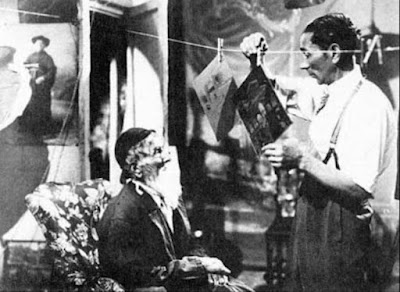
A subplot about a rich American moving to the village with his wife and adult daughter keeps things humming. The American is intent on building a hotel atop a piece of land that locals have been using for a cemetery, and intends on bribing the mayor in order to make it happen. (How do you say Crime Doesn't Pay in Italian?)

Available on Max, La Macchina Ammazzacattivi’s one problem, if you could call it that, is the dialogue often comes so fast and furious you don't always have time to look away from the subtitles in order to enjoy the actors' lively facial expressions. If only more comedies this entertaining and perceptive had such "problems". 

BONUS POINTS: Whoever dubbed in a donkey's braying should have gotten a raise for providing the funniest phony animal sound in movie history.

                                                                        ********

Friday, September 20, 2013

MOVIE OF THE DAY: "APOLOGY FOR MURDER" (1945)

Maybe it's just my dumb luck, but I never met a woman who convinced me to murder her husband. It seemed to be all the rage in '40s movies, though, to the point where the studios were flirting with copyright infringement. 

Picture the dingy office of Sigmund Nuefeld, the president of PRC Pictures. Surrounded by clouds of cigar smoke, Nuefeld is sitting across the desk from his brother, director Sam Newfield. (If you don't want to be accused of nepotism, make the name change just a little less obvious, bub.) They're discussing the studio's next round of releases. 

SIGMUND: I was thinking -- remember Double Indemnity?

SAM: What, with Stanwyck and whatshisname, Freddie Murray? 

SIGMUND: Fred MacMurray. Yeah. It made a mint. Why don't we just do another version?

SAM: A remake? Paramount owns the property.


"Hey, didn't MacMurray and
Stanwyck meet on the stairs, too?"


SIGMUND: No, not a remake. Just -- the same, only different. Dame puts the moves on some sap, gives him a song and dance about her mean rich husband. Convinces the sap to knock him off so they can collect the shekels and run away. Only instead of an insurance agent, the guy's a reporter. And the Edward G. Robinson part, the insurance investigator who smells a rat? We make him the newspaper editor who smells a rat. 

SAM: Sig, you're a genius. Say, you've got Hugh Beaumont and Ann Savage under contract. Squint your eyes and they look like Murray and Stanwyck.

SIGMUND: MacMurray. Think you could finish it by Friday?

SAM: Gimme an extra C-note and you'll have gift-wrapped on Thursday.

SIGMUND: Whaddaya trying to do, break the budget?

One of the most shameless unofficial remakes ever made, Apology for Murder entertains whether you've seen Double Indemnity or not. In fact, it may be even more entertaining if you have, just to marvel at how they got away with it by making the smallest of changes.

Don't do it, Hugh! She isn't worth it!
Like instead of the sap cracking the husband on the skull before making it look like he fell off a train, the sap in Apology for Murder cracks him on the skull before making it look like he drove off a cliff. Oh, and the sap is typing his confession when his boss walks in on him at the office in the middle of the night rather than speaking it into a Dictaphone when his boss walks in on him at the office in the middle of the night. Things like that kept the Paramount lawyers away from the door.


I knew there was a reason why I once referred to Hugh Beaumont as the Poverty Row Fred MacMurray. Not only is there a physical similarity, they sound pretty near the same as well. He even keeps calling Ann Savage "baby" the way MacMurray does Stanwyck. They probably could've traded their roles in Leave it to Beaver and My Three Sons without anyone noticing the difference.

The grief-stricken widow poses for a
shutterbug.
Come to think of it, that leads to another similarity --  the initial shock of seeing a baby-boomer icon of family sitcom fun as a killer. But a key difference is that MacMurray, in Double Indemnity, is a sleazeball right from the get-go, more than happy to start an affair with a married woman, even if it means sending the husband on a one-way trip to the morgue.

Beaumont, on the other hand, as affable newspaper reporter Kenny Blake, is led to believe that Toni Kirkland (Ann Savage) is single until their affair gets red hot. Kenny looks for an out, but once Toni flashes those baby-blues, pickers her lips and gives him the ol' song-and-dance about her terrible husband, they start brainstorming their matricide machinations. 

It's hard for a reporter to maintain his
objectivity when he's the real killer.
Once hubby is over the cliff, things start to go awry. Kenny's editor assigns him to cover the husband's death, which, despite having the aura of an accident, has more than a whiff of murder. Something of a drinker already, Kenny really becomes friendly with Jim Beam when the boys from Homicide pin Harvey's death on a business associate, Craig Jordan. While Toni is delighted that Craig is going to take the rap all the way to the gas house, Kenny is conscience-stricken. 

Adding insult to psychological injury, his editor discovers that Toni's having an affair with her lawyer, Allen Webb. "Anyone who'd go for a phony like her," the editor confidently tells Kenny, "can't be very bright." Ouch! (In one of those only-I-would-notice things, Kenny's editor is named Ward, which was Hugh Beaumont's character on Leave it to Beaver. To those who say there are no coincidences, I say... Eh.)

A man can take just so much from a dame, so when Kenny decides to pay Toni a visit in order to catch her with Webb, guns are drawn. ("You raise murder to a high degree of efficiency," Kenny tells her almost admiringly.) In short order, all three are plugged, with Kenny living long enough to drive back to work in order to write his confession. Frankly, it was no more convincing when MacMurray did it in Double Indemnity.

The Brangelina of Poverty Row. 
Where Apology for Murder surpasses Double Indemnity is the stars' sexual heat. Lacking Billy Wilder and Raymond Chandler's brilliant dialogue, Beaumont and Savage have to rely strictly on their own personal style, and it's more than enough. Fitting of their Hollywood status, neither resemble A-level movie stars; nor do the slightly grungy sets scream glamor. But as many a B-movie has proven, sexual steam rises higher when it mirrors real life.


Ann in a not-so savage moment.
Much of that heat is freely emitted by Ann Savage, the greatest of the Poverty Row bad girls. Just watch her here when she first realizes that Beaumont's the Class A-1 pigeon she's been waiting for. No words are spoken -- just the look in her eyes and a razor-thin, humorless smile telegraph what she has in mind. I've always had a thing for film noir dolls, the kind you don't know whether to kiss or kill. And Beaumont ultimately does both, muttering, "You're not to fit to live" as he pulls the trigger after she's shot him

Yet even as life drips from him, he lovingly whispers to her corpse, "Wait for me, baby. I won't be long." Despite being played for the king of fools, he still can't get over her. And apparently, neither could movie director Guy Maddin, having cast Savage in the lead of his black & white noirish release, My Winnipeg in 2007, a year before her death at 87. What a doll. 

PRC director Edgar G. Ulmer supposedly claimed that the studio's original title for Apology for Murder was Single Indemnity, which is either a good joke or a shamelessness unmatched even by Hollywood standards. But as film historian Michael Price pointed out, before the TV-era there was usually no way you could ever see your favorite movie again once it left town. These low-budget copycat releases helped you re-live the experience. (Today's studios, however, have no excuse.)

Taken strictly on its own terms, Apology for Murder is a fine hour's entertainment.  While the dialogue isn't as hard-bitten as Double Indemnity's, it's certainly well chewed by its stars. Jack Newfield's direction makes sure the pace never flags. Best of all, Hugh Beaumont and Ann Savage are no less mesmerizing than their A-list counterparts. Apology for Murder has nothing to apologize for.

                                                    ****************************
To read about another Hugh Beaumont shocker, Money Madness, click here.


Friday, August 16, 2013

MOVIE OF THE DAY: "MONEY MADNESS" (1948)

At some point in their lives, kids are astonished to discover their parents once had lives before, well, being parents. Imagine what Theodore and Wally Cleaver would have thought if they discovered their father, Ward, used to be a sociopathic killer.

Well, not really, but that's Hugh Beaumont from Leave it to Beaver starring in Money Madness as career criminal Steve Clark. After hiding $200,000 from a bank robbery in a safe deposit box (thanks for the idea!), Steve worms his way into the life of innocent Julie Ferguson. Discovering that poor Julie lives with her nasty Aunt Cora, Steve comes up with a brilliant idea. After two dates, Steve marries Julie before poisoning the battleax. Fast worker, right? Julie inherits the house and suddenly finds a mysterious trunk with 200-grand in the attic. Hey, it could happen to anyone!

"Hands off the threads, lady."
The first inkling you get that Steve's three grains short of a granola bar -- besides poisoning Aunt Cora, I mean -- is when he confesses the crime to Julie. Concerned that Cora's taken a turn for the worse, Julie tries calling a doctor. From out of nowhere, Steve quietly appears and hangs up the receiver. In the quiet, measured tones one would use when describing swatting a fly, Steve explains:

You said I was different. And I am. I don't figure things the way most people do. Now take Aunt Cora for instance. She's old. She's no good to anyone in the world. She's unhappy and she's made you unhappy. There's no reason for her to live. So I -- well, I... fixed her tea last night and her grapefruit juice this morning.

If you look carefully, you can see a smile cross his lips, the kind a child would offer his mother after successfully tying his own shoes for the first time. It's at this point his performance crosses the line from eerie to terrifying, staying on that track for the rest of the picture.

"That'll be a buck and a half. Or I'll cut
you up into little pieces and throw you
to the badgers."
Steve tries to blend in by driving a taxi, which, if you're a New Yorker, sounds like a typical job for an escapee from an institution for the criminally insane. Soon, he starts showing up everywhere Julie happens to be, making a line like, "Your ride's waiting, miss" sound like a disturbing threat. So terrified is Julie that she can't confide the truth of the situation to her own lawyer (who's in love with her). Steve, you see, pointed out that it was she who actually served the spiked drinks to Cora. Their marriage, as Steve calmly explains, is predicated on neither of them testifying against the other in a court of law. Which is as good as any other reason most people come up with.

Money Madness appears to have the happy ending most American movies indulge
in: bad guy killed, girl safe in the arms of the man who loves her. That is, until you remember the entire movie was told in flashback -- and that, in the first scene, Julie was sentenced to prison for ten years for being Steve's accomplice even though she was entirely innocent. Man, talk about cynical!  I guess the moral the moviemakers were trying to get across was Don't talk to men. It's bad for your health.

A familiar sight in my home.


If you still can't wrap your head around the idea of Ward Cleaver as a killer, then one viewing of Money Madness will set you straight. Something of a Poverty Row-Fred MacMurray in looks and style, Beaumont is far more intense here. And, if I haven't made it clear enough, capital-C Crazy, more believable than, say, the grandstanding Jack Nicholson in The Shining

As with other actors discussed on this blog, Beaumont's performance would be considered classic had Money Madness been a major studio release instead of getting lost in the B-movie shuffle. That Beaumont is totally convincing in such an evil role is more astonishing when you consider that he was, at the time, a Methodist minister who took acting gigs to raise money for his church. God and Hollywood work in mysterious ways. 


Despite the idea I might have given you, not every B-movie is a classic in hiding. Most don't even pass the threshold of mediocre. Often, I've despaired that I might have seen all the ones worth watching. Then along comes something like Money Madness, a solid, well-made thriller that comes alive in the very first scene, then keeps ratcheting things up during its 72-minute running time. (Why do most filmmakers today seem to think "The longer, the better"?) I found it almost difficult to describe because it should be seen, as I did, unfamiliar with the story or the plot twists. Some rainy day -- or better, night -- swing over to YouTube and give it a shot. If nothing else, you'll never watch Leave it to Beaver the same way again.


                                                 *********************