Showing posts with label WALLACE BEERY. Show all posts

Tuesday, March 31, 2026

THE EARLY SHOW, PT. 66

 Pre-codes dominate today's quadruple feature, with one semi-noir rounding out the show.


CHINATOWN NIGHTS (1929): This must be the only movie where its source material -- in this case, Samuel Ornitz's Tong War -- is given almost equal billing on the one-sheets and opening credits, making me think either the guy had a lot of pull at Paramount or the phrase was on everybody's tong -- er, tongue.

Two tong leaders -- nightclub owner Chuck Riley (Wallace Beery) and Chinese businessman Boston Charley (Warner Oland) -- are on the Zhan tu (that's warpath to you white devils).  Chuck falls hard for uptown dame Joan Fry; before you can say "dim sum", the two are shacking up, Chinatown-style. But the couple are from two different worlds -- you might call them a dim sum -- and it seems inventible they're going to break like a bamboo chopstick. 

The William Wellman-directed Chinatown Nights has potential but is an utter mess. Filmed as a silent, the Paramount bosses ordered it reshot as a talkie. Dialogue was simply dubbed in over some silent footage, with real talking scenes added only when necessary. By my estimate, it's 50/50 split, and a bad one at that. Much of the dubbed dialogue is out of synch with the actors' lips; the back and forth between the two styles is jarring, often happening in the middle of a scene. Chinatown Nights would have worked better one way or the other rather than an awkward hybrid that likely fooled nobody.

As with the truculent Louise Brooks in The Canary Murder Case, Chinatown Night's leading lady Florence Vidor left the dubbing to someone else. Wallace Beery had no problem yakking his lines as the gangster whose hard heart softens with love. And you can never go wrong with Warner Oland in one of his stereotypical Asian roles. Unless you're Asian. Then you can join the non-movie nerds of today who will find nothing of interest in Chinatown Nights except wondering why people in 1929 paid 10 cents a ticket to watch it.

BONUS POINTS: In an effort to get Chuck out of the crime business, Joan tells the authorities that the tong members are illegal immigrants and suggests mass deportations. Say, that sounds familiar....


SAFE IN HELL (1931): New Orleans chippie Gilda Carlson, accused of murdering a john, is dropped off in Tortuga by her seaman sweetie Carl Bergen, who promises to return to her when the coast is clear. It's hard enough for Gilda to keep away from the horny criminal hotel guests without the local hangman Bruno figuring out how to get his paws on her as well. The unexpected arrival of a certain man from Gilda's past offers the chance of her escape from this island. But just try telling Bruno the hangman that.

Let's get this out of the way: Safe in Hell is one of the grimiest, sweatiest, squirm-inducing studio releases of its time; you've never seen so much spitting or sexually-depraved behavior on celluloid. Every glimmer of hope is killed with all the joy of a New Yorker stomping on a spotted lantern fly. And talk about racy! When Gilda checks into the hotel, one of the male guests warns his pals to avoid using "words ending in 'it', 'itch', and 'er'." While modern day viewers may think Gilda is being punished for her sins, Safe in Hell's original trailer describes her "The Little Girl Who Tried So Hard To Be Good -- And The World Wouldn't Let Her"; pre-code movies usually cut slack to Depression-hit janes who did what they had to in order to survive.

The long-forgotten Dorothy Mackaill gives the doomed Gilda the right balance of cynicism and faith; it's the kind of pre-code character that anticipates Jane Fonda's turn in Klute decades later. The ever-boyish Donald Cook, as Carl, really looks like the kind of guy who'd forgive his girlfriend's trespasses. Yet for all the greasy goons who populate Safe in Hell, it's the two black actors -- Nina Mae McKinney as the barmaid and Clarence Muse as the porter -- who stand out. Not only are they terrific actors whose careers were unfairly confined to roles like these due to their race, their characters seem to be the only decent people on the island. Maybe they need their own ICE troops to throw out the white illegals.

BONUS POINTS: Safe in Hell is the earliest studio movie I know of that begins only with the title card, saving the other credits for the end. Director William Wellman seemed to want to get the movie going pronto.


NARCOTIC (1933): Dwain Esper, the Emperor of Exploitation, never met a social problem he couldn't cash in on. But unlike his delirious 1934 screed Maniac, Narcotic takes a fairly serious if seriously cut-rate look at drug addiction, while providing enough just enough tawdriness to entice audiences who patronized the more declassee grindhouses. 

This "true biography" follows the downward spiral of Dr. William G. Davis from brilliant surgeon to hopeless addict, starting at the local opium den before moving on to the harder stuff, and eventually hawking his own heroin-laced snake-oil remedy. Soon, he's surrounded by junkies ("If I don't get a pop right away, I'm gonna go nuts!"), hopheads, coke fiends, and -- gasp! -- prostitutes. And thanks to the graphic close-ups that would never be featured in studio releases, Narcotic makes it easy to learn how to puff, snort, and shoot up. Thanks for the instructions, Dwain!

Narcotic
 contains everything expected from Esper's
 grimy productions -- flimsy sets, women's gams, rickety silent movie footage of car chases and freak shows, and the requisite stilted line-readings from actors ranging from amateur to washed-up. Special commendation to J. Blackton Stuart, Jr., whose absurd portrayal of a "Chinaman" couldn't be less convincing if he played him as Australian. 

Oddly for the already-odd Esper movies, I recognized character actor Harry Cording (in a rare lead role as Dr. Davis) from his later appearances in the Rathbone/Bruce Sherlock Holmes movies. Having appeared in well over 200 movies, he's the probably the only actor in Narcotic capable of a decent performance, but only when not instructed by the director to chew scenery, mainline heroin, or smoke opium.

BONUS POINTS: In a brief sequence you'll never see on The PittNarcotic also includes documentary footage of a real cesarian birth. When I later described the scene to my wife (a retired nurse), she said, "Oh, that was the old-fashioned way!" 


CRISS CROSS (1949): Burt Lancaster, Yvonne DeCarlo, and Dan Duryea make for
the most dangerous triangle outside Bermuda in this grade-A noir. 
Steve Thompson (Lancaster) returns to L.A. after odd-jobbing around the country, getting back his old job as armored truck driver, while doing likewise with his ex-wife Anna (DeCarlo), despite her being involved with gangster Slim Dundee (Duryea). Thompson gets the bright idea of arranging for Slim's gang to hijack his truck, split the dough with them, and run off with Anna. Sure, no way that plan won't go off the rails.

All noir elements -- doomed lovers, flashbacks, lust confused with love, greed mistaken for genius -- feature in the fast-moving Criss Cross. Director Robert Siodmak handles every aspect, from actors to lighting to framing, with the same skill that made his previous picture Cry of the City such a great watch. And just when you think you've reached the climax, the story continues into another, unexpected direction followed by another and another -- all within the final two reels. 

As for the cast, the incredibly young, curly-haired Lancaster likely never looked better. He and the borderline trashy DeCarlo have a real connection; they look like a couple who know they're doomed yet unable to resist their unhappy fate. And it's always a treat when Dan Duryea turns up in slimy roles like this, giving off sinister vibes with just his eyes. I don't know how Criss Cross never made it on my radar until now, but it was worth the wait.

BONUS POINTS:  Unbilled bit player Tony Curtis (still answering to the name of Bernie Schwartz) makes his very brief movie debut as DeCarlo's dance partner. And Alan Napier (all together now: Alfred the butler on the Batman TV series), has a small but key role as the classy dipso who organizes the truck hijacking. 

                                                                        *********

Sunday, October 6, 2024

THE EARLY SHOW. PT. 41

The first and third movies here have been part of my collection for a while; I figured it was time to give them another spin before deciding if they were ready for the glue factory. And, if you're wondering, I've decided to keep them for a future go-round with the optional commentary. It's hard to let go of the nearest and dearest in your life.

BEHIND THE DOOR (1919): If Howard Hawks' theory holds true -- that a movie should
have three great scenes and no bad ones -- Behind the Door is 2/3 of the way there.  Otto Krug, a former captain turned taxidermist, enlists in the military when war is declared on Germany. As usual (in movies, anyway), his bride Alice sneaks onboard his ship, which is soon torpedoed by a German sub. When Alice is kidnapped by the sub's commander, Krug spends the rest of the war in hot pursuit.

There's a bit more I've left out, such as a subplot involving Alice's miserly banker of a father who wants to marry her off to his assistant, and the anti-German bias Krug feels from his neighbors, neither of which has anything to do with the main story; Behind the Door could actually have been an hour instead of its current 70. (A few more minutes of missing footage are covered by stills and recreated intertitles.) But then it wouldn't have been a Paramount Artcraft Special. 

Yet what works definitely qualifies as great. The first is a brutal, ugly fight between the townsfolks and the German-American Krug, where director Irvin Willat seems to have said, "OK, boys, just beat the shit out of each other until I say 'Cut'." They might not be really bleeding, but it isn't for lack of trying. The second involves Krug learning Alice's fate from the captured German sub commander. If the flashback establishing a gang rape doesn't make you gasp, perhaps the sight of her dead body being shot out of a torpedo launcher might do the trick. And if not that, well, there's always Krug preparing to put his taxidermy tools to good use on the bad kraut. 

Much of Behind the Door's dramatic acting is of the fist-pounding-in-the-hand variety (literally, in the case of the banker). The grandiloquently-named Hobart Bosworth, though, plays Krug in Behind the Door's violent finale in a fascinating way, his seething anger initially masked by a boys-will-be-boys response when learning Alice's awful fate. Comedian-turned-dramatic actor Wallace Beery is the commander, who describes his terrible deeds with the delight of the devil himself. Despite its (unnecessary) ethereal finale involving Krug and Alice reuniting in the afterlife, Behind the Door will likely surprise and shock any present-day viewer. 

BONUS POINTS: As with other restored silents, the original tinting heightens both the drama and poignancy at the right moments.


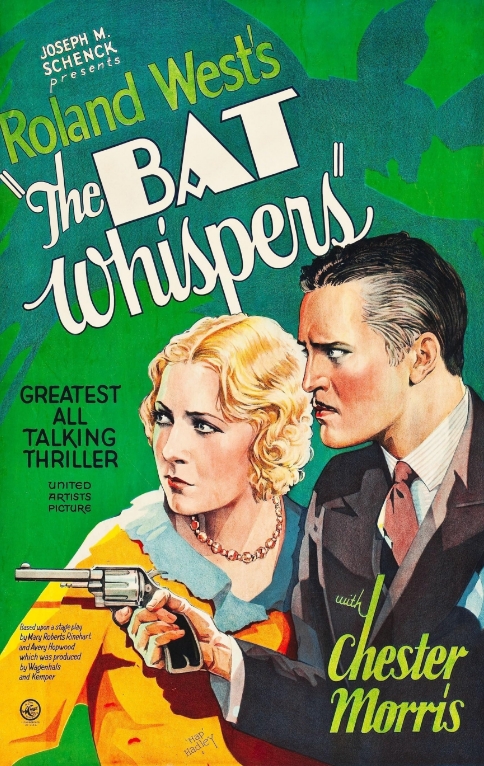
THE BAT WHISPERS (1930): By 1930, there had been a half-decade's spate of "old dark house" mysteries that mixed chills with laughs. Some went from stage to film and, like The Gorilla and The Cat and the Canary, remain entertaining. 

Then there's The Bat Whispers, which focuses too much on the alleged laughs to the detriment of the story involving hidden embezzled funds and a murderous caped criminal known as The Bat (supposedly the inspiration for Batman), who has promised find the money before the police have a chance to stop him. The perpetually-scowling Detective Anderson, something of a nasty piece of work himself, accuses the half-dozen or so suspects of being in on the crime he tries (somewhat ineffectually) to solve before the Bat strikes again. If only he tried to solve the problem of Lizzie the housemaid, whose constant "funny" frightened screams ruin whatever suspense The Bat Whispers has to offer. 

Outside of Fisheye favorite Chester Morris (as Anderson), just about the only entertainment value here is technical. The Bat Whispers was shot on the 65mm widescreen Magnifilm -- pretty much identical to Grandeur used for the previously-discussed The Big Trail the same year. (Both were also shot on regular 35mm for "normal" screenings.) But unlike The Big Trail, where the process worked well with the location shooting, Magnifilm only makes what we're watching resemble a filmed stage play. Perhaps aware of the problem, director Roland West jazzes things up from time to time with astonishingly fluid camerawork and dramatic lighting. usually in close-ups of Morris.

It would be easy to assume Morris was imitating Clark Gable, what with the thin moustache and the near-identical delivery -- only Gable was still working as an extra in 1930. Morris actually often seems to be acting in a different movie from everyone else in The Bat Whispers, which, by its end, tips its hand simply due to attrition -- just how often is a certain character offscreen during crucial moments? And while we're asking questions, why didn't The Bat knock off Lizzie the screaming housemaid when he had the chance?

BONUS POINTS: In a rather charming endpiece, a theater curtain closes after the final scene. When it re-opens, Chester Morris approaches the camera to request that viewers not give away the ending. 


MAMBA (1930): The setting is East Africa, 1913. German and British troops, a year away from being at war with one another, occupy a village. Not yet enemies, they are united in friendship, good beer, Picadilly Cigarettes, and their disgust for Aguste "Mamba" Bolte, a wealth yet slovenly businessman who makes Jabba the Hutt look like Tyrone Power. Desperate for both respect and love, Bolte kids himself into thinking he's getting both when marrying Helen, a young woman whose father has pimped her out in exchange for a loan. The only thing preventing Helen from jumping out of the nearest baobab tree is Karl von Roden, a handsome German soldier who's fallen verliebt with her. But just as their affair blossoms, Karl is called away when war is declared. Lucky for her Bolte is drafted. Even luckier he's killed by natives no longer willing  to put up with colonialism. Unluckier, though, is that she and other solider wives are trapped in a fort under siege by said natives. But nothing will stop a certain handsome German soldier from rescuing her -- even if it takes the British troops to rescue him first.

Yet another 1930 release where the technology was the big draw, Mamba was (deep breath) the first dramatic, non-musical feature shot in two-strip Technicolor. And all this from the humble Poverty Row studio Tiffany-Stahl! Yet it's for all these reasons and more that Mamba likely makes for a difficult watch for many people today. The two-strip Technicolor, with its prominent reds and greens, looks strange to modern eyes. The sound is as far from Dolby as Tanzania is from Burbank. Every cliche that Hollywood of a century ago could use regarding Africans is on display. (And speaking of cliche, what is it about German soldiers with their facial scars and monocles?) 

But all these possible snags pale when compared to Jean Hersholt as Aguste Bolte. Seemingly the precursor to Charles Laughton's nearly identical role in White Woman, Hersholt -- or at least his character -- lacks the latter's dark wit. He is simply, as von Roden describes him, a pig on two feet, whose body odor drifts from the screen and sweat permeates the film nitrate. One is relieved when the tables finally turn on him. His performance in Mamba will make you think twice the next time the Jean Hersholt Humanitarian award is given at the next Oscar ceremony.

A big hit when its $2 ticket in New York is the equivalent of $37 today, Mamba is unexpectedly poignant as well. You know early on that the deep friendship between the British and German troops will come to an end in the final reel or two thanks to the machinations of their governments. And when the Brits take over the German command at the climax (killing natives a-plenty in the process), the stiff-upper lip Major Cromwell refuses to take von Roden prisoner, instead sharing his Picadilly cigarettes as in the old days. It almost erases the foul memory of Jean Hersholt's title character.

BONUS POINTS: One of the native children is allegedly played by Matthew Beard, better known as Stymie from the Our Gang comedies.


MURDER, HE SAYS (1945):  Pollster Pete Marshall is looking for a colleague gone missing in the Ozarks. The Fleagle family, consisting of Mamie, her second husband Mr. Johnson, her twin sons Mert and Bert, and slow-witted daughter Elany are the murderous culprits. As they try to pry the secret hiding place of the money from a bank robbery pulled by a cousin from the dying Grandma, they hold Marshall hostage with the idea of killing him, too. The cousin's daughter Claire swings by pretending to be in on the robbery, but actually wants proof of her father's innocence. With only a nonsense song provided by Grandma providing clues, Marshall and Elany search the dilapidated house for the loot -- when the real bank robbing sidekick Bonnie shows up to get her share.

With a throughline like that, Murder, He Says -- the strangest (and most daring) studio comedy of its time -- is a mix of Arsenic and Old Lace and Last House on the Left. And I didn't even get to Mr. Johnson's liquid radium that makes people and animals glow in the dark -- and if they take too much, kills them as it did Marshall's colleague. Death hangs over the movie as much as any horror movie, with idiot twins Mert and Bert continually trying to kill Marshall, and Mamie threatening to do the same with Grandma. (We never see the dead pollster but we know the body's there somewhere.) The only reason the studio was able to get this passed the censors must have been because it was too absurd to take seriously.

The Fleagle family portrayers deserve a couple of mentions Marjorie Main is in proto-Ma Kettle mode, only with a knife usually a few inches from Marshall's throat, while Peter Whitney is excellent as the shotgun-carrying twins (the split screen used when they're on screen together is aces as well), as is Jean Heather as the beyond-creepy Elany. 

The most surprising performance comes from Fred MacMurray as Marshall. With an endless supply of pratfalls, double-takes, and wacky delivery, it's remarkable this is the same guy who did such a superb dramatic job in the classic noir Double Indemnity the year before. For a role that seemed tailor-made for fellow Paramount player Bob Hope, MacMurray is that much better for being such an unexpected choice. Although Murder, He Says misses the "classic" mark by a few points -- especially with an endless climactic chase scene through hidden hallways leading to a silly bit with a hay thrasher -- it nevertheless has fans galore who consider it one of the all-time great laugh-getters. It's worth watching once to see what moviemakers could get away with in 1945...and seeing Fred MacMurray briefly glow in the dark.

BONUS POINTS: The melody of the nonsense song featuring the hidden money stash clue is identical to the theme of NPR's All Things Considered. I wonder if the estates of the original composers ever considered suing for plagiarism. 

                                                          ***************

Wednesday, September 27, 2023

THE EARLY SHOW, PT. 23

Two silent movies, two gangster pictures -- it's a good day to be alive.

FOR HIS SON (1912): A year after tackling the  question What Shall We Do with Our Old?, D.W. Griffith was back dealing with social issues that still resonate -- in this case, drug addiction. A physician decides the best way to keep his layabout son in money is to develop a soda with a special ingredient -- cocaine -- and marketed as Dopokoke. Before you can say "strung out", the whole town is going Dopokoke-crazy -- including the physician's son, who starts adding pure cocaine to his own soda stash. When his fiancée breaks things off with him, the son elopes with his father's secretary, another cokehead. Now shooting up the stuff, it doesn't take long before he overdoses, leaving his father bereft of both his son and, presumably, a thriving cocaine business.

There's nothing funny about drug addiction. But there are few things unintentionally amusing, or at least baffling, about the 15-minute long For His Son. A soda called Dopokoke sounds like a mock commercial from the first season of Saturday Night Live. People of all ages knock back glass after glass of the stuff at the local ice cream parlor, yet despite its effect -- and a promotional sign boasting FOR THAT TIRED FEELING -- nobody is aware that it's essentially liquid cocaine, despite being called, duh, Dopokoke. At least the son figures it out, giving him the chance to get the real deal without having it watered down. Too bad that once he and his bride start holing up in their drug den, they appear to age about 40 years in four seconds.

As with D.W. Griffith's other shorts at the time, For His Son was filmed at Biograph Studios in the Bronx; from the looks of it, it probably could have been in the can by the end of the first day of shooting. Simple sets, one exterior locale, a hand-cranked camera standing rigidly in one place. The actors ratchet up the melodrama to make sure we can feel their emotions coming through the screen. At times, they really do seem coked out -- not that I would know, of course. Sure, For His Son goes over the top -- what do you expect from a movie more than a century old? -- but can be seen as an interesting piece of American culture that can take modern audiences by surprise. Almost as much as Dopokoke does to its consumers.

BONUS POINTS: Blanche Sweet (the fiancée) is, as far as I know, the only person from D.W. Griffith's troupe of players who appeared on an episode of The Many Loves of Dobie Gillis.


MENILMONTANT (1926): Dimitri Kirsanoff's Menilmontant, a 37-minute French silent movie, is likely considered "experimental" or "avant-garde". And by 1926 standards, perhaps it is. But unlike other movies with those two sometimes-dreaded adjectives, 
Menilmontant actually has an understandable throughline. Two nameless sisters, having discovered their murdered parents' bodies, move to the city (Paris), where they work at an artificial flower factory. The younger of the two eventually spends the night with a disreputable young man. Nine months later, having given birth, the young woman, now homeless, walks the streets looking for food and shelter. Before the day is over, she discovers her sister, having been "ruined" by the same disreputable young man, is now a hooker. Both women find their salvation in each other: the younger one gives her sister the baby, which presumably will set both of them on the right track. Meanwhile, the young man is murdered by another woman he presumably ruined. C'est la vie, mon ami!

From Menilmontant's first shocking frames -- the violent ax murder of the parents -- to the fade out, you know you're watching something unusual. Quick cuts, dissolves, double exposures, and tight close-ups set it apart from your average 1926 release. Much of Menilmontant has the feel of a dream; the performances of Nadia Sibirskaia, Yolande Beaulieu, and Guy Belmont (as the sisters and the young man) add to this quality. They are neither completely realistic nor artificial, occupying a strange in-between stage one finds only in the most unusual of silent cinema.

Not that I don't have some questions. The sisters were sharing a humble but perfectly nice apartment, so why is the younger one suddenly homeless? How did doing the dirty turn the older sister into a hooker? Will the baby really survive better with a hooker than her real mother? And why do the sisters go their separate ways at the end? I figured the now-impure sisters, along with the baby, would continue sharing an apartment and nobody would bat an eye, considering the French are tres sophistique. Funny how Menilmontant resembles an American movie in that respect.

BONUS POINTS: Plenty of location shots of the Paris neighborhood of Menilmontant (now you know what the title means).


THE SECRET SIX
 (1931): M-G-M must have noticed the kind of dough that gangster pictures were raking in for Warner Brothers, seeing that The Secret Six follows roughly the same formula as The Public Enemy: a newcomer brought into the bootlegging game quickly goes up the ladder of the criminal underworld, challenging and eventually bringing down his immediate superior, before meeting his own inevitable end.

But while The Public Enemy relied on newcomer James Cagney, The Secret Six stars Metro's longtime dependable character actor Wallace Beery in the lead as Louie "Slaughterhouse" Scorpio. Beery is quite good here as the bootlegger who never touches alcohol -- he always orders "a glass of cow" at speakeasies. Go ahead and laugh (if you haven't already) but he reminds me at times of Marlon Brando, using subtle physical and verbal "tricks" to seem believable as the guy who can never quite shake his days as a slaughterhouse worker no matter how fancy his clothes or plentiful his money. (Watch how he spits out his chewing tobacco. Disgusting.) Showing strong support is Lewis Stone as alcoholic lawyer Richard Newton, who also leads Scorpio's gang. Stone, better known for his paterfamilias roles, is startling as the soulless mouthpiece who has no problem turning one of his gunsels over to the cops for a murder Scorpio committed. It's just business, you see.

What makes 
The Secret Six  fascinating today is that it also acted as a launchpad for three new Metro contract players: Ralph Bellamy as Newton's second lieutenant, who makes the mistake of turning his back on Scorpio before the end of the second reel; Jean Harlow as a worker at a high-class speakeasy; and Clark Gable as the wiseass reporter who's doubling as an undercover spy for "The Secret Six", a group of businessmen out to destroy the underworld's grip on the unnamed city. It's always interesting to see Gable in his early, pre-stardom days; only Beery rivals him sheer charisma. Although billed seventh in the credits here, Gable runs every scene he's in, especially those with good ol' boy John Mack Brown (as a rival reporter), and even Jean Harlow -- only 20, and still in her awkward stage. Sporting an obviously higher budget than the Warners' crime movies, The Secret Six is great to look at in all respects and is worthy of any 1930s gangster film festivals.

BONUS POINTS: The titular Secret Six wear domino masks to disguise themselves from outsiders, giving them an unintendedly creepy look. 


LARCENY (1948): Any movie where Dan Duryea plays the heavy is 90 minutes well spent, especially in Larceny, where he helps to push things to the film noir goal line, even if it doesn't quite make the score. Duryea plays Silky Randall, the well-dressed leader of a pack of conmen. Silky sends his ace bunco Rick Maxon to a small town in order to swindle Deborah Clark by helping to set up a youth center in honor of her late husband killed in the War. Things are going well, although the scam gets mucked up by the arrival of Silky's trashy girlfriend Tory, who's been seeing Rick on the sly. And even as Rick finds it hard to shake Tory, he starts getting the guilts over lifting Deborah's hundred-grand contribution for the youth center. Will he pull out of the scheme? Not if Silky has any say in it -- even if it means framing Deborah for Tory's murder.

Yes, there's plenty of noir ingredients in Larceny, but we're supposed to root for the antihero, which is difficult to do when he's fleecing a war veteran's widow. Perhaps that's why John Payne is the perfect for the role of Rick. Unlike Duryea's characterization of Silky, you can tell almost from the get-go that Payne's Rick has something resembling a soul residing deep inside his otherwise steel-cold shell. And it's appropriate that Deborah is played by someone named Joan Caulfield, since she's one step removed from Joan of Arc. I don't want to feel bad for the sucker in movies like this! Every time Dan Duryea popped back onscreen, I breathed a little easier. Not only does he knock his slimy delivery out of the park, his fantastic late-'40s wardrobe is something I would con Deborah for.

The real surprise in Larceny is Shelly Winters as the tawdry Tory. Never one of my favorite actresses, she's fabulous as the hot hoochie playing Silky for a sap while riding Rick on the side, chewing on hardboiled dialogue like she hadn't eaten in weeks. "Stop twisting my arm!" she shrieks at Rick during a violent moment, "people will think we're married!" Payne can give as good as he gets: "You might have a brain, but you must've rented it out to a medical student!" As I think about it, Larceny is better than I initially thought it. I just wish that damn war widow didn't get in the way.

BONUS POINTS: Two years after appearing in The Chase, Don Wilson returns to the land of noir, auctioning off the Rose Bowl football for a good cause before returning to more familiar climes of The Jack Benny Program. 

                                                             ****************

Tuesday, February 18, 2020

STARS IN OUR EYES

Fully aware of what he brings
to the table.
The recent death of Kirk Douglas was a signal that the participants of "Hollywood's golden age" are fast disappearing. In fact, Kirk might have been the last of the greats.

It also served as a reminder that some people are born to be not just actors, but movie stars. One look at Kirk in his prime, and you know this isn't a plumber, bursar, or milkman. He isn't even a leading presidential candidate in the JFK mode. This is a S*T*A*R!

Even the name Kirk Douglas tells you everything you need to know -- everything except he was born in upstate New York as Issur Danielovitch, the son of Russian immigrants. So when you think of Jewish movie stars, forget Woody Allen for once and go with Spartacus.

Nobody in movies today looks remotely like Kirk Douglas (except Michael Douglas, and that's only because he can't help it). Actors like Tom Cruise and Leonardo DiCaprio strive to look forever young, as if they even sleep with sunblock with a 95 SPF.


On the other hand, when you consider that Humphrey Bogart and
Tom Cruise are both age 56 in these photos, maybe taking care of
yourself isn't such a bad idea.


Kirk Douglas' movie debut in 1946 must have been a shock to audiences. Consider three of the most popular movie stars from a little over a decade earlier.


Gaze upon those faces carefully. Now picture them on a movie screen. Today's audiences would turn away in revulsion, these actors suitable only for the latest chapter of the Saw franchise. In no way, shape or form does this trio look like movie stars by our standards. Yet for theatre owners in 1932, booking a movie starring any of them was like printing money.

Talent and personality be damned -- neither George Arliss, Marie Dressler nor Wallace Beery would get past the studio security guards today. But back in the early 1930s, they were just what the doctor (i.e., studio accountants) ordered. Arliss reeked of class in a time of Depression, while Dressler and Beery were simply relatable.

For whatever reason, people just looked different back then. Or did they? Study these two compelling photos taken roughly a century ago.


The melancholy young woman and disheveled fellow could be featured in a Wes Anderson movie. Who they don't look like, at least at first glance, are ZaSu Pitts and Charlie Chaplin. It makes you consider the magic of make-up, costumes, and making funny faces for the camera.

Is it possible that movie actors of different times could switch places without anyone being confused? Only two came to mind -- and I'm talking physical, not stylistic, similarities. As I studied their photos, the resemblance came primarily from their younger days.


Could be half-brothers, right? Although it might be more obvious they are, in actuality, Paul Muni and John Malkovich, as you can see when they're older:


Well, whaddaya know -- there's still a resemblance, kinda sorta. Would Malkovich have made it as an actor in Muni's time? On stage, very likely. On screen... perhaps in supporting roles made popular by Dwight Frye, aka Renfield in Dracula.

So perhaps some actors really are essentially interchangeable with those of the past. Let's sign off by comparing a 1950s soiree with Vogue's 2019 Young Hollywood Party:


Well, there goes my thesis all shot to hell.

                                                       ***************