Showing posts sorted by relevance for query phil rosen. Sort by date Show all posts

Monday, December 11, 2023

THE EARLY SHOW, PT. 27

 As the years pass by with ever-quickening speed, I realize now just how limited time has become. So if I don't like an old movie or TV show, I turn it off after 10 minutes. Therefore, the following were worth my hour or 70 minutes, but not necessarily yours. 

THE PHANTOM BROADCAST (1933): Roll over Milli Vanilli, and tell Bing Crosby the news!
Radio crooner Grant Murdock is the handsome heartthrob of women everywhere. What they don't know is that his sexy voice belongs to his hunchback/clubfooted manager and piano accompanist Norman Wilder. Wilder is willing to put up with Murdock's ego and thoughtless womanizing as long as the dough is rolling in. But Murdock goes too far when he sets his sights on Wilder's new voice student, the innocent Laura Hamilton. Wilder drops by his apartment intent on killing him, only to discover someone else has beat him to it. Believing Laura is the murderer, and wanting to protect her, Wilder calls the cops, falsely confessing to the crime. A moment later, Laura drops by, unaware Murdock is dead.  Now she tells him! 

What Monogram Pictures lacked in money, they more than made up for in the occasional offbeat movie like The Phantom Broadcast, sensitively directed by Phil Rosen. Filling out the movie is a subplot of gangster Joe Maestro trying to kill Wilder in order to take over Murdock's career. From what I've read about organized crime's decades-long influence in show business, I'd say that more was true to life than a musical ventriloquism act with a human dummy. Even less believable is the idea of Wilder taking a murder rap for a student he's known for one day. His far too noble -- make that stupid -- move leads to him getting shot by the police while escaping, only to make one last appearance on the radio, singing for a startled studio audience before dying. Yes, it's melodramatic and farfetched, but also surprisingly downbeat -- especially when the real killer, Murdock's jilted girlfriend, gets off scot-free on a cruise to Europe!

Of the cast, British-born Ralph Forbes is the best in his role of the unfortunate Norman Wilder. A handsome leading man already turning to character work in his late 20s, Forbes never plays for the audience's sympathy. Wilder accepts his fate, while having found a way to capitalize on his talent, even if it means being literally the man behind the curtain. Forbes has a nice moment when, standing before a full-length mirror, he briefly sees himself tall and proud, minus his physical deformities, before returning to his real self. For all its implausibility, The Phantom Broadcast is ultimately a fascinating B-movie that deserves a good restoration and reappreciation. Just don't expect much in the way of realism (except for a talented guy wanting to kill the jackass taking the bows).

BONUS POINTS: Phil Rosen also directed the previously-discussed Beggars in Ermine, The Strange Mr. Gregory, and The President's Mystery. A former cameraman, he was also a founding member of the American Society of Cinematographers.  Why doesn't this guy have a star on the Hollywood Walk of Fame? 


NIGHT OF TERROR (1933): A hideous serial killer known as The Maniac has murdered millionaire Richard Rinehart. This doesn't seem to bother Arthur Hornsby, a scientist living at the Rinehart mansion, who has himself buried in the back yard for eight hours to prove that he's developed a way to revive the dead. As various Rinehart relatives meet a bad end, the faithful servant Degar sure seems to be the killer... as does his wife Sika... and Richard's brother John... In fact everybody but Arthur Hornsby, who's in a coffin six feet underground -- or is he?

Night of Terror seems to be Columbia Pictures' sole entry in the horror cycle of the early 1930s. The studio convinced Universal to loan out Bela Lugosi for his services as Degar, a role that defines the word "thankless". Columbia wasn't known for big budgets, but, Night of Terror could pass for a PRC quickie. "Exterior" scenes take place at night in order to disguise the cheap sets; actors peek through doorways and skulk around the mansion to pad out the running time; the smartass reporter continually insults the stupid police chief investigating the murders; the science behind an inane experiment is never explained; and the primary suspect -- Degar -- speaks slowwwly in order arouse our suspicion. The only thing we suspect is that the writers came up with Night of Terror the day before shooting started.

Lugosi likely knew he deserved better than programmers like Night of Terror -- it's easy to picture him silently choking every time his character Degar has to say "Yes, master" to his employer. (He was probably cast because of a similar "exotic" get-up he wore the year before in Chandu the Magician at Fox.) While it's always a pleasant change of pace to see Lugosi as someone other than evildoer, it's just too bad it has to be in a throwaway like Night of Terror. Looks good in a turban, though.

BONUS POINTS: In a strange finale, The Maniac -- who is actually pretty weird-looking -- returns to warn the audience not to tell anybody who the real killer is, or else, "I'll come into your bedroom late at night and tear you limb from limb!" I believe him.

DANGEROUS TO KNOW (1938): It's a tale as old as crime. Underworld kingpin Stephen Recka decides that marrying blue blood Margaret Van Case will be his entree to high society. All he has to do is frame Van Case's fiancée Philip Easton for embezzlement. Still, there is the little problem of Recka's jealous mistress Lan Ying... and Police Inspector Brandon snooping around... and his own gunsel Nicki Kusnoff trying to take over his criminal empire. Can't a gangster have a moment's peace?

I've said that the best B-movies were made by the Poverty Row studios, but Paramount's Dangerous to Know is an excellent example of what the majors were capable of when they hired the right people and left them alone. Director Robert Florey puts some thought into the camera set-ups, and getting solid performances out of the cast. 

And what a cast! Akim Tamiroff is Recka, a Bach-worshipping crime boss who has the city government under his fat thumb, yet wallows in self-pity for not being "respectable." His "exotic" live-in girlfriend Lan Ying is typical of the kind of role Anna May Wong was forced to accept at the time, but she gives it a depth that comes from experiencing the second-rate treatment she herself was given by the studios.

Offering strong support is Lloyd Nolan as Brandon, the witty yet driven cop who can gift Recka with a pair of chocolate handcuffs as a birthday gift while promising to get him to the electric chair eventually. (Nolan should have been given an entire B-movie series as Brandon. He's great.) Almost stealing movie is Anthony Quinn as Recka's sidekick Nicki -- not necessarily because of any overriding talent, but because he's only 23 years old and is already, y'know, Anthony Quinn. Possessing a smart director, crackerjack cast, and a speedy 70-minute running time, Dangerous to Know makes for a better watch than expected.

BONUS POINTS: A tense conversation between Lan Ying with a guest repeatedly uses the word "hostess" to get across the idea that she's actually Recka's live-in mistress -- a clever way of ducking the censor's scissors in the post Pre-Code days.


THE JACKIE GLEASON SHOW: EDDIE CANTOR'S 65TH BIRTHDAY (January 12, 1957): When the most interesting part of a live TV show is wondering if the star is going to keel over in the closing moments, something is wrong. But that's the chance you take when celebrating the not-so-healthy birthday boy Eddie Cantor, whose professional stage career began in 1907. 

Things begin badly enough when the flashy women who usually appear in Gleason's opening credits are replaced by lisping seven-year-old girls glammed up like Times Square trollops. Edward R. Murrow then warms up the crowd with a grim tribute more appropriate for a funeral. Then there's the dearth of Cantor's friends and contemporaries. Instead of, say, Jimmy Durante, Jack Benny, and Groucho Marx -- the kind of people who would give this show some entertainment value today -- we have the likes of... Eddie Fisher! Pinky Lee! Nepo-baby Mailyn Cantor! An interminable "Waiting for the Robert E. Lee" production number! I suppose Lucille Ball & Desi Arnaz's appearance makes some kind of comedic sense, but I don't recall a series titled I Love Eddie. At least Burt Lancaster gets two plugs for his latest movie, The Rainmaker, so it's not all for naught. 

The only people from Cantor's generation who deign to appear are George Jessel (who'd do 10 minutes at an autopsy) and Burns & Allen (in the 1957 version of Zooming in by appearing on film rather than in person). Hell, Jackie Gleason couldn't be bothered contributing a 15-second tribute, and it's an episode of his own show! 

Maybe Murrow's solemn introduction was appropriate after all. Viewers, aware of Cantor's two heart attacks, were probably concerned when, near the end, the enervated host needs to carefully sit down and slowly drink a cup of water provided by a stagehand. Immediately after the closing credits, Cantor was taken to the hospital by ambulance. Now that would have been interesting to watch.
BONUS POINTS: Thanks to one of the sponsor's commercials, we learn that the Bulova Senator watch can withstand the shock of its owner playing piano. 

                                                        **************

Friday, April 12, 2024

THE EARLY SHOW, PT. 34

 Strictly by coincidence, this Early Show has two "bringing the dead back to life" movies, and two TV shows from the early 1960s. If you've seen any of these, the next drink's on me. On a Zoom call, I mean.


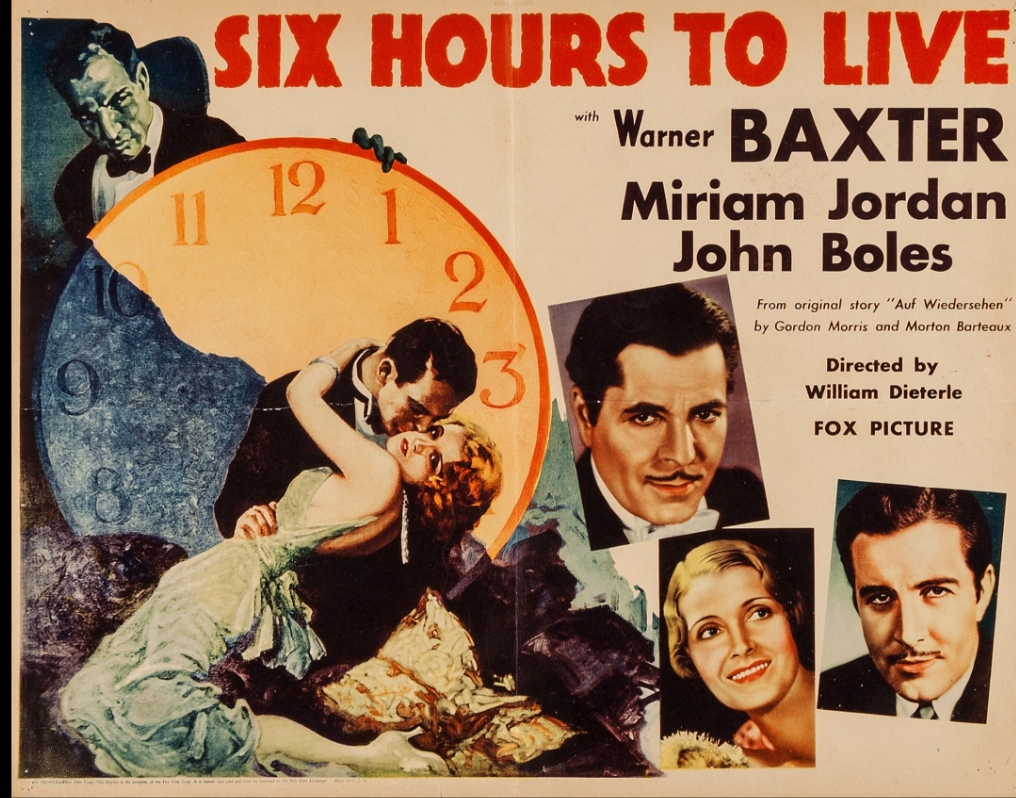
SIX HOURS TO LIVE (1932): Paul Onslow, an ambassador of Sylvaria, has been assassinated by an unknown person. Good news: The police commissioner has a friend who's invented a machine that can bring the dead back to life. Bad news: They can stay alive only six hours. (You'd think he'd have worked a little harder on fixing that glitch.) Onslow will use that time to have dinner, explain to the woman who loves him that he's no longer the marrying kind, find the guy who killed him, and remind the police commissioner that death is scary only in your mind. I'd have dropped a couple of tabs of acid, but to each his own.

Sci-fi, horror, and politics were hot stuff in the early '30s movies. Six Hours to Live manages to combine all three genres, along with a dash of romance. Onslow is the only representative who refuses to sign a pact involving international finance, believing that it's a cover for the major governments to make out like bandits while their citizens get nothing. He isn't wrong -- that's why someone at the table wants him out of the way in order for a substitute to vote yea. Otherwise, the pact is null and void, as Onslow will be in a few minutes. Once revived, he has a new appreciation for life, taking a moment to help a streetwalker (money only!) and a little flower girl (ditto). Onslow doesn't even kill his assassin, preferring that the guy suffers "a living death". Today, that's known as, well, life as we know it.

Six Hours to Live's political angle was typical for its time, being a mildly progressive subplot that drives the story. Warner Baxter makes Onslow the rare rich guy in a silk cape who's on the side of the little man. (The cape also gives a Dracula-vibe when he's closing in on his killer.) Nor does he overdo his (second) death scene. Wilting like a flower, Baxter rests alongside a tree as a beatific gaze passes over his eyes as the end comes. Director William Dieterle (Syncopation) provides style perfectly fitting all the genres the movie covers -- the life-revival scene could fit in any horror movie of its time. It's just too bad that, as usual, Six Hours to Live's print on YouTube is bleary and over-pixilated. The Musuem of Modern Art possesses a restored version, but you have to be, you know, a scholar to access it. Ergo, I advise you to skip Six Hours to Live as it appears online and wait for someone at MOMA to drop dead for six hours so you can sneak in and see their print. (Kidding, MOMA, kidding!)

BONUS POINTS: Two years earlier, co-stars John Boles and Marilyn Harris were in Frankenstein, as Victor Moritz and the little girl who gets thrown in the lake respectively (if not respectfully).


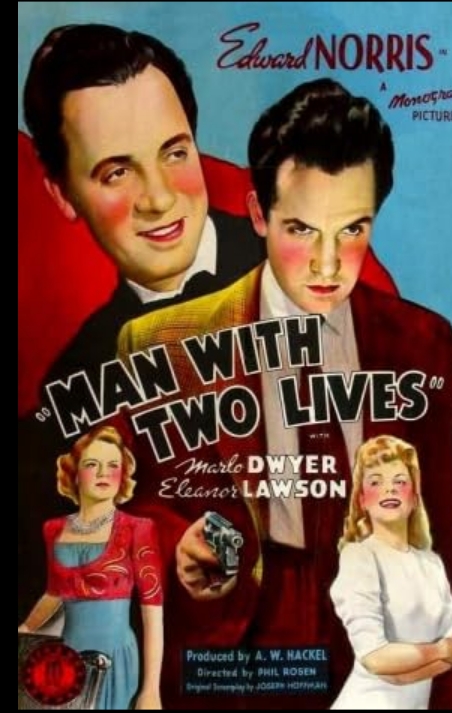
MAN WITH TWO LIVES (1942): When nice guy Phillip Bennett dies in an auto
accident, his father asks Dr. Richard Clark to make good on his reviving-the-dead experiments. Good news: it works! Bad news: the soul of a gangster named Panino, who was executed at the same time, enters Phillip. Why don't these scientists ever take these things into consideration? 

By the 1940s, only a B-movie outfit like Monogram would try pulling off a sci-fi/ gangster hybrid like Man with Two Lives. And gosh darn it, the thing works -- up to a point. One-time A-list supporting actor Edward Norris plays the title role -- or roles -- convincingly; his transformation into a cold-blooded gangster is something of a shock, as is his blunt romancing of Panino's trashy moll Helen, along with his growing hatred of his loving family and fiancée Louise. Even Panino's gang is scared of him. Yet you can see something of the good Phillip underneath the monster from time to time, giving his character a complexity not usually seen in B's. You actually start feeling sorry for him -- here's a guy through, no fault of his own, is on a very obvious self-destructive path, thanks to an ill-considered wish from his loving father and twisted brilliance of a scientist...

Which is probably why at the very end, Man with Two Lives goes kablooey when the story turns out to be a nightmare suffered by Phillip during a four-day coma following the accident. I hate when that happens, especially in a movie as good as this. Had Man with Two Lives (couldn't Monogram afford a "The" in the title?) been a pre-code from a decade earlier, Phillip would have been shot by a cop as he was here, but too damn bad about how it wasn't his fault. His father and the scientist would be condemned to a lifetime of guilt; his fiancée would never know a day's happiness from then on. Doesn't that sound like a better picture?

BONUS POINTS: Phil Rosen, the director of Man with Two Lives, showed how powerful a gloomy climax could be with his previously-discussed Monogram pre-code The Phantom Broadcast. 


DR. KILDARE (UNAIRED PILOT) (1960): It isn't unusual for a TV series to undergo cast
changes before its premiere. Dr. Kildare went a step further to change the lead actor and concept. For the pilot, Lew Ayres was brought back to recreate his starring role from MGM's nine Kildare movies from 1938 to 1942 (and 1950 radio series).  No longer a young intern, he's now chief diagnostician at Blair General Hospital. And as Dr. Gillespie mentored him decades earlier, so Kildare mentors the young intern Dr. Grayson. The circle of life and all that.

Lionel Barrymore, the original Gillespie, was six years dead but not forgotten, as his portrait hangs in Kildare's office. Ayres even quotes a line of dialogue Barrymore spoke in one of the movies (a reference to a "mentally retarded ringtail baboon" wouldn't make the cut today). The story itself -- Kildare wanting to keep Dr. Grayson at the hospital rather than allowing him to go into private practice -- is a remake of one of the early Kildare movies. (Don't ask me which; they all blend together in my memory.) Kildare goes behind Grayson's back to upset his plans, causing a brief rift between the two before amends are made during a run-up to brain surgery, no doubt a common event in busy hospitals during the overnight shift.

As when he was the young Kildare, Lew Ayres is a warm, comforting presence; you'd want him as your GP even if he didn't accept insurance.   Joe Cronin is serviceable the role of Dr. Grayson -- but why didn't that part go to the charismatic, 24-year-old Robert Redford instead of the brief uncredited role he has here? No matter. Lew Ayres and MGM parted ways when his request that Dr. Kildare not be sponsored by cigarettes was refused. (Who did this guy think he was, a doctor?) The studio revived the original idea of young Dr. Kildare mentored by the wise Dr. Gillespie, giving Richard Chamberlain and Raymond Massey a comfortable five-year run shilling cancer sticks between visits to the O.R. It's my personal diagnosis that this was the first example of TV producers trashing the older audience in favor of younger, primarily female viewers. Now pay the receptionist on the way out.

BONUS POINTS: The Kildare pilot was directed by John Newland, the director and host of One Step Beyond. Olan Soule, one of the most familiar character actors in TV history, plays a doctor. Do a Google Image search; if you're of a certain age, you'll automatically say, Oh, that guy! 


ONE STEP BEYOND: "THE SACRED MUSHROOM" (1961): Next to The Twilight
Zone,
 One Step Beyond was my favorite spooky show during childhood. The difference between the two was that One Step Beyond was based upon true stories -- maybe. As host John Newland explained at the end of the episodes, nobody could prove or disprove their veracity. For a gullible eight year-old, that was good enough.

One episode, titled "The Sacred Mushroom", couldn't be disproved, though, because it wasn't a dramatization at all. Newland and his crew travelled to a village in Mexico to investigate a 'shroom that, when ingested, allegedly provided the gift of ESP.  After bribing some locals with medicine, Newland and his pals are able to meet up with a shaman at a midnight ceremony, where a missionary and two American scientists eat the 'shroom. Aside from the missionary getting an embarrassing case of the giggles, the Yanquis show zero side effects. The shaman does correctly diagnose one of the scientist's heart problems and, while he's at it, solves a local burro theft, which makes me wonder if med schools and police academies are a waste of time and money.

Eventually it's time for Newland himself to get in on the action. Under the care of a certain Dr. Baharish, Newland first needs to take an ESP test while sober. When he flunks that, it's time for the mushroom, which leaves him feeling "fine" and "strong", along with a sense of "well-being". (My experiences with mushrooms leaned more toward "goofy as hell".) Following a round with a strobe light, which leaves him seeing colors while his eyes are closed, it's time for a repeat of the ESP test, where he now scores higher than before. Personally, I would have been more convinced if he had found a stolen burro. "The Sacred Mushroom" promises more than it delivers -- I was hoping for Newland to yell, "The walls are melting!" -- but when was the last time you saw a 1961 TV show where someone ate a (semi) magic mushroom?

BONUS POINTS: "The Sacred Mushroom" was One Step Beyond's most popular episode. It was also the only one not to go into syndication after its original network run. I wonder if John Newland saw that during his 'shroom trip. 

                                                               ************